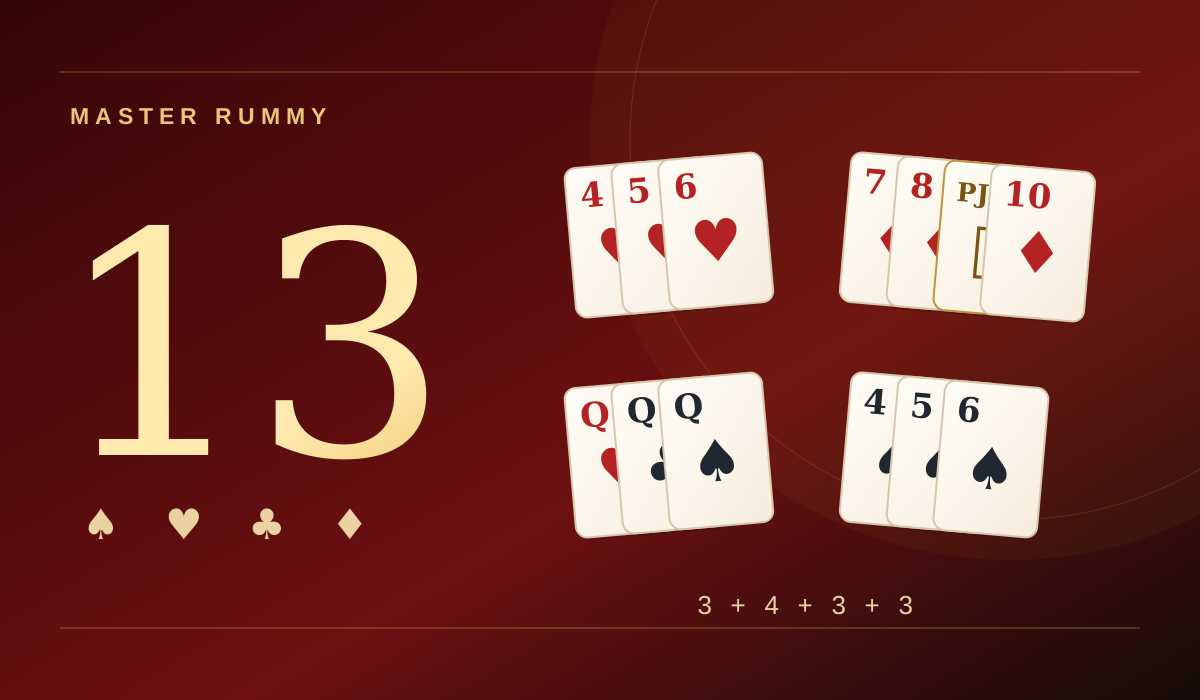
The rule to remember: arrange all 13 cards into valid groups, with at least two sequences and at least one pure sequence. On your turn, draw one card, choose what to keep, and discard one: 13 → 14 → 13. A pure sequence uses consecutive cards of one suit without a joker replacing a missing card. The remaining groups can be sequences or sets.
This illustrated guide explains a common 13-card Indian rummy format. It is a learning reference, not a guarantee that every table or app uses identical settings. Check the rules shown inside Master Rummy for the available format, scoring and declaration controls. Master Rummy offers recharge and paid in-app purchases, but does not offer cash withdrawals or cash rewards.
1. Start with the table, not the score
A common setup has two to six players, two standard 52-card decks and two printed jokers: 106 cards altogether. Each player receives 13 cards. Deck counts, the first player and special opening rules can vary. Follow the table's instructions rather than assuming every game uses a highest-card toss.
Swipe or scroll to read the full table ↔
| Table area | What it means |
|---|---|
| Closed deck | The face-down pile from which you draw an unseen card. |
| Open pile | The face-up discard pile. Normally only its top card is available. |
| Joker indicator | The exposed card identifying the wild-joker rank for that hand. |
| Declare or finish area | The control used to submit a completed hand; its appearance depends on the app. |
Read the symbols as follows: ♥ hearts, ♦ diamonds, ♣ clubs and ♠ spades. A suit is not just a colour: hearts and diamonds are different suits even though both are red. PJ below means printed joker.
2. Play one turn: draw, arrange, discard
- Draw one. Take a card from the closed deck or an eligible top card from the open pile. You temporarily hold 14 cards.
- Arrange your groups. Check whether the new card completes a sequence, improves a set or creates a better option.
- Discard one. Return an unwanted card face up to the open pile, leaving 13 cards.
- Declare only when ready. If your remaining 13 cards meet every requirement, use the table's finish and confirmation controls.
Discarding means letting go of one card; declaring means asking the game to validate your entire hand. They are different actions. Joker pickup restrictions, timers and whether an open-pile card can immediately be discarded again are table-specific rules worth checking first.
3. Build a pure sequence first
A pure sequence contains at least three consecutive cards of the same suit, with no joker substituting for another card. For example, 3♥ 4♥ 5♥ is pure. So is 8♣ 9♣ 10♣ J♣. Matching numbers in mixed suits do not make a sequence.
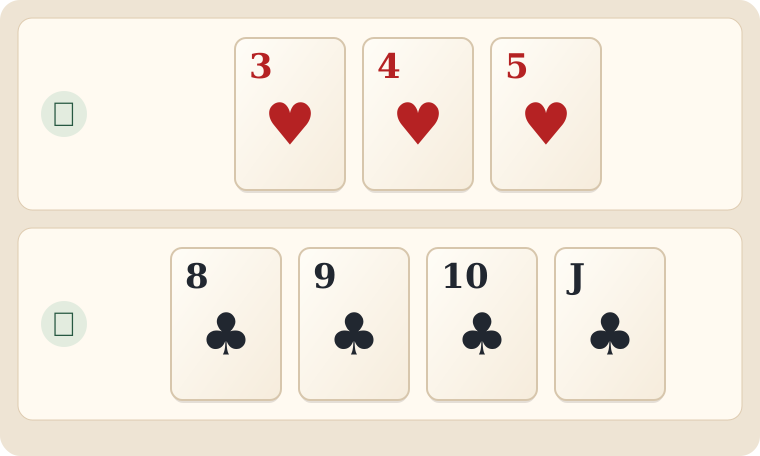
Longer sequences are allowed in this common format. But one long group does not automatically count as two sequences. You can split 3♥ 4♥ 5♥ 6♥ 7♥ 8♥ into two separate valid groups of three. A five-card run cannot be split into a three-card sequence and a two-card sequence: each needs at least three cards.
4. Use a joker to complete an impure sequence
An impure sequence uses a printed or wild joker in place of a missing card. In 6♦ 7♦ PJ 9♦, the PJ stands for 8♦. The group follows one continuous diamond sequence once that substitution is understood.
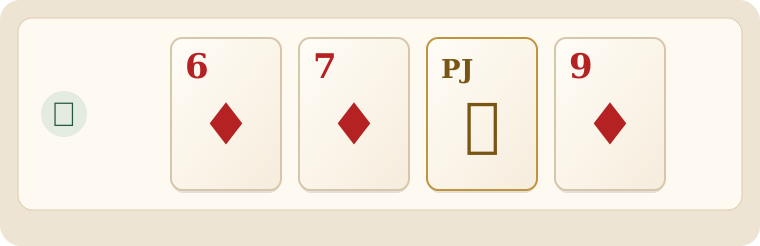
One joker replaces one card, not two. A group such as 4♠ PJ 7♠ still lacks one of the two intervening cards, 5♠ and 6♠. Write down the rank each joker represents when learning; it makes gaps much easier to notice.
5. Recognise a set: same rank, different suits
A basic set has three or four cards of the same rank in different suits. For example, 8♥ 8♣ 8♦ is a set, and K♥ K♣ K♦ K♠ is a four-card set. A joker may replace a missing member if the table allows it.
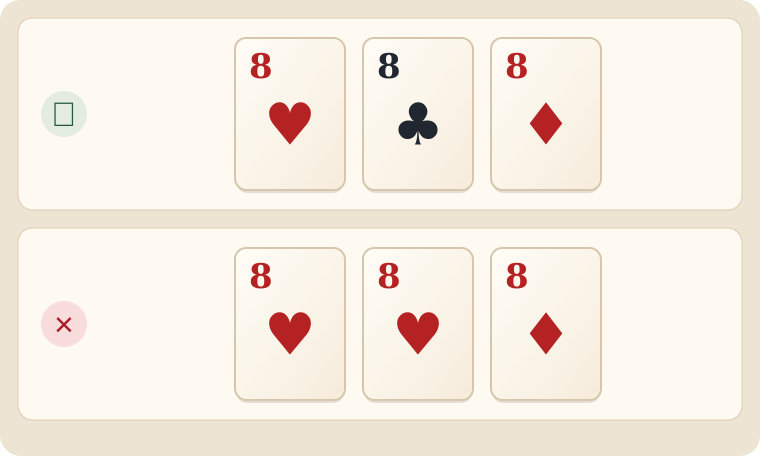
For your first games, use these simple three- or four-card sets. Some variants permit additional jokers in larger groups; do not assume those extensions apply at your table. A set is not a sequence and cannot replace the required second sequence. Each physical card belongs to only one group.
6. Understand printed and wild jokers
A printed joker is the special joker card in the deck. A wild joker is an ordinary card whose rank is designated wild for the current hand. If the indicator is 7♦, all sevens are wild in the example below.
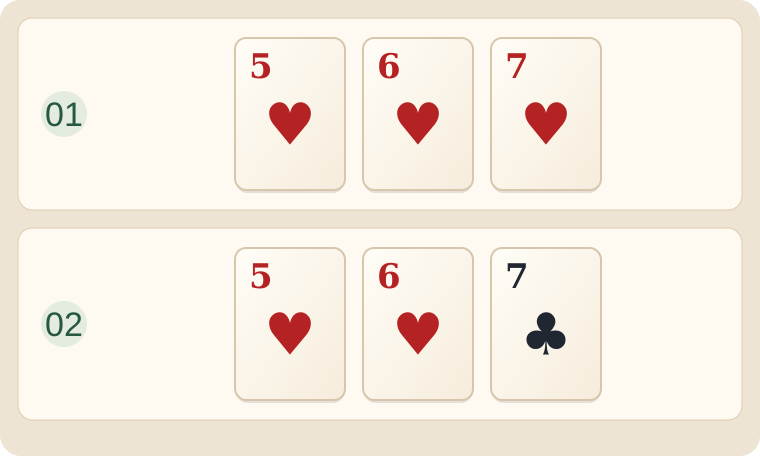
The distinction is how the card is used, not simply whether its rank is wild. A printed joker has no natural suit-and-rank position, so it cannot fill a pure sequence. If the indicator itself is a printed joker, some tables make aces wild; other rules differ. Check the displayed joker rule before arranging your hand.
7. Put the ace at one end, never in a loop
An ace can be low in A♣ 2♣ 3♣ or high in Q♠ K♠ A♠. It cannot bridge the king and the two. Therefore K♥ A♥ 2♥ is not a valid sequence.
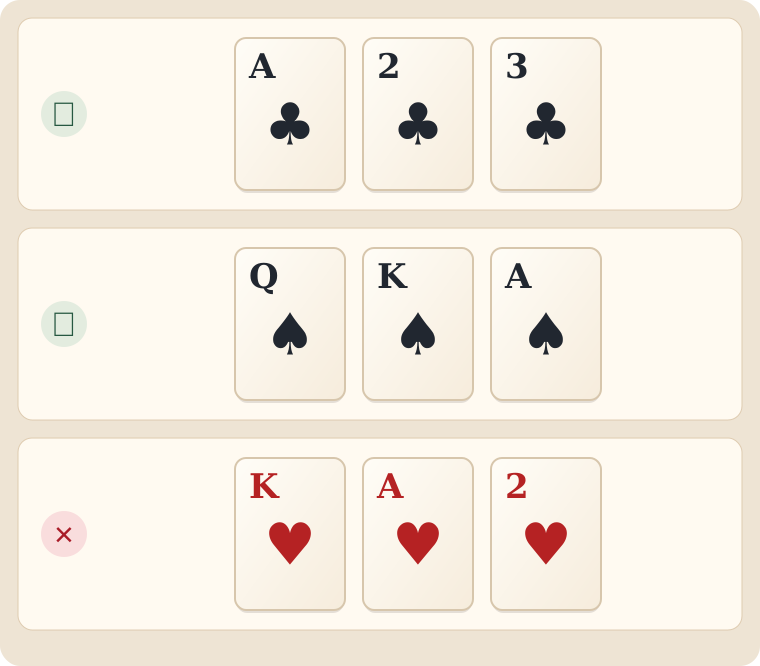
Sequence position and scoring value are separate ideas. In the common scoring examples below, an unmatched ace is still worth 10 points even when you hoped to use it below a two.
8. Check a complete 13-card declaration
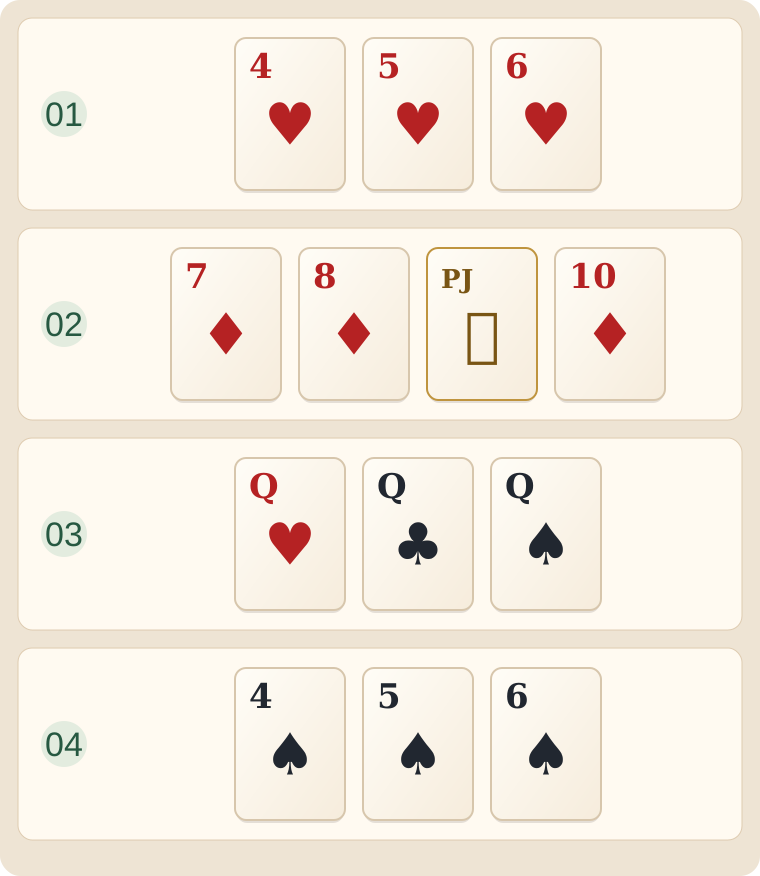
Here is a finished hand you can check group by group. Assume the illustrated numbered cards are being used naturally and PJ is a printed joker.
Swipe or scroll to read the full table ↔
| Cards | Group | Count |
|---|---|---|
| 4♥ 5♥ 6♥ | Pure sequence | 3 |
| 7♦ 8♦ PJ 10♦ | Impure sequence; PJ replaces 9♦ | 4 |
| Q♥ Q♣ Q♠ | Set with three different suits | 3 |
| 4♠ 5♠ 6♠ | Another pure sequence | 3 |
Two pure sequences are allowed: the requirement is at least one, not exactly one. The 3 + 4 + 3 + 3 pattern is convenient but not mandatory. Other group sizes can work when all 13 cards are used legally and the sequence requirements are satisfied.
9. Learn points without confusing them with cash
Points describe the result of a hand. They are not a promise of cash value or a withdrawal balance. The following is a common teaching model, not a confirmed Master Rummy scoring schedule.
Swipe or scroll to read the full table ↔
| Card | Value |
|---|---|
| A, K, Q, J and 10 | 10 points each |
| 2 through 9 | The number on the card |
| Printed and designated wild jokers | 0 points |
Under a common points convention, a valid winner scores zero. With no pure sequence, all non-joker cards count. With a pure sequence but no second sequence, the qualifying pure sequence is excluded while the other cards count. Once both sequence requirements are met, valid groups are excluded and only ungrouped cards, often called deadwood, count. Check your format for caps and exceptions.
Example A: a normal losing hand scores 42
Assume the wild rank is 8. The hand has 4♥ 5♥ 6♥ and 9♠ 10♠ PJ Q♠, with PJ replacing J♠. Its six ungrouped cards are K♦, Q♣, 7♦, 3♠, 2♣ and A♦. The score is 10 + 10 + 7 + 3 + 2 + 10 = 42. Notice that 7♦ cannot extend the heart sequence.
Example B: no pure sequence does not automatically mean 80
Assume the wild rank is 7 and the player has not made an invalid declaration. The 13 cards are 4♥ 5♥ PJ | 8♣ 9♣ PJ | K♥ K♣ K♦ | 2♠ 2♥ 2♦ 2♣. There is no pure sequence, so every non-joker card counts: 4 + 5 + 8 + 9 + 30 + 8 = 64. An 80-point cap would not change 64 into 80.
A penalty is different from a card total. Some formats use 20 points for a first drop, 40 for a later drop, and 80 for an invalid declaration or maximum loss. These are examples, not universal rules. A 64-point normal loss and a fixed 80-point invalid-declaration penalty describe different situations.
A drop means leaving the current hand according to its rules. Do not treat all your cards as ordinary discards; the app handles them. Availability, timing, penalties and card handling vary by format. Points, Pool and Deals are general rummy format names, not a list of confirmed Master Rummy modes.
10. Take ten seconds before you declare
- Do the submitted groups contain exactly 13 cards?
- Are there at least two separate valid sequences?
- Is at least one sequence pure, with no substituted card?
- Does each joker fill exactly one permitted position?
- Are the sets valid, without repeated natural suits?
- Are all cards grouped, with none used twice?
- Have you avoided a K-A-2 sequence?
- Have you discarded the extra card and checked the app's confirmation step?
An app may validate your declaration only after you submit it. Do not assume an enabled button proves the hand is correct.
11. Practise a simple decision routine
- Sort by suit, then rank. Look for a natural three-card sequence before focusing on sets.
- Keep useful connections. Two adjacent cards can offer more routes than isolated high cards, but evaluate the whole hand.
- Give each joker a job. Use it to fill a specific gap, not to hide an unfinished group.
- Recheck before discarding. A high card may already complete a group; do not discard it just because it carries points.
- Review one mistake at a time. After a hand, ask whether the issue was the pure sequence, a missing second sequence or an overlooked card.
No routine guarantees a win. For a first practice exercise, arrange the illustrated 13-card hand with physical cards, remove one card, and explain which requirement stops being satisfied.
12. Beginner questions, answered directly
How many sequences do I need in 13-card rummy?
At least two, including at least one pure sequence, in the common format explained here. The remaining cards must also form valid groups.
Can both required sequences be pure?
Yes. Two pure sequences satisfy the sequence requirement; there is no need to add an impure sequence just to use a joker.
Can a wild joker appear in a pure sequence?
Yes, when used as its own natural rank and suit rather than as a substitute. If sevens are wild, 5♥ 6♥ 7♥ is the example to remember.
Can I use two identical cards in a set?
Not in the basic sets described here. Two 8♥ cards repeat the same suit; use different suits of the same rank instead.
Does a six-card sequence count as two sequences?
Only if you arrange it into two independently valid groups of at least three cards each. It is not automatically counted twice as one group.
Is K-A-2 a valid sequence?
No. An ace can be low in A-2-3 or high in Q-K-A, but it cannot join the two ends of the rank order.
Does having no pure sequence always cost 80 points?
No. A normal losing-hand total and an invalid-declaration penalty are different. Calculate according to the table's rules; the example above totals 64.
Can I withdraw cash or receive cash rewards in Master Rummy?
No. Master Rummy has recharge and paid purchases, but no cash withdrawals or cash rewards. Read the displayed purchase details before buying.
References and how to use this guide
This guide adapts an educational Indian rummy rules document into beginner-friendly explanations and original diagrams. Arithmetic and card-group examples have been checked. For general variants, compare Pagat's Indian Rummy rules and RummyCircle's rules reference. These sources describe their own conventions; they do not confirm Master Rummy features or policies.
Next, revisit the quick rules overview or browse more Master Rummy guides. For any difference between this general explanation and a specific game, follow that game's displayed rules.