
Which card should you keep? Start with your pure sequence, then ask what each loose card can actually complete. Watch visible pickups, count useful cards without guessing at hidden hands, and check every group before declaring. The seven lessons below give you a way to explain your choices, not a promise that every choice will win.
You know how to draw and discard. Now comes the tricky bit: two cards look useful, but you cannot keep both forever. We will work through those choices with small examples. If sets or jokers still trip you up, spend a few minutes with the beginner rules guide first.
Use these examples alongside your table rules, especially for drops and penalties. The points here are scores, not money. Master Rummy has recharge and paid purchases, but no cash withdrawals or cash rewards.
1. Give the pure sequence a clear plan
Sort your cards by suit and look for the easiest natural run to finish. A pure sequence needs at least three consecutive cards in one suit, without a substitute joker. Rather than hoping one will appear, name the card you need for it.
With 5♠ 6♠, either 4♠ or 7♠ can complete a three-card run. With 5♠ 7♠, you specifically need 6♠ for that three-card pattern. This does not make one pair automatically best: available copies, useful extensions and the rest of your hand still matter.
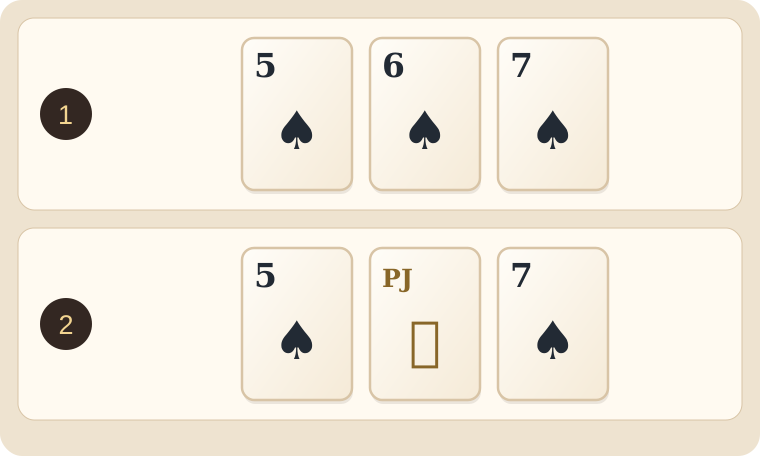
Joker distinction: 5♠ PJ 7♠ is impure because PJ replaces 6♠. However, if sevens are wild, 5♠ 6♠ 7♠ can remain pure when 7♠ is used in its natural position. A printed joker has no natural rank and suit.
You can build other groups before finishing the pure sequence. Do not ignore a useful draw merely because it arrives early. Recheck your plan after every draw; one pure sequence alone is not a complete declaration and does not guarantee a particular penalty reduction.
2. Read the open pile as evidence, not certainty
An opponent taking 8♦ from the discard pile is a clue. They might be forming 6♦ 7♦ 8♦, 7♦ 8♦ 9♦, 8♦ 9♦ 10♦, a set of eights, or extending a longer group. The pickup does not reveal their full hand or prove they are one card from finishing.
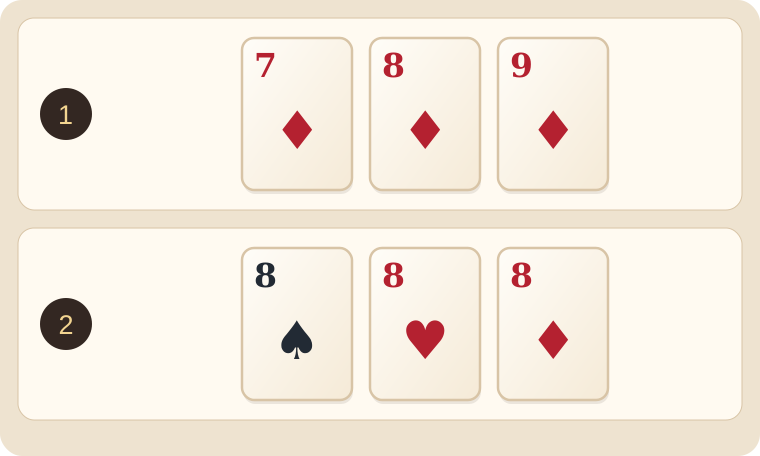
Keep a small mental record: which card was taken, which card was later discarded, and who acts next. Distinguish an observed fact from your hypothesis. For example, “8♦ was taken” is a fact; “9♦ would finish that player's hand” is only a possibility.
Do not retain every diamond and every eight indefinitely. That can leave your own hand disconnected. Multiple decks can contain duplicate physical cards, and an opponent's plan can change. Use the clue to compare otherwise similar discards rather than treating it as a guaranteed read.
3. Balance defensive discards with your own progress
A defensive discard avoids offering an obviously useful card when a reasonable alternative exists. It is not a command to block at any cost. The relevant player is whoever can legally take your top discard next, according to the table's turn order.
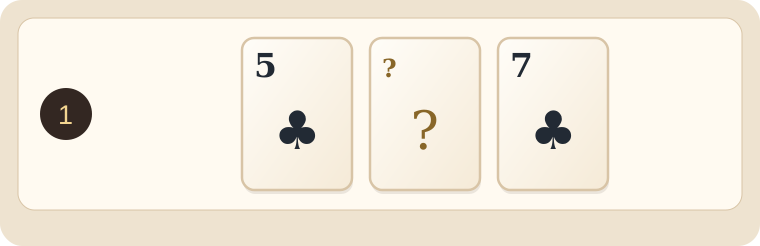
Suppose that player previously picked up 5♣ and you are considering discarding 7♣. A 5♣ 6♣ 7♣ run is plausible, but you do not know whether they hold 6♣. If another equally unhelpful card has no such connection, consider it instead. If keeping 7♣ breaks your only strong route to a sequence, the cost of blocking may outweigh the uncertain benefit.
- First protect completed groups and cards with a clear purpose.
- Compare the remaining discard candidates using recent visible information.
- Reassess old clues rather than treating them as permanent.
A discarded 10♣ does not prove that 7♣ is safe or dangerous. Likewise, repeated nines in the pile do not make every neighbouring card safe. There is no universal “never discard a middle card” rule.
4. Count useful cards before quoting probabilities
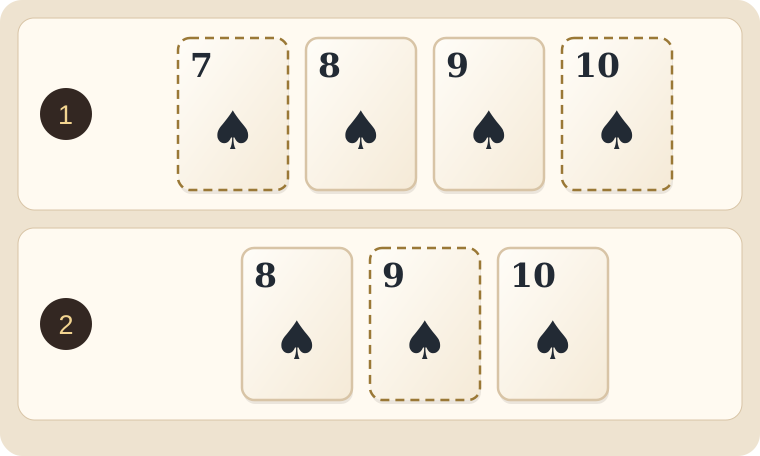
An out is a card that improves or completes the particular pattern you are evaluating. Separate a card type, such as 7♠, from the number of physical copies still available. Two types do not always mean twice as many available cards.
Swipe or scroll to read the full table ↔
| Cards held | Needed card types | Check before keeping |
|---|---|---|
| 8♠ 9♠ | 7♠ or 10♠ | How many copies of each might remain? |
| 8♠ 10♠ | 9♠ | Is the gap card already visible elsewhere? |
| K♠ K♦ | K♣ or K♥ | A set still does not replace a required sequence. |
| A♠ 2♠ | 3♠ | K♠ cannot make K-A-2 a valid sequence. |
A transparent, hypothetical calculation
Imagine a teaching exercise with exactly 40 cards in a uniformly shuffled stock. Suppose it contains two copies each of 7♠ and 10♠, and two copies of 9♠. The next draw completes 8♠ 9♠ with probability 4 / 40 = 10%, compared with 2 / 40 = 5% for 8♠ 10♠.
Those percentages apply only to that stated stock composition and one draw. They are not measured Master Rummy probabilities or win rates. During real play, cards you cannot see may be in other hands, not in the stock. Visible copies, jokers, overlapping groups and additional draws change the analysis. Without those assumptions, a fixed percentage is misleading.
Practical takeaway: an open-ended pair can offer more natural completions, but count plausible available copies and evaluate the whole hand before deciding.
5. Reduce disconnected high cards, not useful sequences
Under a common scoring convention, an unmatched A, K, Q or J has a nominal value of 10 points. Four such cards total 40 before applying the actual scoring rules. Whether those values count depends on valid groups, sequence eligibility, jokers and the table's penalties.
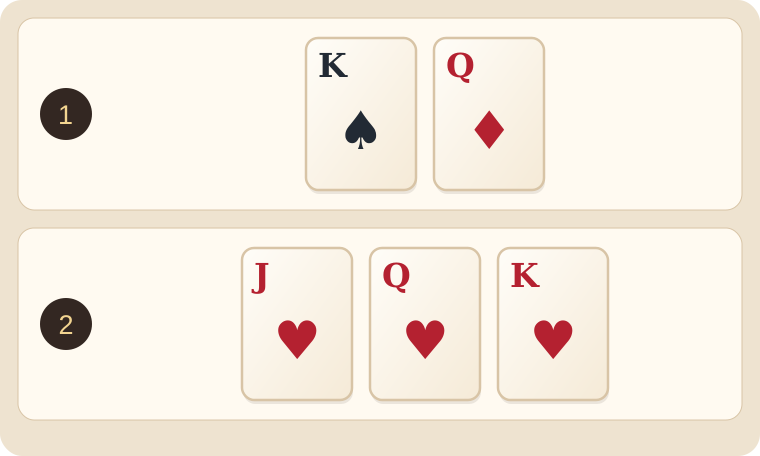
K♠ and Q♦ do not form a sequence because their suits differ. If neither has a useful connection, reconsider keeping both. By contrast, J♥ Q♥ K♥ is already a pure sequence: throwing away K♥ simply because it is a high card damages the hand.
After drawing, ask: does this card complete a group, extend a realistic pair, or merely add potential points? Review stranded high cards early, but do not use a rigid “discard all face cards by turn three” rule. A designated wild rank may also change a card's role and value.
6. Check the drop option before relying on it
A drop, where offered, means leaving the current hand under the format's rules. Before using it, check whether it is available, when it is allowed, what point cost is displayed and whether the action requires confirmation.
Some formats distinguish a first drop from a later drop. Figures such as 20, 40 and an 80-point cap occur in some rulesets, but are not universal and are not confirmed Master Rummy settings. A cap is a maximum, not the loss you would necessarily have incurred.
Compare the stated cost of dropping with the uncertain outcome of continuing. A weak hand with few connections deserves reassessment; failing to finish a sequence by a particular turn does not automatically mean dropping is best. If the app does not offer a drop option, do not assume closing it is an equivalent action.
This is about understanding scoring choices, not a strategy for earning cash or protecting a withdrawable balance. Take a break when play becomes frustrating, and read purchase details before spending.
7. Zone the hand and audit all 13 cards
During play, separate completed sequences, candidate groups and ungrouped cards. Before declaring, the candidate and ungrouped cards must also belong to valid groups. A tidy layout does not by itself make the hand valid.
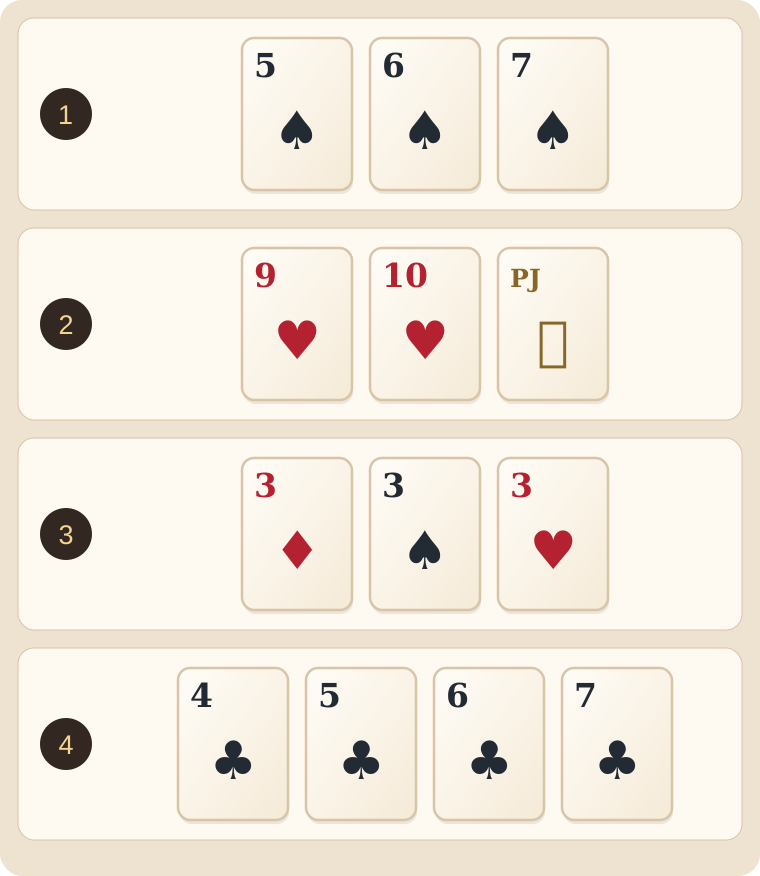
Swipe or scroll to read the full table ↔
| Group | Why it works |
|---|---|
| 5♠ 6♠ 7♠ | Pure sequence, three cards. |
| 9♥ 10♥ PJ | Impure sequence; PJ represents J♥. |
| 3♦ 3♠ 3♥ | Set of threes in different suits. |
| 4♣ 5♣ 6♣ 7♣ | Another pure sequence, four cards. |
Assume the numbered cards are used naturally. This example has three sequences, including two pure sequences, plus one set. Each physical card is used once, and none is left over.
- Count exactly 13 cards in the submitted groups.
- Find at least two valid sequences, including at least one pure sequence.
- Check each joker's specific replacement and every set's suits.
- Look for gaps, duplicate use and an invalid K-A-2 wraparound.
- After drawing a fourteenth card, use the game's discard and finish controls correctly.
Take enough time to check; “three seconds” is not a rule or a safety guarantee. An enabled Declare button does not prove that the groups are valid.
A short practice routine
Recreate the illustrated hand with physical cards, remove 6♠, and explain why the first group no longer works. Then restore it, replace 7♣ with K♦, and identify the leftover card and incomplete club sequence. Finally, compare two possible discards and say which observation supports your choice. Review the reasoning, not just whether that hand happened to win.
Advanced rummy questions, answered directly
Does an open-ended pair always have double the chance?
No. It offers two natural completing card types in the example, but their available copies may differ. A two-to-one probability comparison needs equal copy availability and the same draw pool.
Should I always draw from the closed stock?
No. A known useful top discard may be better than an unknown draw. Weigh its value against the information the pickup reveals, and follow any pickup restrictions.
Can a joker appear in a pure sequence?
A wild-rank card can appear in its own natural position. A printed joker, or a wild card substituting for a different card, cannot make that group pure.
Does no pure sequence always mean an 80-point loss?
No. Normal card totals, fixed invalid-declaration penalties and maximum caps are different. Apply your table's rules rather than assuming every unfinished hand receives the cap.
Can these strategies guarantee a win?
No. Random draws and other players' decisions remain uncertain. Use the guide to make explainable choices and reduce avoidable mistakes.
Sources and further reading
Try one lesson at a time. In your next practice hand, focus on the pure sequence; in the one after that, track open-pile pickups. Changing everything at once makes it harder to notice what helped.
For other rule conventions, see Pagat’s Indian Rummy reference. Ready to follow scores across several hands? Read the tournament guide. For a quick reset on the basics, return to the rules overview.