
Before the first deal, know how the event ends. Check how many hands count, how scores add up and who moves to the next stage. “Freeroll” tells you about entry, “ranked” about ranking and “multi-table” about the table setup. You still need the event rules to know how all three work together.
Winning a hand feels good, but it may not put you at the top of the leaderboard. This guide walks through that difference. It explains tournament formats in general; it does not announce live Master Rummy events. Check the app or ask support about current availability.
The examples use points, not cash. Master Rummy has recharge and paid purchases, but no cash withdrawals or cash rewards. New to sequences and sets? Start with the 13-card rules guide, then come back here.
1. How is a tournament different from one hand?
A hand is one deal. A tournament can bring several deals or stages together, so one good hand is only part of the result. Some events add penalty points; others use tournament chips or ranking points. Find out which number you are trying to improve before you start.
Swipe or scroll to read the full table ↔
| Question | One hand | Whole event |
|---|---|---|
| What must I complete? | A valid arrangement of the cards. | The published number of deals or stages. |
| What does the score mean? | Card totals or penalties under the hand rules. | An aggregate, chip balance or ranking formula. |
| When am I finished? | When the hand ends under its rules. | At the event's completion or an applicable elimination condition. |
Do not assume every tournament uses identical starting chips, automatically eliminates a player after one loss, or moves players after every round. These are format choices. The same caution applies to re-entry, ties, late arrival and stage resets.
2. Freeroll, ranked and multi-table: three different labels
Freeroll: check what “free entry” actually covers
A freeroll generally means no entry fee for that event, but eligibility may still be conditional. Read whether a ticket, invitation, account status or other qualification is required. Do not infer that every activity, purchase or later event is free, or that a reward is withdrawable.
Ranked or leaderboard: find the scoring direction
A ranked event places players according to a stated score or rating. It does not automatically mean paid entry. Check whether lower penalty totals or higher ranking points are better, how many hands count and when the board is finalised.
Multi-table: understand movement and advancement
A multi-table tournament distributes players across tables. Depending on its structure, it may move players, combine tables or advance selected players to another stage. Not every event continuously rebalances seats or uses the same qualification threshold.
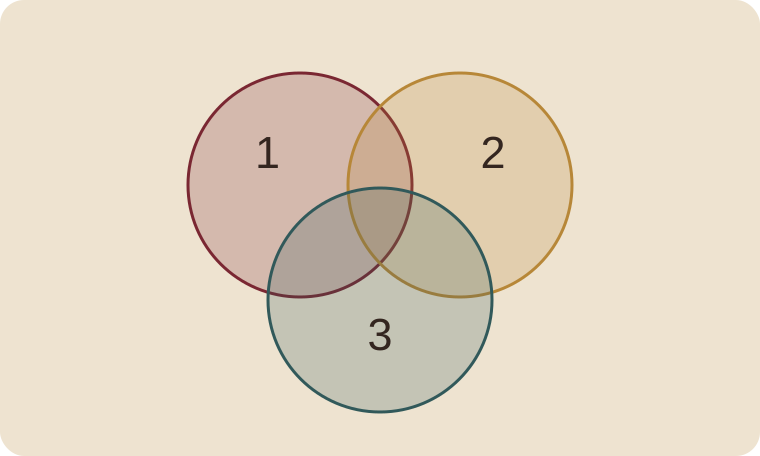
These labels can overlap: an event could have free entry, a leaderboard and multiple tables at the same time. Treat them as separate questions, not three mutually exclusive modes. None of them alone tells you the rewards, fees, eligibility or tie-break rule.
3. Before joining: a practical registration checklist
- Confirm the event: title, rules version, date, start time and time zone.
- Check eligibility: age, location and any entry qualification shown by the organiser.
- Read entry details: any fee, ticket requirement, cancellation terms and re-entry restrictions.
- Understand the score: starting values, what counts, scoring direction and stage resets.
- Find advancement rules: number of qualifiers and the exact tie-break order.
- Prepare the device: connection, battery, turn timer, reconnect procedure and support contact.
Save the event identifier and relevant rules before starting. Never infer your local start time from a number without a time-zone label. If a condition is unclear, ask support before joining; do not treat a generic article as the event's contract.
4. Read a leaderboard without confusing points and rank
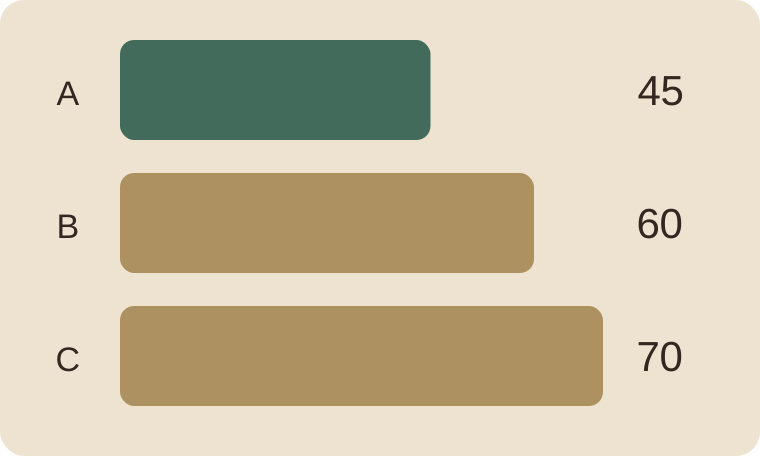
Here is a fictional four-deal exercise. Its only ranking rule is lowest total penalty points first. It does not model an actual Master Rummy event, transfers of chips, rewards or all possible outcomes at one table.
Swipe or scroll to read the full table ↔
| Player | Four deal scores | Total | Rank |
|---|---|---|---|
| A | 10 + 20 + 0 + 15 | 45 | 1 |
| B | 0 + 25 + 15 + 20 | 60 | 2 |
| C | 20 + 10 + 30 + 10 | 70 | 3 |
Player B's zero in the first deal does not make B the overall leader after four deals. All counted results matter. Conversely, in an event that awards points for achievements, higher may be better. Always read the definition before interpreting the number.
If two totals tie, do not invent a winner. The published tie-break may use another measure or a further stage. Also check whether an event resets scores between stages or carries them forward; adding numbers across a reset produces the wrong comparison.
5. Adapt your decisions as an event progresses
Early stage: learn the pace, scoring and timer while making sound groups. Avoid unnecessary invalid declarations. There is no universal instruction to drop every weak hand or to wait for other players to eliminate themselves.
Near a qualification cutoff: check the remaining deals, your position and the published advancement rule. A provisional rank is not a guaranteed qualifying place. “Bubble” is sometimes used for the area just outside a qualifying or rewarded position; the term does not establish a cash payout.
Final stage: continue to apply the same card-validity checks. Do not speed up to pressure others, deliberately delay play or mistake urgency for a better hand. Each player has their own allowed time and choices.
Review disconnected high cards and the route to a pure sequence. K♠ Q♥ 8♦ 4♣ J♠ 2♥ is only a six-card fragment, not a complete 13-card hand. Under ordinary non-wild values it totals 10 + 10 + 8 + 4 + 10 + 2 = 44, but that is not the final penalty of a whole hand. The seven missing cards and the actual rules matter.
No reliable completion probability follows from that fragment alone. Several jokers do not automatically create a pure sequence: a joker substituting for another card cannot make the group pure. See our seven advanced strategy lessons for conditional outs examples.
6. At a new table, observe before assuming
If the event moves you, first confirm your seat, turn order, current score and timer. Start a fresh mental record of visible pickups and discards. Three turns may give useful clues, but cannot reliably classify an opponent or reveal their complete hand.
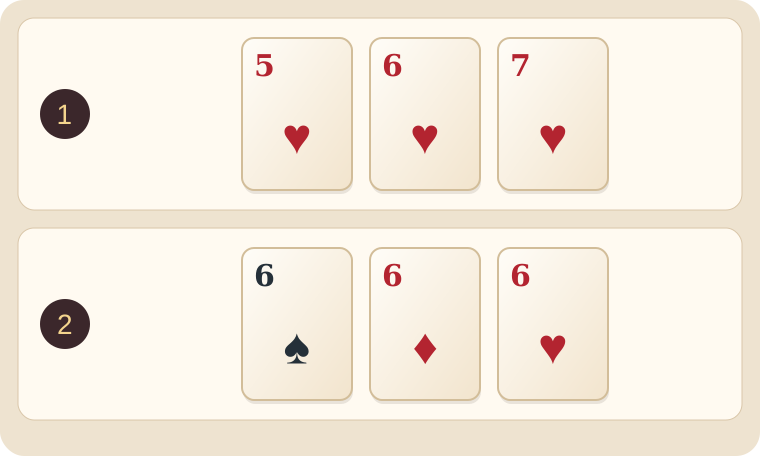
An opponent taking 6♥ might be building 4♥ 5♥ 6♥, 5♥ 6♥ 7♥, 6♥ 7♥ 8♥ or a set of sixes. Those are possibilities, not proof. Even an apparently unrelated K♠ could complete a different group; no discard is universally safe.
Compare plausible discard candidates without keeping every potentially useful card for your opponents. Track the player who can legally take your discard next. Do not sacrifice a strong group solely to block an uncertain pattern.
7. Drop, timeout and disconnection are different situations
A voluntary drop is a rules-defined choice to leave a hand, where available. A timeout is running out of decision time. A disconnection is losing access to the server. They may have different consequences and must not be treated as interchangeable.
Swipe or scroll to read the full table ↔
| Situation | Check |
|---|---|
| First or later drop | Availability, permitted timing, exact point cost and confirmation. |
| Turn timeout | Automatic action, penalty and whether repeated timeouts affect participation. |
| Disconnection | Reconnect window, handling of missed turns and support procedure. |
| Invalid declaration | Validation process and the specified penalty. |
Values such as 20, 40 and an 80-point cap belong to some rule systems, not all tournaments. Dropping for 20 instead of a possible maximum of 80 does not prove you saved 60: the result of continuing was uncertain. A cap is not an automatic score for every unfinished hand.
If you disconnect, reconnect through the official app and check the recorded state. Do not assume the game paused or protected your score. For a dispute, keep the event ID, time and relevant screenshots, and contact the organiser. Never share your password or one-time codes.
8. Audit a complete 13-card declaration
Stage pressure does not change the basic validity requirement. In the common format explained in our rules guide, arrange all 13 cards into valid groups, including at least two sequences with at least one pure sequence.
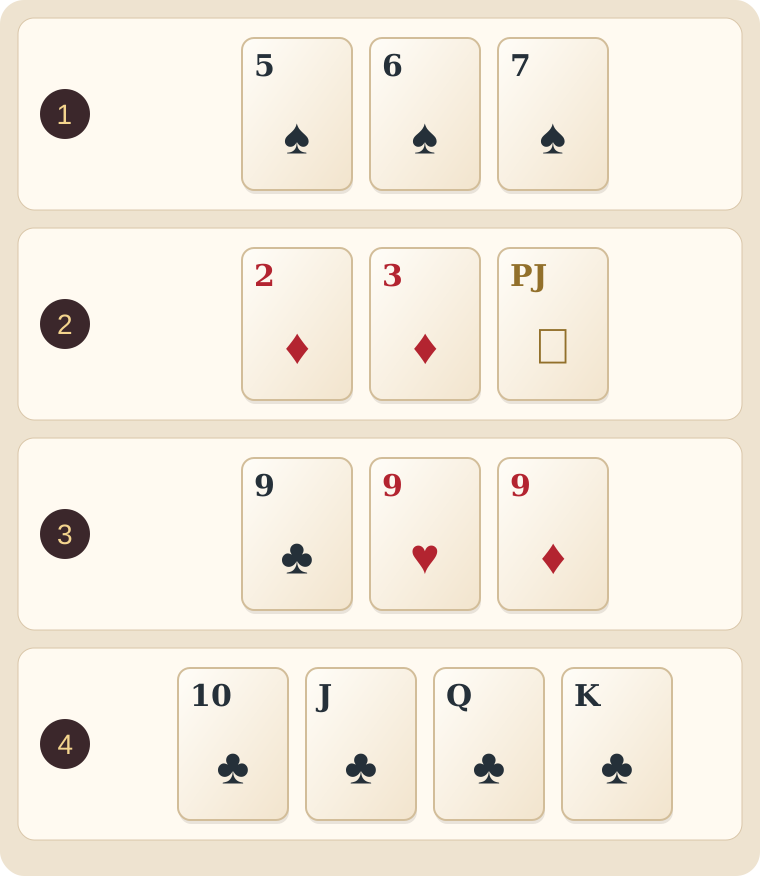
- 5♠ 6♠ 7♠: a three-card pure sequence.
- 2♦ 3♦ PJ: an impure sequence with PJ representing 4♦.
- 9♣ 9♥ 9♦: a set of three different suits.
- 10♣ J♣ Q♣ K♣: a four-card pure sequence.
The count is 3 + 3 + 3 + 4 = 13. Every physical card is used once; no loose card remains. A wild-rank card used naturally can still belong to a pure sequence, unlike a substitute joker. Check the app's actual discard, finish and confirmation controls rather than assuming every interface uses the same slot.
9. Tournament questions, answered directly
Does Master Rummy currently offer these tournaments?
This guide does not confirm ranked, freeroll or multi-table availability. Check the current app or ask masterrummyx@gmail.com. It is not an event listing or registration page.
Does “freeroll” guarantee cash rewards?
No. Entry conditions and rewards are separate. Master Rummy does not provide cash withdrawals or cash rewards.
Is ranked play always paid?
No. Ranking describes how performance is ordered, not the entry price. Read the event's entry conditions separately.
Must I drop whenever I lack a pure sequence?
No. Assess the complete hand and the available rules-defined choices. There is no universal joker count, turn number or percentage that decides every hand.
Will a disconnection cost exactly 20 points?
Not necessarily. Timeout and reconnect rules vary. Only the actual event's policy can establish the action and penalty.
Can I advance by winning just one deal?
Only if that event's advancement rule says so. A cumulative format may count every deal and additional tie-break criteria.
10. Sources and the next learning step
For a first practice exercise, cover the totals in the leaderboard example and add the scores yourself. Then explain why winning one deal did not put Player B first overall. If you can explain that, you have the key idea.
You can compare another operator’s event explanations in RummyCircle’s tournament help; its offerings are not Master Rummy’s. For game rules versus legal permission, read our India legal guide. Or return to the strategy lessons for card-by-card decisions.