Is rummy legal in India? There is no useful blanket “yes” for every version of the game. Playing cards without stakes, paying for app access and staking value on an online result are different situations. Calling rummy a game of skill does not, by itself, make online money play lawful.
Sources checked: 11 October 2026. This is a plain-language reading guide, not legal advice or a certificate for any app. If you are deciding whether to operate or pay for a particular game, get advice on its actual rules and payment flow.
You may have seen an old article saying that rummy is legal everywhere because it involves skill. That leaves out the important part: what players pay, what they risk and what they can receive. Start there, rather than with a green tick on a state map.
1. Start with the version of rummy you mean
Imagine three people saying “I play rummy.” One plays cards with family without stakes. Another pays for access to a card app. The third risks purchased value on the result of a hand. They are describing the same card family, but not the same legal question.
Swipe or scroll to read the full table ↔
| Situation | What to check |
|---|---|
| Cards without stakes | The setting and applicable local rules; do not confuse this with an online money game. |
| Paid app access or purchases | What the payment buys and whether any purchased value is risked during play. |
| Stakes linked to a result | The applicable prohibition and the full payment-and-reward arrangement, not just the game's name. |
This table helps you ask the right questions. It is not an approval list. An app-store listing, a familiar brand name or a working payment button cannot settle those questions for you.
2. What changed in the national framework?
The Promotion and Regulation of Online Gaming Act, 2025 distinguishes online money games from social games. Its money-game definition is not limited to games of chance. It addresses payment or stakes linked to an expectation of monetary or other enrichment, and its provisions prohibit offering online money games, related advertising and payment facilitation. Purchased credits and tokens need attention too; see sections 2 and 5–7.
The 2026 Rules specify 1 May 2026 as their commencement date. Do not mistake the earlier consultation drafts for the final rules. When checking an app, use the legislation and current official decisions, not an old promotional summary.
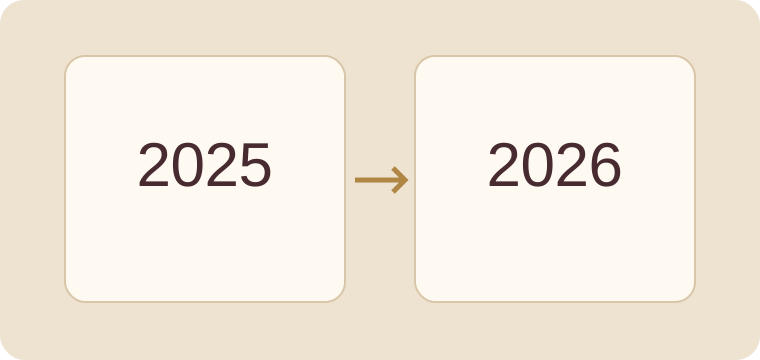
A publication date matters. A guide written before these changes may explain an older court case accurately and still give the wrong practical impression today. Keep the date of the source beside the claim it is meant to support.
3. Does “game of skill” settle the issue?
No. The Supreme Court's 27 May 2026 judgment in State of Tamil Nadu v. Junglee Games India distinguishes skill from betting on skill. It allowed the Tamil Nadu and Karnataka appeals and set aside the challenged High Court judgments. Read its conclusions, especially paragraphs 376–377, rather than treating earlier headlines as current approval for money play.
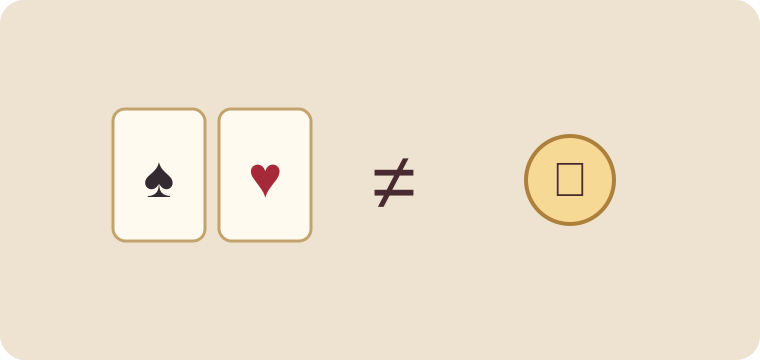
Older cases still need context. The frequently cited K. R. Lakshmanan decision concerned horse racing and statutory exceptions; it was not a licence for every modern rummy app. The 2026 judgment explains that distinction. Learning to arrange cards well and deciding whether a payment model is lawful are separate tasks.
4. A purchase is not the whole story
Ask what happens after checkout. Is the purchase simply access to entertainment, or does it provide something the player can stake? Can a result increase that value? Can it be transferred, redeemed or exchanged for something else? “No withdrawal button” answers only one of those questions.
The Act allows certain access fees within its social-game definition, subject to its conditions. That is not a blanket exemption for all in-app purchases. A product needs to be assessed by how it works, including its credits and rewards, not by the label “social” or “free.”
Swipe or scroll to read the full table ↔
| Question | Ask for a clear answer |
|---|---|
| What am I buying? | Access, a cosmetic item, credits or something else? |
| Can I lose it through play? | Describe the stake or deduction, if any. |
| What can a result give me? | Points, items, credits, money or other value? |
| Can that value leave the account? | Check transfer, redemption and exchange conditions. |
Keep the purchase description and receipt. If the explanation is vague, pause before paying and ask support. Do not assume that a small amount changes the nature of the arrangement.
5. What does this mean for Master Rummy?
Master Rummy offers recharge and paid purchases. It does not offer cash withdrawals or cash rewards. Those are product facts, not a legal clearance. This article does not claim that Master Rummy is licensed, government-approved or available lawfully in every location.

For a specific purchase, check the description shown in the app. If you need to know how purchased items can be used, transferred or redeemed, ask masterrummyx@gmail.com before buying. A support answer about a feature is still different from independent legal advice.
If you just want to understand the cards, begin with our illustrated 13-card rules guide. Its sequence and set examples explain play; they do not establish permission to stake money.
6. Why a state list or a safety badge is not enough
Do not rely on a list that marks most states green and a few red without a review date and sources. Check the national framework, relevant state law and the product's actual design together. A change in one can make a saved screenshot unhelpful.

The same applies to badges. Encryption concerns data protection. A randomness assessment concerns the dealing process within its tested scope. Neither tells you whether a payment model is lawful. KYC, a tax invoice and an app-store listing are not interchangeable with regulatory permission.

Do not bypass a location restriction with a VPN. If access is restricted or the terms are unclear, stop and ask the operator for clarification. Keep personal documents and one-time passwords out of public chats.
7. Questions players actually ask
Is every online rummy app legal because rummy uses skill?
No. Skill alone does not resolve the treatment of stakes, payments and rewards. Read the current framework and the actual product terms.
Does “no cash withdrawal” prove an app is a social game?
No. You also need to understand purchases, stakes, transfers and other forms of value. Do not decide from one button being absent.
Does “freeroll” mean an event is legally approved?
No. It describes an entry arrangement, not regulatory approval. Our tournament guide explains the terminology without advertising a live event.
Can I withdraw winnings from Master Rummy?
No. Master Rummy does not provide cash withdrawals or cash rewards. Read purchase details before paying.
Where should I check a legal claim?
Start with the official documents below, check their dates and ask a qualified Indian legal professional about the specific arrangement. This page cannot determine your individual position.
Official sources and a sensible next step
- MeitY: Promotion and Regulation of Online Gaming Act, 2025 — definitions and prohibited activities.
- MeitY: Promotion and Regulation of Online Gaming Rules, 2026 — final notified rules.
- Supreme Court: State of Tamil Nadu v. Junglee Games India, 27 May 2026 — particularly the concluding findings.
Save this distinction: understanding the game is not the same as approving its payment model. For card practice, move on to our seven strategy lessons. For a legal decision, take the actual terms and purchase flow to a qualified adviser.