
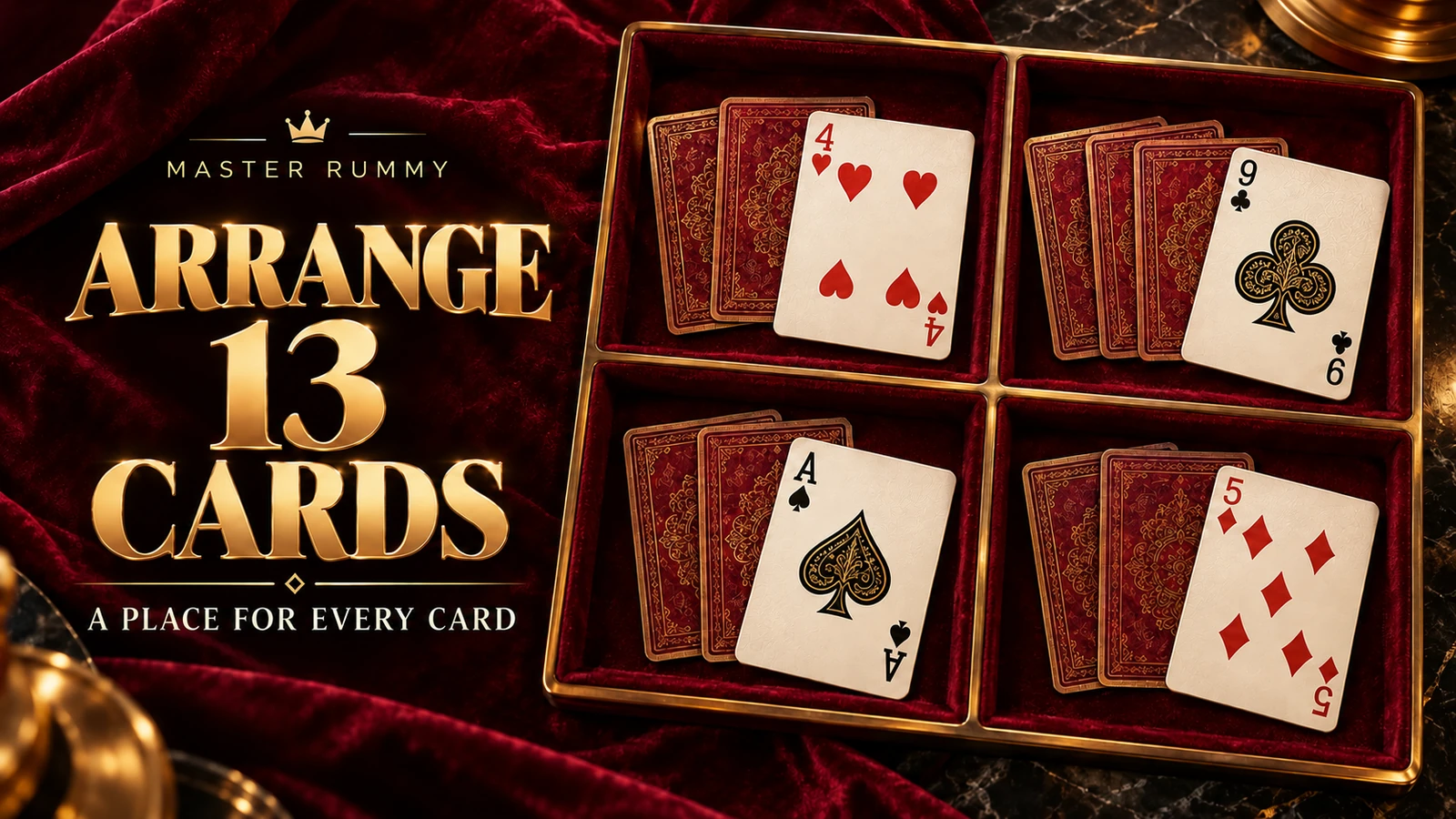
Arrange 13 cards in two passes: first by suit and rank, then by their role in the hand. Keep completed groups together, leave unfinished connections visibly separate and put loose cards where you cannot overlook them. Sorting makes possibilities easier to see; it does not make an incomplete group valid.
The aim is not a perfectly tidy screenshot. It is a layout you can read quickly after every draw. The examples below use common 13-card rules. For the declaration requirements themselves, start with the full rules guide.
First pass: make the suits easy to scan
Bring hearts together, then clubs, diamonds and spades, or use any suit order you can repeat comfortably. Put the ranks in order within each suit. Keep track of the designated wild rank before deciding whether a card is being used naturally or as a substitute.
Now scan for consecutive runs. Do not sort only by number: 6♥ 6♣ 6♦ is useful for seeing a set, but a hand arranged entirely that way can hide 4♥ 5♥ 6♥. Once you have noticed your sequence options, move any useful same-rank cards together in the second pass.
Second pass: arrange by job
Try this 13-card practice hand. Assume kings are not wild and every ordinary card shown is being used naturally. Do not add imaginary cards to finish the incomplete groups.
Swipe or scroll to read the full table ↔
| Cards | Current job | Count |
|---|---|---|
| 2♥ 3♥ 4♥ | Completed pure sequence | 3 |
| 6♣ 7♣ | Unfinished connection | 2 |
| 9♠ 9♦ 9♣ | Completed different-suit set | 3 |
| J♠ Q♠ K♠ | Completed pure sequence | 3 |
| 5♦ A♦ | Loose cards, not a sequence | 2 |
The total is 3 + 2 + 3 + 3 + 2 = 13. Keeping 5♦ and A♦ in a separate area is deliberate. Two pure sequences are present, but those loose cards and the unfinished club pair still prevent a valid declaration.
Do not let one card work in two places
Overlapping possibilities are easy to miss when you move cards around mentally. Suppose the five actual cards are 6♥ 7♥ 8♥ 8♣ 8♠. You can see a heart sequence and an eight set, but both options need the same 8♥. You do not have six cards.
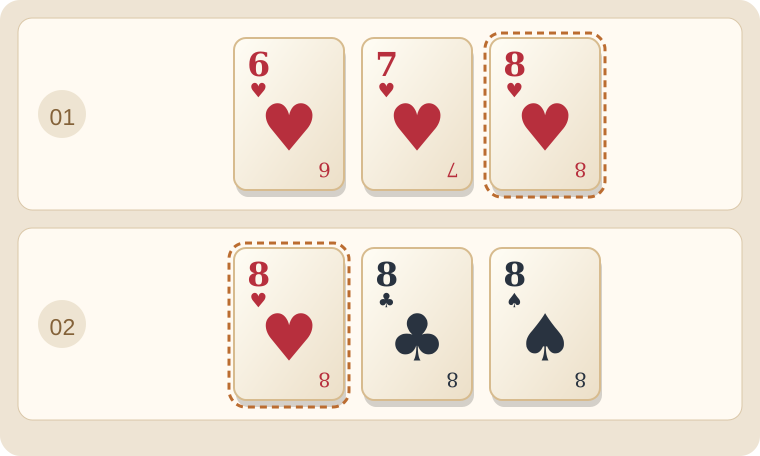
Place the shared card in one group at a time and inspect what remains. This may feel slower at first, but it exposes the cost of a rearrangement immediately. An attractive set is not helpful if creating it removes your only pure sequence.
Follow one draw all the way through
Return to the 13-card table above. For this exercise, the next draw is 8♣. You temporarily have 14 cards. Slide it beside 6♣ 7♣, then choose between the two loose diamond cards. Discard A♦ for this worked example, leaving 5♦ aside.
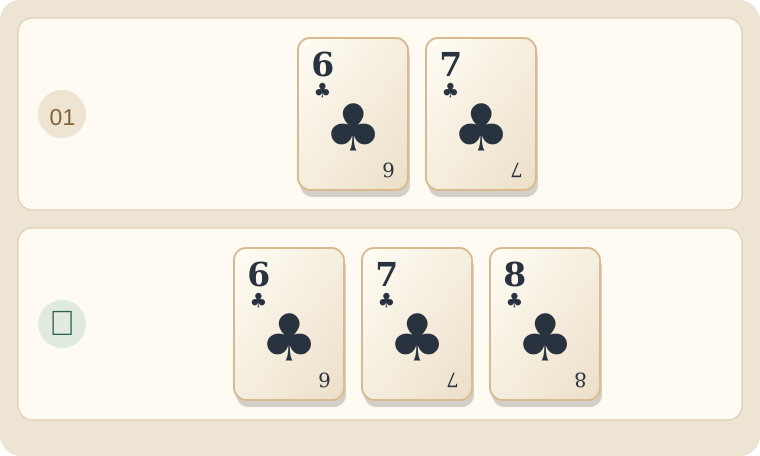
You have four complete groups of three cards and one loose 5♦: 12 + 1 = 13. Stop here before pressing any declaration control. The layout looks nearly finished, but “nearly” is not enough.
For a second practice turn, draw 5♥. Add it to 2♥ 3♥ 4♥, making a four-card heart sequence, then discard the loose 5♦. Now the groups contain 4 + 3 + 3 + 3 = 13 cards, with no leftovers. These draws are chosen for the exercise; they are not predictions of what a real deck will provide.
Choose a layout you can maintain on a phone
Use visible gaps or the app's grouping controls if available. Keep the unfinished connection in the same area until its role changes. When a new card completes it, move the whole group together rather than leaving one of its cards elsewhere.
If an app has automatic sorting, use it as an aid, not a declaration check. It may arrange cards by a fixed order without understanding the plan you are considering. After any automatic or manual move, check that no joker changed its intended role and no card was accidentally separated from a finished sequence.
Make the final count a separate step
Read each submitted group aloud when practising. Check its type, count its cards and then move on. Finally add the counts and look for leftovers. This final pass catches errors that sorting alone cannot: an invalid set, a hidden gap or a card mentally assigned to two groups.
For the group rules, see how to make a pure sequence. If your problem is choosing where the joker belongs, use the joker examples before rearranging the whole hand.
Common arrangement questions
Must every hand be arranged 3 + 3 + 3 + 4?
No. It is a convenient pattern, not the only valid one. Every group and the complete hand must still meet the rules.
Should I keep jokers together?
You can keep them visible while planning, but assign each one a specific permitted position before checking a declaration.
Can a loose card be ignored if the other groups are complete?
No. The 5♦ in our first practice turn is exactly that trap. Every submitted card must be accounted for.
Rule reference: Pagat's Indian Rummy rules give the general background. The layouts and selected draws here are original practice exercises.