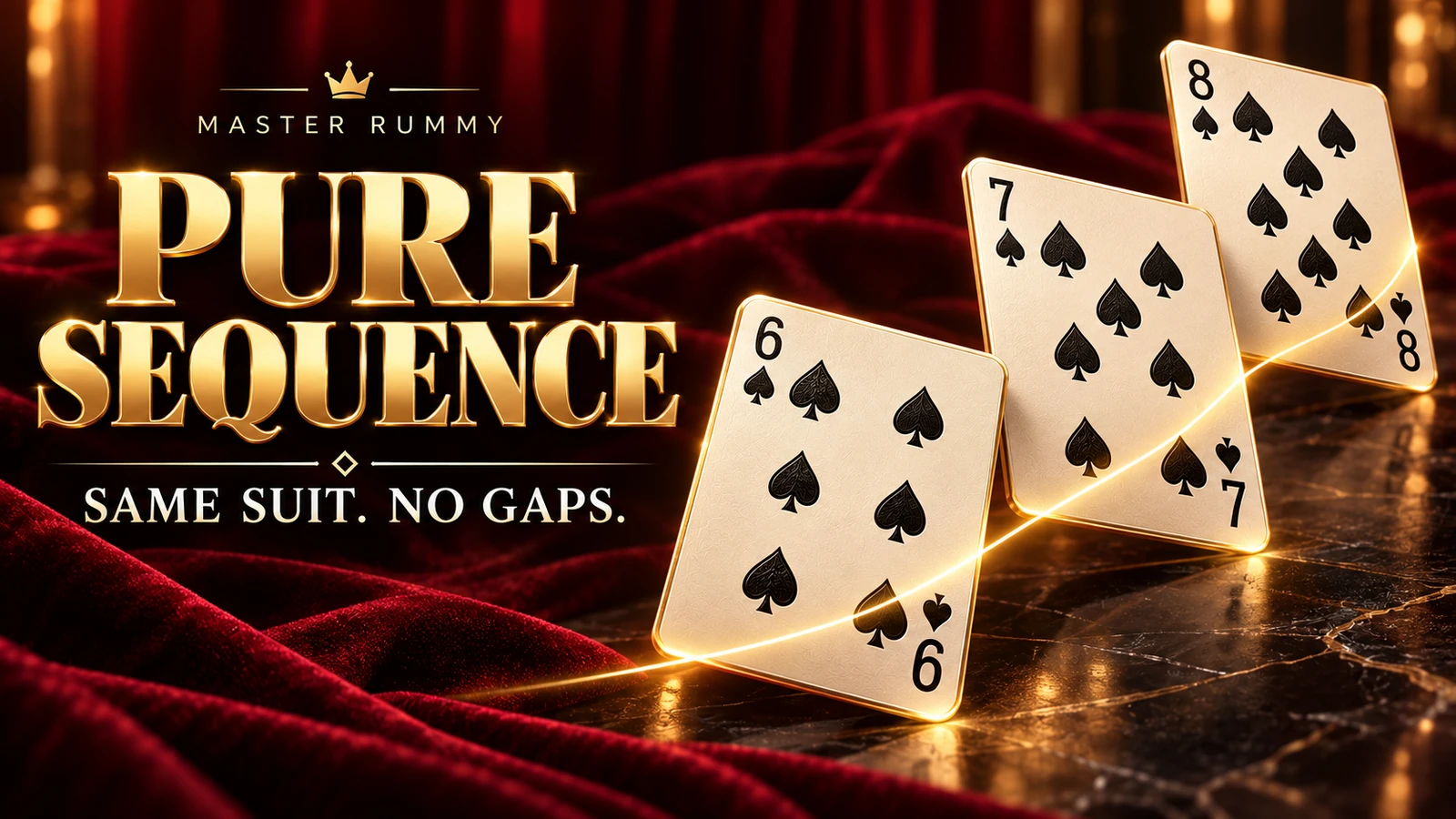
To make a pure sequence, arrange at least three consecutive cards of the same suit without using a joker to replace a missing card. The quickest check is to read both the rank and the suit: six of spades, seven of spades, eight of spades. If either changes unexpectedly, stop and inspect the group.
A pure sequence is the foundation of the common 13-card format, but it is not a complete declaration by itself. This guide focuses on spotting and building that one group. The complete rules guide explains how it fits with the other cards.
Use a three-part check, not a quick glance
- Count the cards. Two connected cards are a starting point, not a sequence.
- Follow the suit. Every card belongs to the same suit, not merely the same colour.
- Read the ranks in order. There must be no missing rank and no substitute covering a gap.
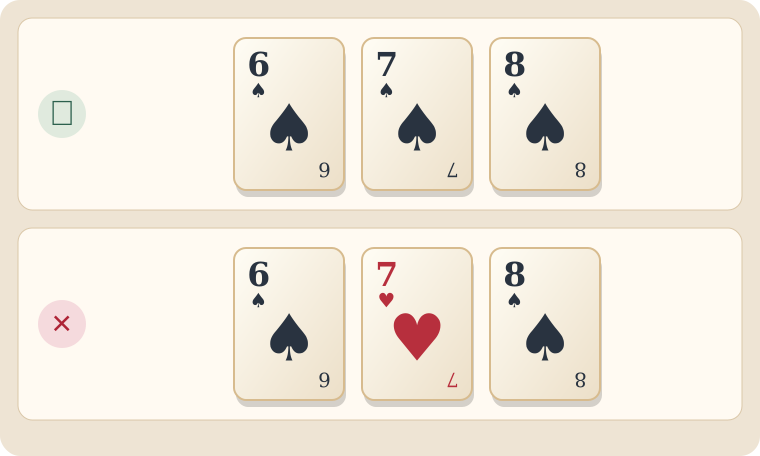
Try checking the second row without looking at the large centre symbols. Reading “6, 7, 8” sounds correct, which is exactly why it is easy to miss the heart. Now read “6♠, 7♥, 8♠.” The mistake becomes obvious. On a small phone screen, slow down for the small suit mark beside the rank.
Start from the cards you actually have
Suppose you hold 6♣ 7♣. Either 5♣ or 8♣ can complete a three-card natural sequence. If you hold 6♣ 8♣ instead, the immediate three-card completion needs 7♣. Write those possibilities down when practising. This is a description of the card shapes, not a claim that either useful card is still available to draw.
Do not turn that observation into “always keep every adjacent pair.” Your whole hand matters. You may already have a pure sequence, need a second sequence in another suit, or have several weak groups competing for space. The useful habit is to name the missing card before deciding how much space to give a plan.
Keep the ace at one end
In the common format used here, the ace can sit below two or above king. A♦ 2♦ 3♦ and Q♦ K♦ A♦ work. K♦ A♦ 2♦ does not: the rank order does not bend around from king through ace back to two.
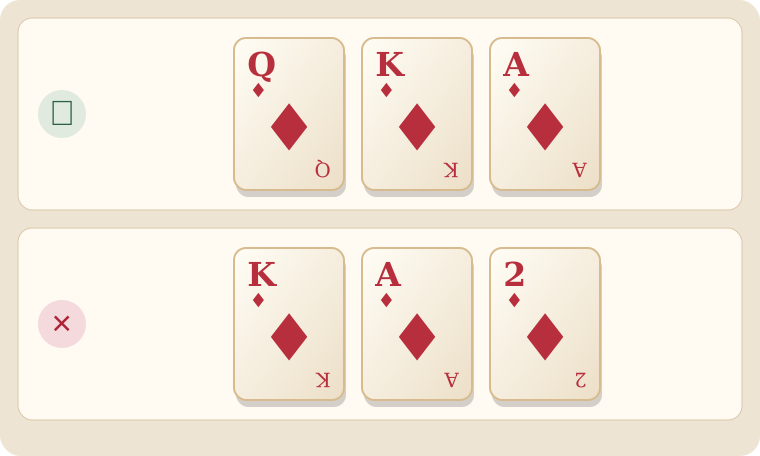
When arranging an ace, choose the end that fits the cards already beside it. If you place A♦ next to K♦, you are looking toward Q♦, not 2♦. This simple layout choice can prevent a mistaken declaration later.
Ask what the wild card is doing
Suppose eights are designated wild. In 6♥ 7♥ 8♥, the eight of hearts occupies its own natural position, so the group can remain pure under this common rule. In 6♥ 7♥ 8♣, the club eight substitutes for the heart eight; that group is impure.
The word “wild” alone does not answer the question. Ask whether the card means itself or a different card. A printed joker has no natural suit-and-rank position to occupy. If the distinction feels fiddly, our joker guide walks through it separately. Always check how your table defines designated wild cards.
Longer is fine; imaginary extra groups are not
4♠ 5♠ 6♠ 7♠ is one four-card pure sequence. It is not two sequences because you can see both 4-5-6 and 5-6-7 inside it: those would share the same physical cards.
With 3♣ 4♣ 5♣ 6♣ 7♣ 8♣, you can instead make two disjoint groups: 3♣ 4♣ 5♣ and 6♣ 7♣ 8♣. Count the cards after separating them. Each card appears once, and each group has at least three cards. Whether to split a longer run depends on what the rest of your hand needs, not on the run looking impressive.
A two-minute practice check
Lay out 5♦ 6♦ 7♦, then change only one card at a time. Replace 6♦ with 6♥: the suit fails. Restore it, then replace 7♦ with 8♦: there is a gap. Restore it again, then add 8♦: you now have a valid four-card pure sequence. Explain the change in a sentence before moving on.
This exercise makes the test repeatable. During a game, repeat the same checks after rearranging or discarding. A group that was pure earlier may have been broken by a later decision. Use our arrangement guide to keep completed and unfinished groups visibly separate.
Questions that often cause confusion
Do three red cards make a pure sequence?
No. Hearts and diamonds are different suits. Colour is not a substitute for suit.
Can I have two pure sequences?
Yes. A joker-assisted sequence is not compulsory. You must still account for every remaining card.
Does one pure sequence mean the hand is safe to declare?
No. Check the required second sequence and all other groups. One correct group cannot rescue an unfinished hand.
Rule reference: Compare Pagat's Indian Rummy rules for the sequence conventions behind these examples. Table-specific rules take priority if they differ.