
The most useful beginner tip is to give every card a job. Separate completed groups from possible groups, find a natural sequence, then decide what the new draw changes. Do not start by asking which card looks lucky or which one has the biggest number. A tidy hand makes the next decision much easier.
This guide is for your first few practice hands. It uses the common 13-card rules explained in our complete rules guide; your table's scoring and controls may differ. Keep a deck nearby if you can. Moving the actual cards is often clearer than trying to remember every example.
Start with three piles in your mind
When the cards arrive, sort them by suit and rank. Then look for three kinds of cards: finished groups, useful connections and cards with no clear partner. You do not have to make three literal piles in the app; a little space between groups is enough.
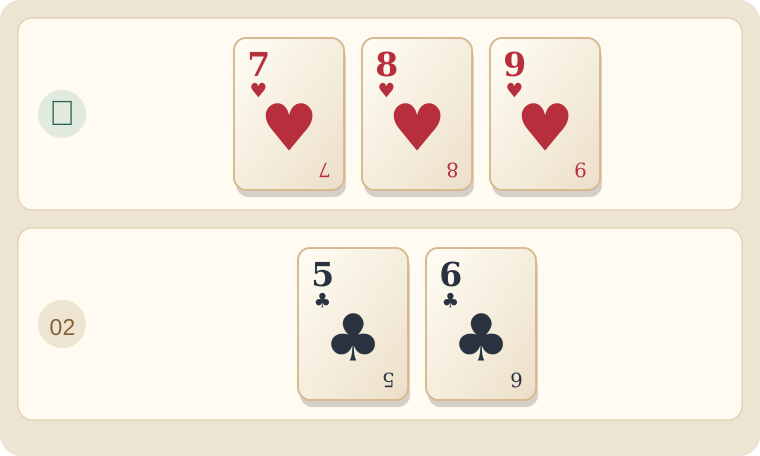
For example, 7♥ 8♥ 9♥ is already a natural sequence. The pair 5♣ 6♣ is promising, but it is not a finished group. An isolated K♦ deserves a second look before you decide to keep it. This distinction prevents a common beginner mistake: counting a pair as though it were already a sequence.
Use the same short routine each turn
- Read the draw. Does it finish something, improve a connection or merely add another loose card?
- Rearrange before choosing. Try the useful position first. Do not leave a helpful card at the end of the hand and forget it.
- Compare two discards. Which choice leaves a clearer route for the other 13 cards?
- Count again. After discarding, you should be back to 13. A declaration needs another full check.
Suppose you already hold 5♣ 6♣ and draw 7♣. Place the three clubs together before considering a discard. If you keep staring at the new card in isolation, you may miss the group it has completed. Now compare the unrelated cards elsewhere in your hand; there is no need to undo the new sequence just because the seven has a higher face value than a loose two.
Learn the difference between a connection and a wish
Two neighbouring cards of one suit, such as 5♣ 6♣, have a visible relationship. A lone Q♦ might eventually connect to something, but that is not yet a plan. Early in a hand you can keep more than one possibility. As new information arrives, be willing to let a weak possibility go.
A useful question is: “What exact card am I waiting for?” If you cannot name one, the card may not have a job yet. This is not a rule to discard every isolated card immediately. A high card may complete a set or become useful after the next draw. The point is to make the reason explicit, then review it rather than keeping a card out of habit.
Give a joker a named position
Do not use a joker as a vague label for “this group will work somehow.” Say what it represents. In 4♠ PJ 6♠, PJ represents 5♠. In 4♠ PJ 7♠, one card cannot cover both missing positions. If this is the part that keeps tripping you up, read how to use a joker and build the examples with physical cards.
A joker also does not remove the need for a pure sequence. Before celebrating a convenient substitution, check whether a natural sequence is present elsewhere.
Practise checking one complete hand
Try the following arrangement. All ordinary cards are used naturally; no joker substitution is needed. Read each group from left to right, then add the group sizes.
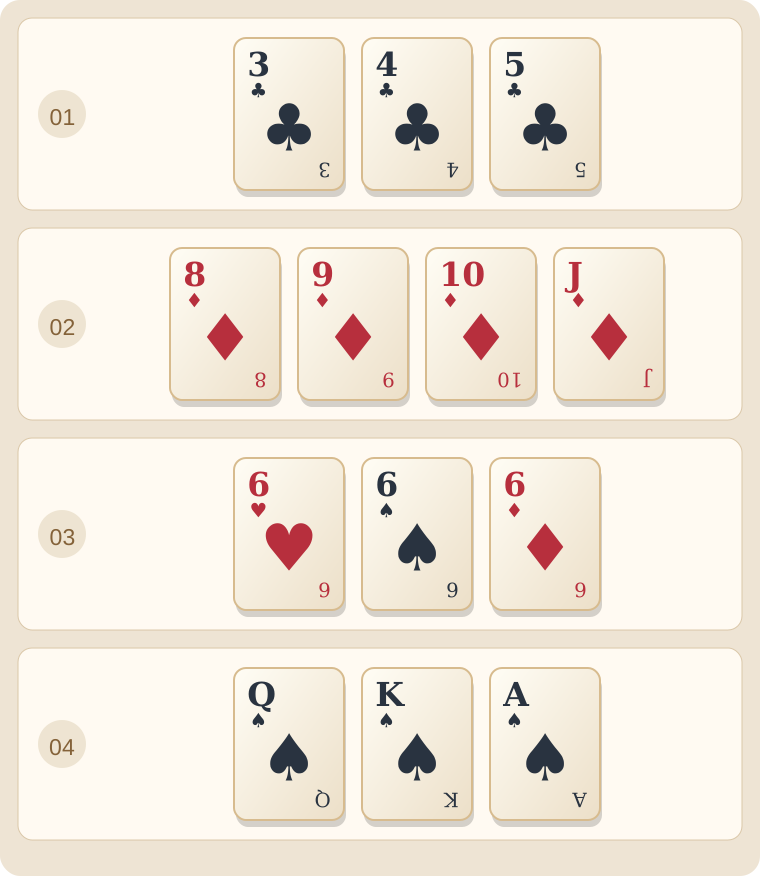
Now remove J♦ and replace it with 2♥. The diamonds still form a valid three-card sequence, but 2♥ is loose. The other groups looking neat does not make that leftover card disappear. Put J♦ back and explain why the whole arrangement works again. That small exercise is more useful than simply memorising a picture of a valid hand.
Keep a one-line practice note
After a hand, choose one decision to review: “I missed the club sequence,” “I kept an isolated king too long,” or “I counted the same eight twice.” Avoid judging the entire hand only by whether you finished first. A sensible decision can be followed by an unhelpful draw, while a poor decision can occasionally get lucky.
For the next practice hand, work on just that one issue. If you keep losing track of groups, use the 13-card arrangement method. If suits are the problem, slow down and name the suit aloud as you check.
Quick beginner questions
Should I always discard high cards first?
No. A king completing Q♠ K♠ A♠ is doing useful work. Compare its role with the cards that are still ungrouped.
Do I need a joker to finish?
No. The complete hand above uses no joker. Useful natural cards are not a consolation prize.
Can I declare as soon as I have a pure sequence?
No. It is one requirement, not a finished hand. Check the second sequence and every remaining card before submitting.
Rule reference: Pagat's Indian Rummy rules provide background on the game. The practice examples here are original teaching exercises, not a promise about any particular draw or result.