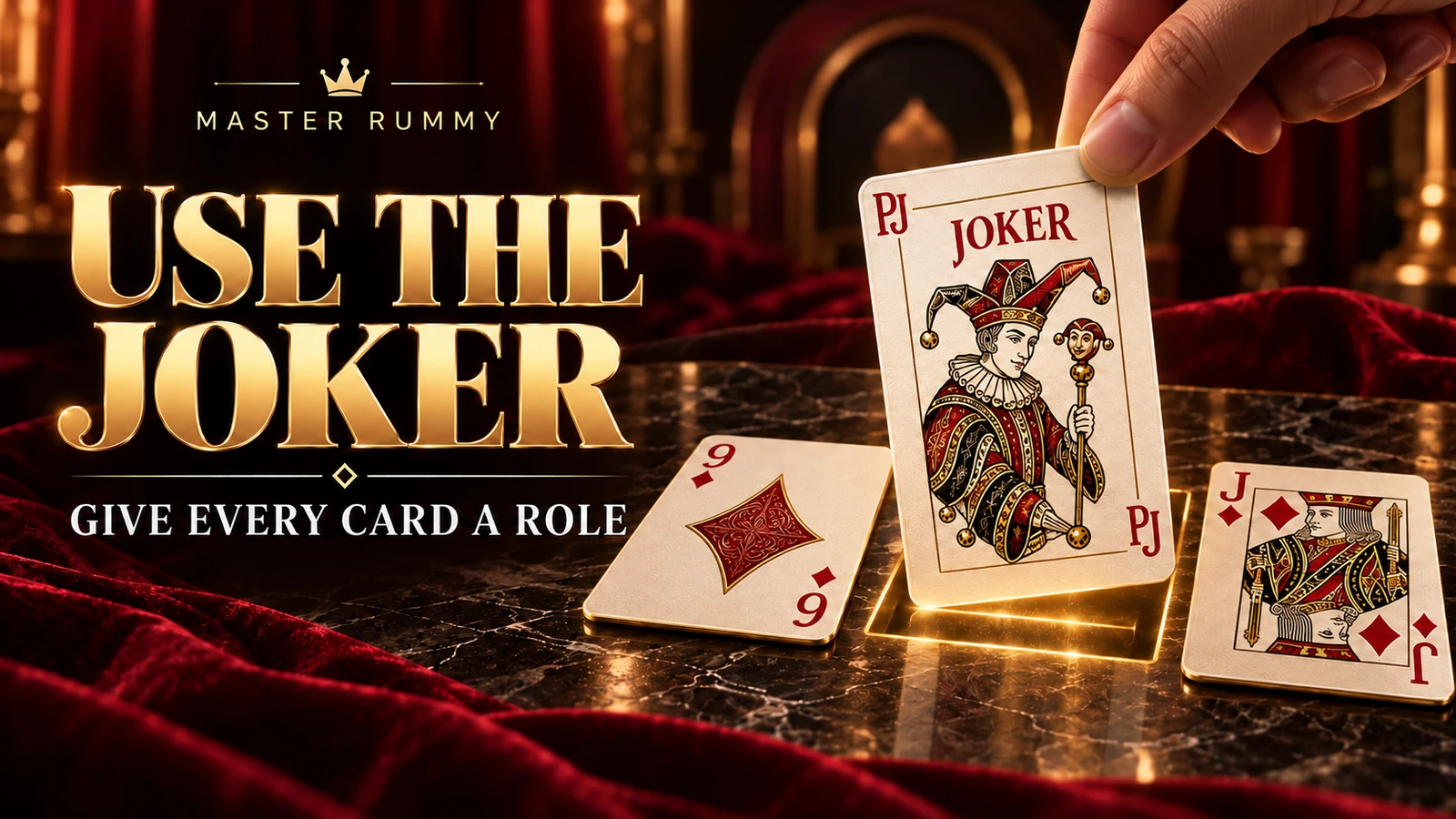
Use a joker to stand for one specific missing card in an allowed group. Before accepting the group, name the card the joker represents and read the full sequence or set. This simple habit is more reliable than treating the joker as a magic card that makes any three cards work.
We use PJ for a printed joker in the examples. The guide follows a common 13-card format; check your table's rules for the designated wild rank, joker limits and pickup restrictions. The full rules guide covers the complete hand.
Identify which kind of joker you have
Swipe or scroll to read the full table ↔
| Type | What to look for | First question |
|---|---|---|
| Printed joker | A special joker card rather than an ordinary suit-and-rank card | Which missing card will it replace? |
| Designated wild card | An ordinary card whose rank is wild for this hand | Is it being used naturally or as a substitute? |
Do this check again at the beginning of every hand. A seven that was wild previously is not automatically wild now. If the indicator or the app's rule is unclear, resolve that first rather than building the whole hand around an assumption.
Name one missing position
In 9♦ PJ J♦, the joker represents 10♦. Read the completed idea as 9♦ 10♦ J♦: consecutive ranks, one suit, one substitution. It is a valid impure sequence in the teaching format.
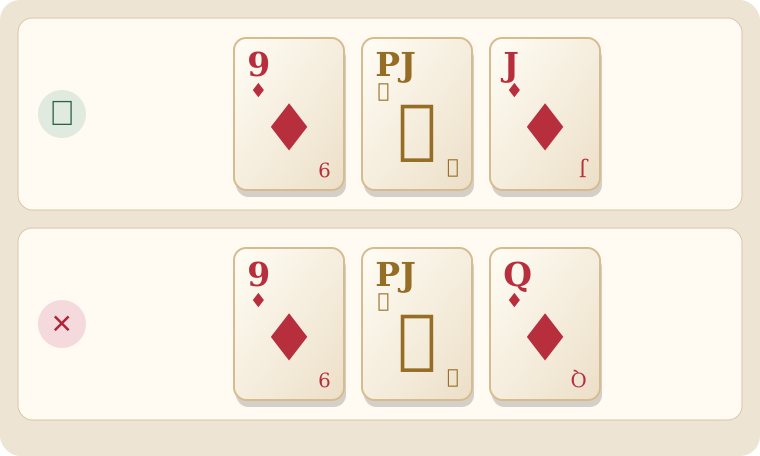
Physically sliding the queen closer does not remove the missing rank. This is why it helps to say the intended ranks aloud. The same test works for a longer group: read every position, including the ones represented by jokers, without skipping a number.
Use a wild card naturally when it fits
Assume eights are wild. Compare 6♥ 7♥ 8♥ with 6♥ 7♥ 8♣. In the first group, the heart eight means itself. Under the common natural-use rule, that sequence is pure. In the second group, the club eight represents the missing heart eight, making the sequence impure.
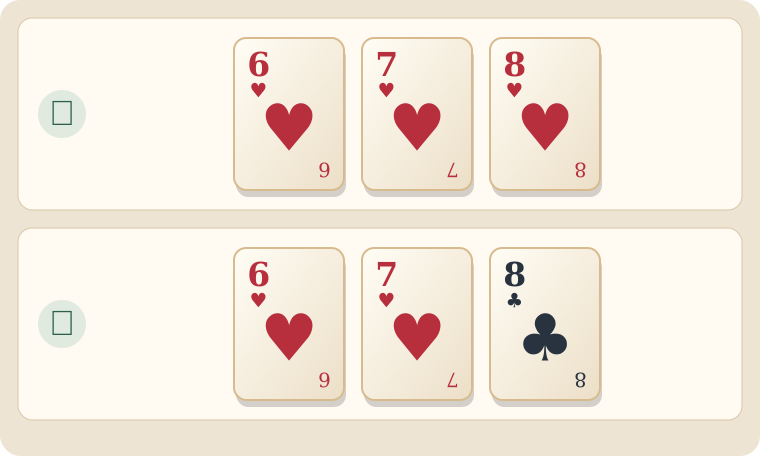
Moving 8♥ away from the first group might give another group a helpful substitute, but it could also remove your only pure sequence. Check the whole hand before moving it. See our pure sequence guide for more on this distinction.
A set still needs a valid pattern
Q♥ Q♦ PJ can represent three queens in different suits, with PJ filling Q♣ or Q♠. Choose one role; the joker does not count as both. Q♥ Q♥ PJ still contains duplicate natural suits and is not a valid standard set just because a joker is present.
Keep the roles separate when learning. A set matches ranks; a sequence follows ranks in one suit. If you cannot say which type of group you are making, do not try to fix it by adding a joker.
Free a joker only after replacing its job
Suppose 9♦ PJ J♦ is complete and you draw 10♦. You can place 10♦ in its natural position, then consider using PJ elsewhere. Make the replacement first. Removing the joker and forgetting to insert the ten leaves 9♦ J♦ unfinished.
This does not create an extra card slot. After the draw you still need to return from 14 cards to 13 by making a legal discard. Recount any group you changed, then compare the whole arrangement. A flexible joker is useful only when the new layout genuinely improves on the old one.
Check the joker inside a whole hand
Try this practice layout: 2♣ 3♣ 4♣ 5♣ | 9♦ PJ J♦ | Q♠ K♠ A♠ | 6♥ 6♣ 6♦. It contains 4 + 3 + 3 + 3 = 13 cards. The clubs and spades are natural sequences, the diamonds are an impure sequence with PJ as 10♦, and the sixes form a different-suit set.
Now replace 3♣ with K♥. The diamond group still works, and the spade sequence is still pure. But 2♣ 4♣ 5♣ is no longer a complete sequence and K♥ is loose. The joker has done its own job correctly; it has not solved every problem in the hand. Avoid judging the entire declaration by the neatness of the joker group.
Practise the substitution, then explain it
Make one joker group with physical cards. Write down what PJ means. Replace the joker with that actual card and check whether the result is valid. Then try changing one neighbouring card so the group stops working. Explaining why it failed is the useful part of the exercise.
For organising multiple possibilities without double-counting a card, use how to arrange 13 cards. Keep the joker's chosen job visible until you deliberately change it.
Quick joker questions
Can a printed joker make a pure sequence?
Not when it substitutes for a missing card. A printed joker has no natural rank-and-suit position of its own.
Should I always move a joker to a high-card group?
No. First check the sequence requirements and the groups the move would break. Point value alone is not enough.
Can I pick up a discarded joker?
Check the actual table's pickup restrictions. Do not assume every available-looking card in the open pile may be taken.
Rule reference: Pagat's Indian Rummy rules explain general joker conventions. Examples here illustrate card roles, not guaranteed outcomes or special Master Rummy features.