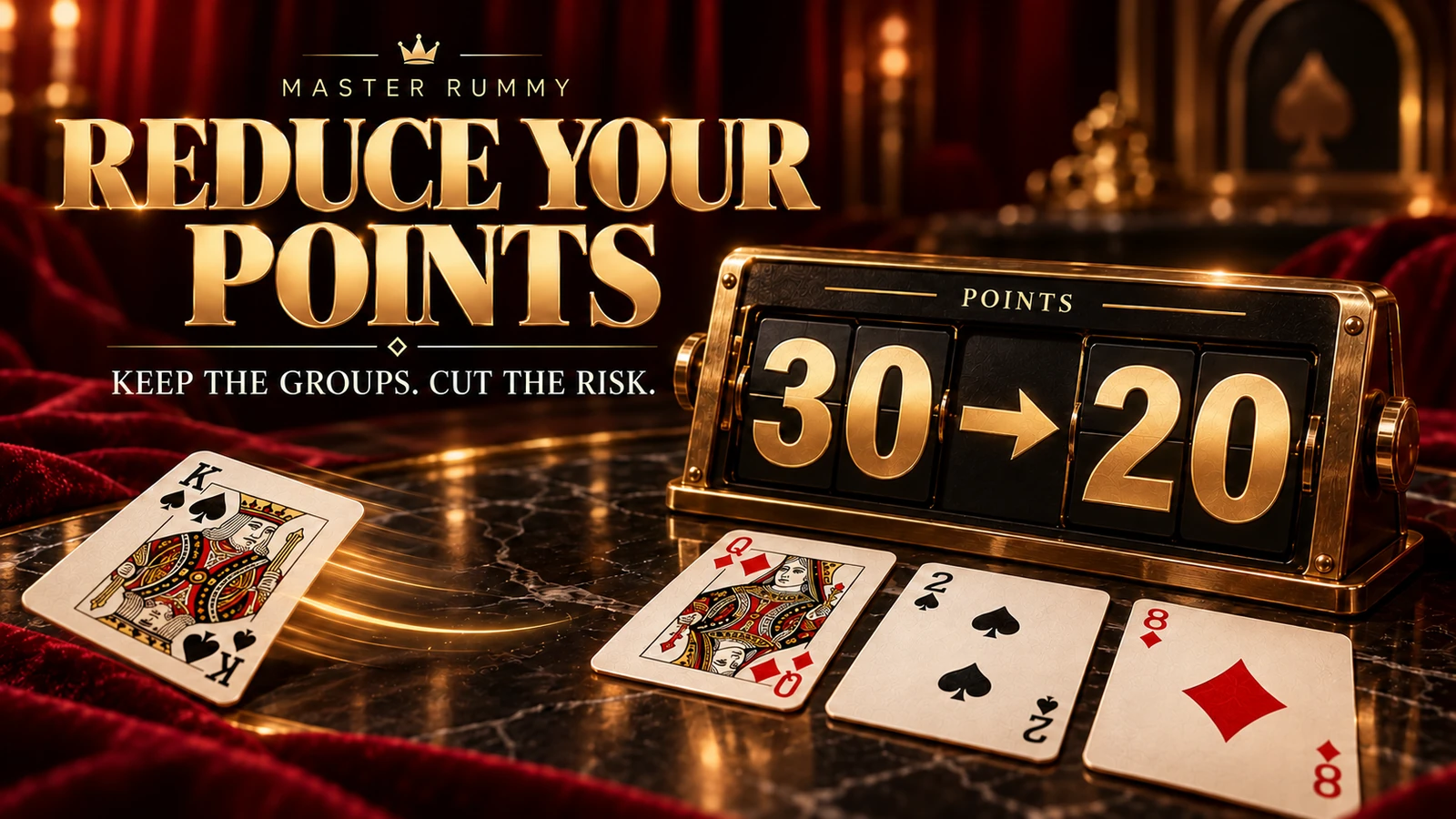
To reduce points in rummy, protect valid sequences before throwing away high cards. Then compare the cards left outside useful groups. A king with no connection may be an easy discard; the king in J♥ Q♥ K♥ is doing a job. Point values alone cannot tell you which one to release.
This guide is about limiting the points exposed in an unfinished hand, not earning money. It uses a declared scoring convention so you can check the arithmetic. Your table’s rules decide what actually counts, whether a drop is available and what penalties apply.
First ask which cards are being counted
In the examples below, A, K, Q and J have a value of 10; numbered cards have their face value; jokers have zero value. Aces are the nominated wild rank, and no aces or printed jokers appear in the worked hand. Most importantly, the player has the required pure sequence and second sequence. Under our example’s convention, cards in valid groups are then excluded and the remaining cards are counted.
That last condition matters. Without a qualifying pure sequence, many rulesets count all eligible cards rather than just the ones you left loose. If you have one pure sequence but no second sequence, a different part of the hand may still be chargeable. Do not apply the “loose cards only” shortcut until you have checked the actual scoring conditions.
For the group requirements, keep the complete 13-card rules guide handy. This article does not set Master Rummy’s penalties or promise that every format calculates a losing hand identically.
A 30-point snapshot you can verify
Lay out this 13-card teaching hand:
2♥ 3♥ 4♥ | 7♣ 8♣ 9♣ | 5♠ 5♥ 5♦ | Q♦ K♠ 2♠ 8♦
The first two groups are pure sequences; the three fives form a different-suit set. There are 3 + 3 + 3 + 4 = 13 cards. Under the stated convention, the four cards at the right are exposed: Q♦ contributes 10, K♠ contributes 10, 2♠ contributes 2 and 8♦ contributes 8. That is 30 points, not a prediction of the final score.
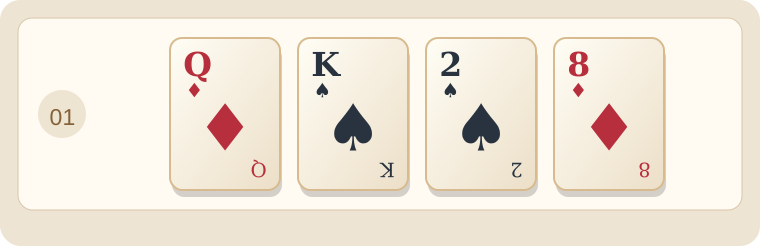
Notice that 2♠ and 8♦ do not form a useful pair just because both are numbered cards. Also, the loose 8♦ cannot share the already-grouped 8♣ as though one physical card could appear in two places.
One useful draw, one deliberate discard
Now draw 6♣ from the closed stock. You have 14 cards. It extends the club sequence to 6♣ 7♣ 8♣ 9♣ without disturbing either of the other completed groups.
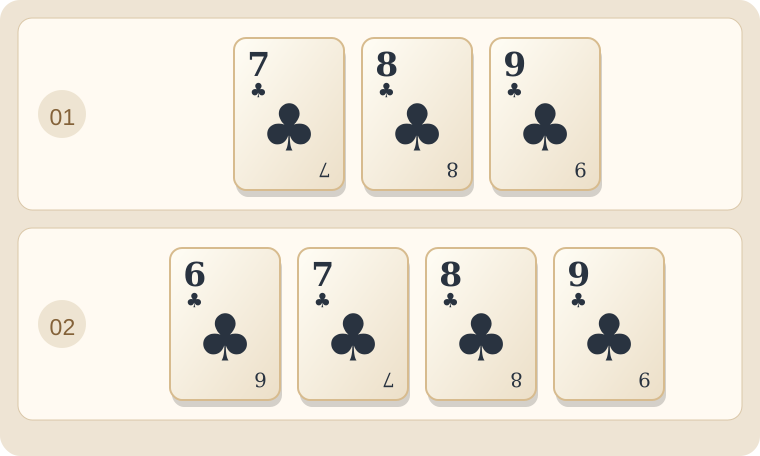
Discard the isolated K♠. The remaining hand has groups of 3, 4 and 3 cards, plus Q♦, 2♠ and 8♦: 3 + 4 + 3 + 3 = 13. The exposed total is now 10 + 2 + 8 = 20. You reduced it by 10, but you are not ready to declare because three cards remain outside valid groups.
Q♦ would remove the same immediate 10 points. Choosing between the two high cards calls for another check: which has a credible future connection, and what have recent visible pickups shown? In this isolated example neither has support, so the score calculation alone does not prefer one over the other.
Compare the hand after the discard, not the card before it
Swipe or scroll to read the full table ↔
| Discard | What remains | Exposed points |
|---|---|---|
| K♠ | All completed groups survive; Q♦, 2♠ and 8♦ remain loose. | 20 |
| 2♠ | All completed groups survive, but both isolated high cards remain. | 28 |
| 9♣ | 6♣ 7♣ 8♣ remains a valid sequence; all four original loose cards remain. | 30 |
All three choices return the hand to 13 cards. The difference is what they leave exposed. Discarding 9♣ is legal as a grouping choice here, but it gives away the extra space that the useful draw created. There may be other considerations in a live hand; this table isolates the point consequence.
Keep a future route without keeping every possibility
A low card is not automatically useful, and a high card is not automatically waste. If you hold J♦ Q♦, both are expensive when ungrouped but have a clear natural route through 10♦ or K♦. Keeping them may make sense early in a hand. Keeping a lone Q♦ indefinitely because “a queen might arrive” is a much weaker plan.
Before retaining an unfinished group, name a specific useful draw and check whether that draw would require breaking another group. If every plan depends on the same card, you have fewer independent options than the layout suggests. Reassess when visible information changes rather than waiting a fixed number of turns.
A short review after each hand
- Mark which scoring conditions were satisfied when the hand ended.
- Write down the counted cards, not just the total shown.
- Find one discard where you could have preserved the same groups with fewer exposed points.
- Check whether the alternative was sensible using information available then—not a card revealed later.
If a format offers a drop, check its timing and displayed point cost before deciding. A maximum penalty is a ceiling, not an estimate of what your present hand will cost. Closing the app is not a substitute for a confirmed drop action.
Questions that often cause confusion
Should I discard every face card immediately?
No. Protect useful groups and compare the whole resulting hand. J♥ Q♥ K♥ may be a pure sequence; removing its king can create more exposed points than it saves.
Does a zero-point joker make an unfinished hand valid?
No. Its point value and its role in a declaration are different questions. Give the joker a valid replacement position and still satisfy the sequence and 13-card requirements.
Keep practising the decision
Try the same hand again with 10♣ as the useful draw. It extends the other end of the club run and creates the same opportunity to remove an isolated card. Next, draw a J♠ that does not immediately complete a group and explain why simply returning that draw may leave the original 30 points unchanged.
Continue with which cards to discard and using jokers correctly. For a separate rules reference, see Pagat’s Indian Rummy guide; its variant-specific penalties should not be copied into another game.