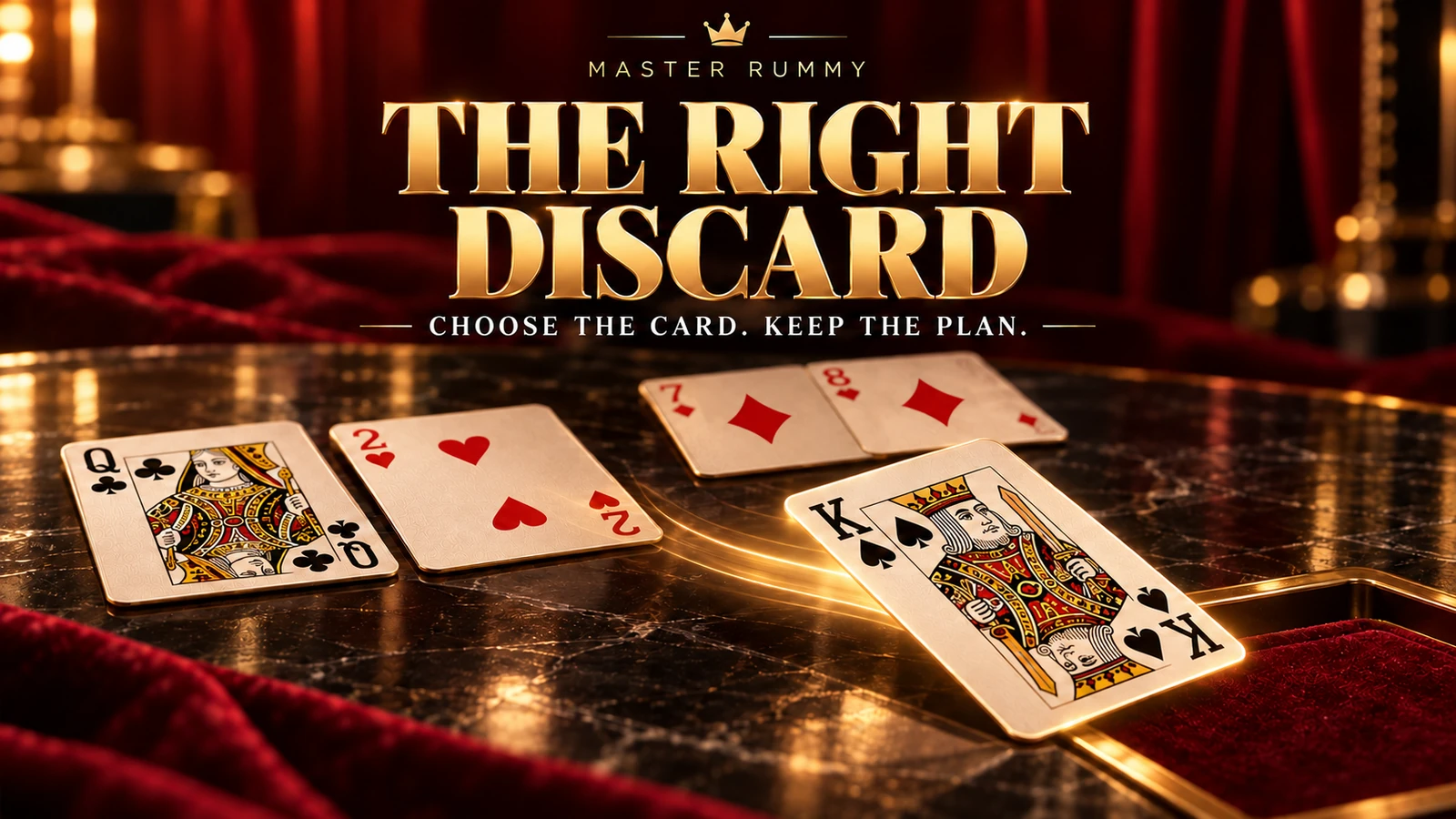
Discard the card that leaves your hand with the clearest workable plan. First protect valid groups, then compare loose cards by their connections and point cost. If two choices are genuinely similar, recent open-pile pickups can help break the tie. They cannot tell you another player’s complete hand.
“Always discard the highest card” is tempting advice because it is easy to remember. It also fails as soon as that high card completes a sequence. A better question is: what will my 13 cards look like after this discard? Here is a practical way to answer it without trying to predict every hidden card.
Make a shortlist before choosing
After drawing, you normally need to go from 14 cards back to 13. Separate completed groups from unfinished ideas, then identify two or three genuine discard candidates. Do not treat a card as spare while also relying on it in a group.
For each candidate, ask what removing it breaks. A disconnected K♠ has a different role from K♠ in J♠ Q♠ K♠. Similarly, 7♦ 8♦ is not a completed sequence, but it has specific natural completions—6♦ or 9♦—rather than just a vague hope of matching something.
If those distinctions are still new, read how to arrange 13 cards first. Sorting is not decoration: it makes the consequences of a discard easier to see.
Try a full-hand choice
For this teaching hand, aces are wild and none is present. Begin with:
4♠ 5♠ 6♠ | 9♥ 10♥ J♥ | 3♣ 3♦ | 7♦ 8♦ | Q♣ K♠ 2♥
Count it: 3 + 3 + 2 + 2 + 3 = 13. You have two pure sequences, a pair of threes, two connected diamonds and three loose cards. Now draw 3♠ from the closed stock. The three threes form a different-suit set, so there are 14 cards and one must go.
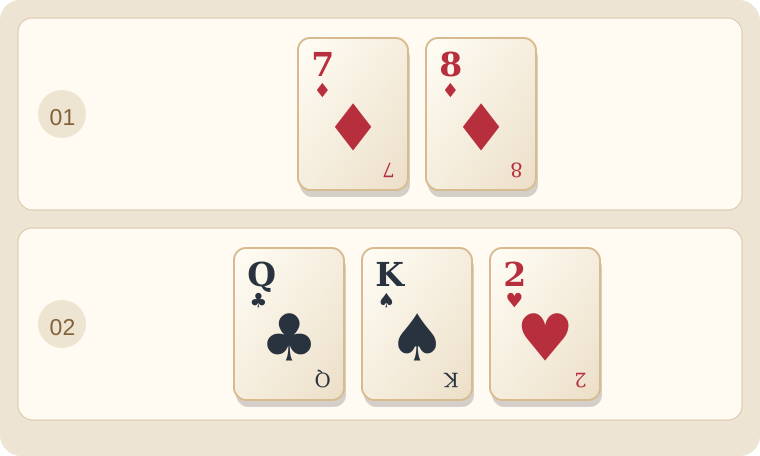
Q♣ and K♠ are both disconnected high cards. Neither completes a group in this hand; both have the same point value under the familiar ten-point face-card convention. Meanwhile, 7♦ and 8♦ still have a clear route together. This gives you a sensible shortlist without pretending the unfinished diamond pair is already valid.
Use a visible clue only as far as it goes
Suppose the player who can take your next discard recently picked up Q♥. That queen could belong in a heart sequence or in a set of queens. You do not know which, and you do not know whether their plan has since changed.
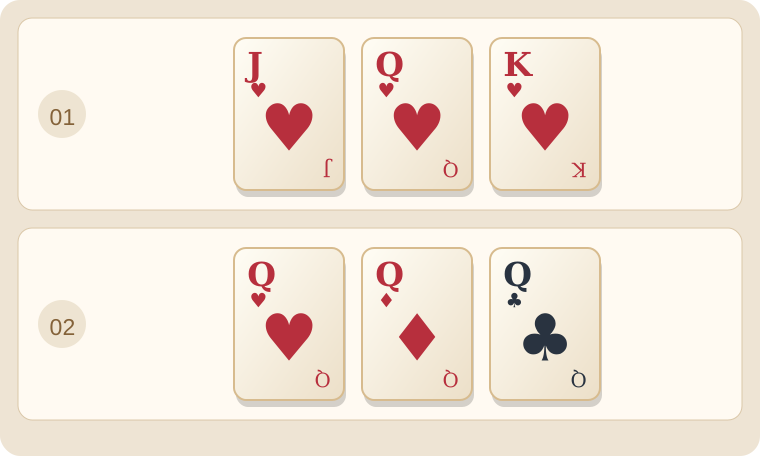
Because Q♣ could complete that possible queen set, the clue gives a reason to prefer releasing K♠ when your own alternatives are otherwise equal. It does not make K♠ a safe card or prove Q♣ would help. Another unseen sequence or set could use the king.
After discarding K♠, your hand is:
4♠ 5♠ 6♠ | 9♥ 10♥ J♥ | 3♣ 3♦ 3♠ | 7♦ 8♦ | Q♣ 2♥
That is 3 + 3 + 3 + 2 + 2 = 13. The sequences and set are intact, but the remaining four cards do not form valid groups. You have made a reasoned discard, not finished the hand.
Compare candidates with the same questions
Swipe or scroll to read the full table ↔
| Question | What to look for |
|---|---|
| Does removing it break a group? | Check the exact remaining ranks and suits, not just the group’s size. |
| What specific draw would use it? | Name a natural completion, set partner or valid joker replacement. |
| Is that plan competing for another card? | One physical card cannot complete two groups at once. |
| What points remain exposed? | Use your format’s scoring conditions; do not count only loose cards automatically. |
| What recent evidence changes the tie? | Visible pickups and discards are clues, not proof of hidden cards. |
You do not need to recite every question on every turn. Practise them slowly with physical cards first, then make a habit of noticing which comparison actually decides the choice.
Three discards that deserve a second look
A duplicate-looking card
With multiple decks, two copies of the same rank and suit may appear. They cannot simply stand together as a standard different-suit set. But a duplicate is not automatically useless: separate sequences could each use one physical copy. Check its second role before throwing it away.
A card that just arrived
A closed-stock draw can be unhelpful, and returning it may be reasonable. Still, check whether it extends a run or frees a joker before dismissing it. For open-pile pickups, follow the table’s restrictions; some rules do not allow immediately discarding the very card just taken.
A low card kept only because it is cheap
A loose 2♥ costs fewer points than Q♣ in many scoring systems, but neither finishes a group merely by staying in your hand. Keeping the low card can limit exposure while leaving a longer route to completion. Decide which trade-off fits the current hand instead of calling every low card “good.”
A two-minute review that improves the next choice
Pause a practice hand at the 14-card stage. Write two possible discards, then lay out the resulting 13-card hand for each. Name the remaining missing cards and count what you have broken. Finally, add one visible pickup as a clue and see whether it changes the choice or merely your confidence.
Do this before revealing the next draw. Judging only after seeing a lucky card rewards hindsight, not a repeatable decision. Record one sentence: “I discarded X because it preserved Y and left Z as the next useful draw.” If you cannot finish that sentence, revisit the layout.
Quick answers
Can I know that my discard will not help anyone?
Usually not from the visible information alone. You can avoid obvious connections when alternatives are comparable, but hidden hands and duplicate copies prevent certainty.
Should I block an opponent even if my own hand gets worse?
Not automatically. Explain the actual cost to your hand first. Keeping every possibly useful card for someone else can strand your own sequences and increase exposed points.
Next, work through a points-reduction example or a complete 13-card decision walkthrough. For general variant rules, see Pagat’s Indian Rummy reference; the observations and practice choices here are educational examples, not knowledge of another player’s cards.