A useful strategy for 13-card rummy starts with the hand you actually have. Group it, name the missing cards, and reassess after every draw. This walkthrough follows one 13-card hand through two useful draws, including the card-count checks that stop a good-looking arrangement becoming an invalid declaration.
There is no draw sequence you can make the deck deliver. The two draws below are deliberately chosen for a teaching exercise. Their value is that you can explain each keep, move and discard—not that the same cards will arrive in a game.
Start with an untidy hand
Assume aces are wild; none appears here. Put these 13 cards on the table in the order shown:
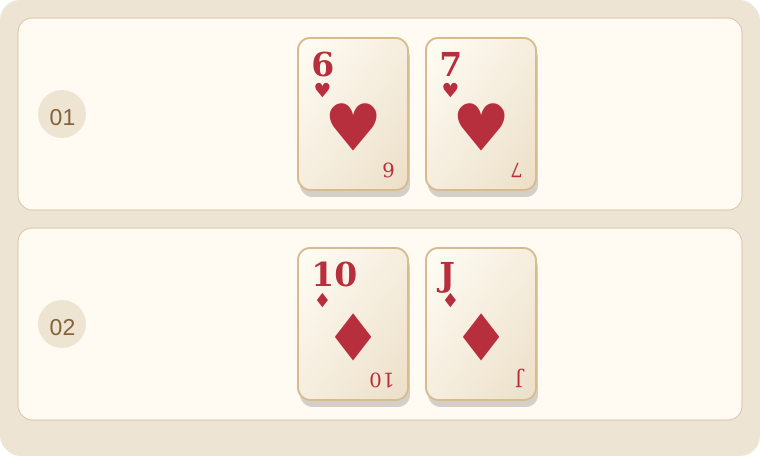
6♥ 7♥ | 10♦ J♦ | 8♠ 8♥ | 2♣ 3♣ 4♣ | 5♣ | 9♦ | Q♠ K♥
It is easy to see a heart pair, a diamond pair, a pair of eights and a three-card club run. But the separated 5♣ and 9♦ are not actually spare. Before planning the next draw, try every card you already own in its natural place.
Find progress that does not require luck
Move 9♦ beside 10♦ J♦ and extend the clubs with 5♣. The same physical cards now read:
6♥ 7♥ | 9♦ 10♦ J♦ | 8♠ 8♥ | 2♣ 3♣ 4♣ 5♣ | Q♠ K♥
Count the blocks: 2 + 3 + 2 + 4 + 2 = 13. You already have two pure sequences—the diamonds and clubs. No new card was needed. The main unfinished ideas are the heart pair and the eights; the queen and king currently have no support.
The required sequence conditions are already satisfied in this example, so the next decision is not “find any pure sequence at any cost.” It is “give every remaining card a valid home.” In a hand without a pure sequence, that priority would be different.
Name the useful cards and the competing role
5♥ can turn 6♥ 7♥ into a three-card heart sequence. 8♣ or 8♦ can join 8♠ 8♥ as a different-suit set. Those are specific possibilities to recognise if they appear, not promises about what remains in the stock.
There is also an overlap worth noticing: 8♥ could join 6♥ 7♥ right now. That would make a heart sequence but remove a member of the proposed eights set. Both arrangements are legal to consider; you cannot count the same 8♥ in both at once.
Swipe or scroll to read the full table ↔
| Arrangement | What it achieves | What it gives up |
|---|---|---|
| Keep 8♠ 8♥ together | A two-card set candidate remains. | 6♥ 7♥ still needs a natural completion. |
| Use 6♥ 7♥ 8♥ | Another pure sequence is complete. | 8♠ is left without its set partner. |
Do not glue the cards into one layout mentally. Keep the alternative visible until a draw gives you a reason to prefer one. The point is to avoid double-counting progress, not to declare one layout universally best.
First draw: 5♥ arrives
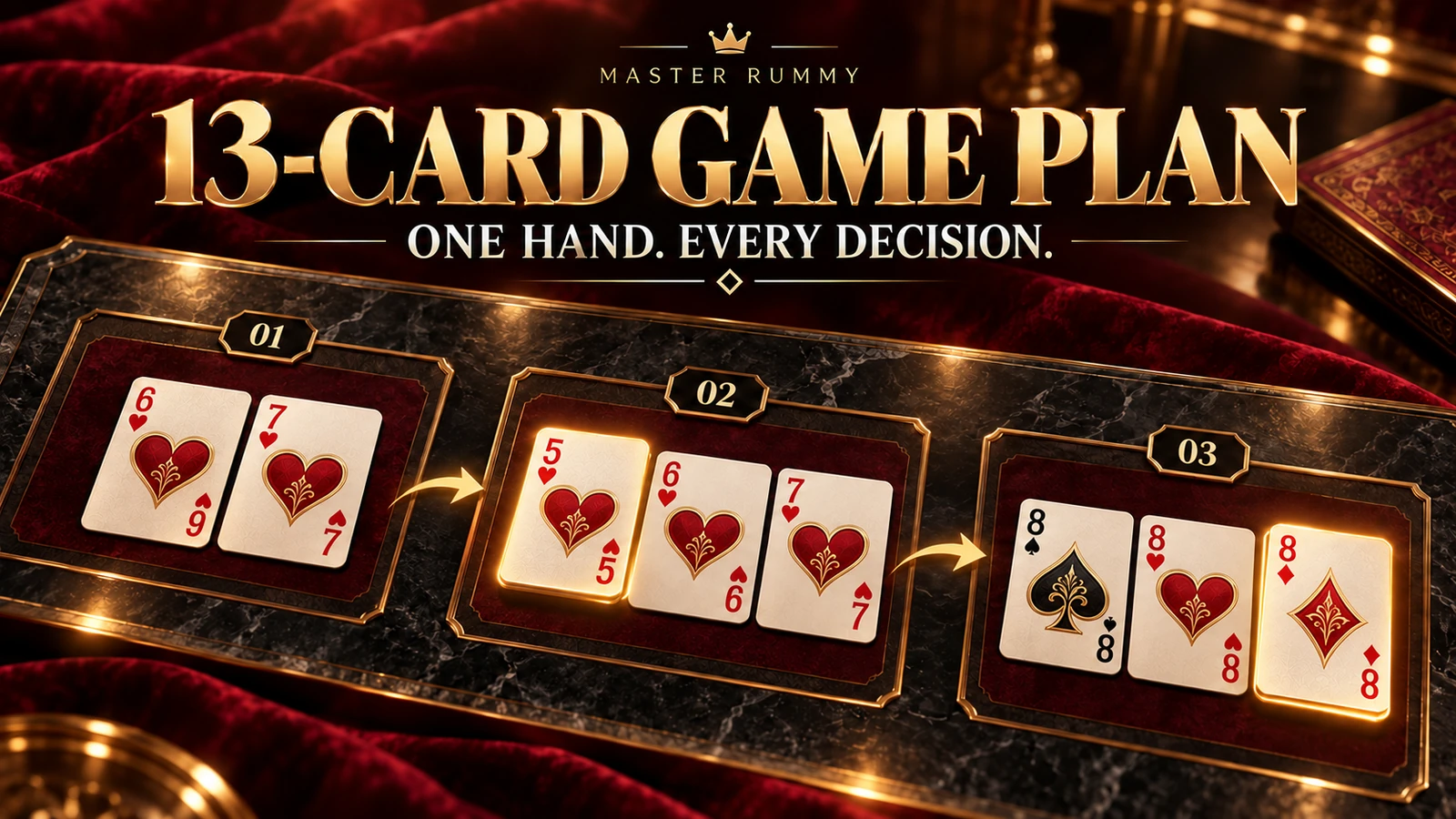
For the exercise, draw 5♥ from the closed stock. You now have 14 cards. Place it with 6♥ 7♥, so the heart run is complete without borrowing 8♥ from the eights.
Choose K♥ as the discard. Q♠ is an equally isolated ten-point alternative under the usual face-card value; without other information this example does not prove the king is a better choice. We use K♥ so the next position is easy to follow.
5♥ 6♥ 7♥ | 9♦ 10♦ J♦ | 8♠ 8♥ | 2♣ 3♣ 4♣ 5♣ | Q♠
You are back to 3 + 3 + 2 + 4 + 1 = 13. Three sequences are finished. The pair of eights and the loose queen still prevent a valid declaration. Do not confuse “most of the hand is ready” with “all of the hand is ready.”
Second draw: 8♦ arrives
Now draw 8♦ from the closed stock. The new card creates 8♠ 8♥ 8♦, a set of three different suits. There are 14 cards again; discard the loose Q♠ and lay out the final 13:
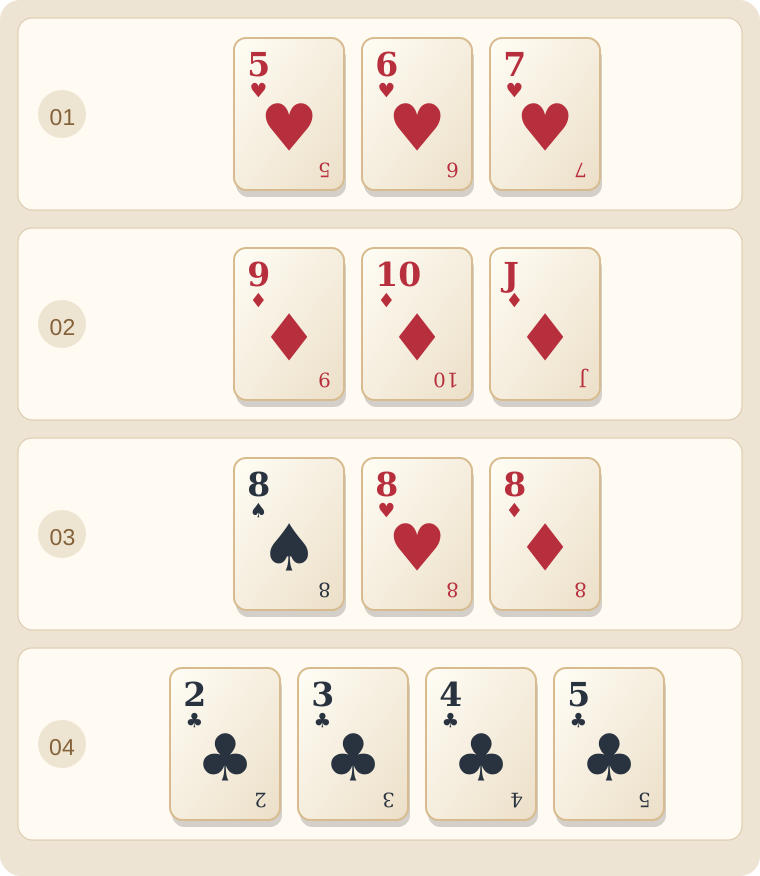
The result meets the standard group requirements used in this guide. Before submitting in an app, check the actual rules and finish controls. A highlighted button is not a substitute for checking the groups yourself.
What if the next draw is unhelpful?
Return to the position after discarding K♥. Suppose the next stock card is J♣ instead of 8♦. It does not extend 2♣ 3♣ 4♣ 5♣ or complete the eights. Simply replacing Q♠ with J♣ does not make the hand closer to a valid declaration on the connections shown.
Returning J♣ is a reasonable comparison, but review both isolated high cards using any visible information. The important habit is to evaluate the new 14-card position, not to keep every new card because it feels like progress.
Separate a repeatable decision from a lucky result
In this walkthrough, the repeatable work happened before the helpful draws: spotting 9♦, extending the club run, identifying the overlap at 8♥ and keeping a clear account of 13 versus 14 cards. Those habits remain useful even when the deck supplies neither 5♥ nor 8♦.
For a harder exercise, rebuild the finished hand but replace 5♥ with 9♥. The heart group is now 6♥ 7♥ 9♥, with a gap. Moving 8♥ into it can create 6♥ 7♥ 8♥ 9♥, but it breaks the three-eights set and leaves 8♠ 8♦ as an incomplete pair. Explain both consequences before deciding what draw you would need next.
Two common strategy questions
Must every declaration have four groups?
No. This example uses 3 + 3 + 3 + 4 because it is easy to inspect. Longer valid sequences can produce other arrangements. Check all 13 cards and the required sequence conditions rather than forcing every hand into four boxes.
Should I always keep the first grouping I find?
No. A useful draw can make a different arrangement better. Re-group deliberately, count every physical card once and check that improving one block has not silently broken another.
For the next exercise, use the invalid-declaration checklist. If the hardest part was choosing between the queen and king, read the discard decision guide. The complete rules article explains the underlying groups; Pagat’s Indian Rummy reference describes a separate rules variant.