Before declaring, check the whole hand—not just the group you finished last. Count 13 cards after the final discard, check the required sequences, give each joker a specific job and make sure every physical card appears in only one group. Then use the game's finish controls in the required order.
The easy mistake is to see your missing card arrive and stop looking. Perhaps it completes a set, but a sequence elsewhere was broken while you rearranged the hand. A short check catches that better than a quick glance at whether the cards look tidy. The examples below use the standard teaching model explained in our 13-card rummy rules; the table's exact declaration procedure and penalties still apply.
1. Count cards before counting groups
Drawing takes a 13-card hand to 14. The card you discard must not remain in your imagined finished hand. Lay out the cards you will actually submit, then count them again.
Four groups of three only account for 12 cards. That is a common near-finish, not a complete declaration. Four groups can work as 3 + 3 + 3 + 4 = 13, although this is not the only possible arrangement. A longer valid sequence is allowed in the model used here; four groups are not a universal requirement.
If a card sits between two groups, choose its home now. You cannot count the same 8♥ in a heart sequence and a set of eights at once, even if both combinations look convincing on their own.
2. Check ranks and suits, not just colours
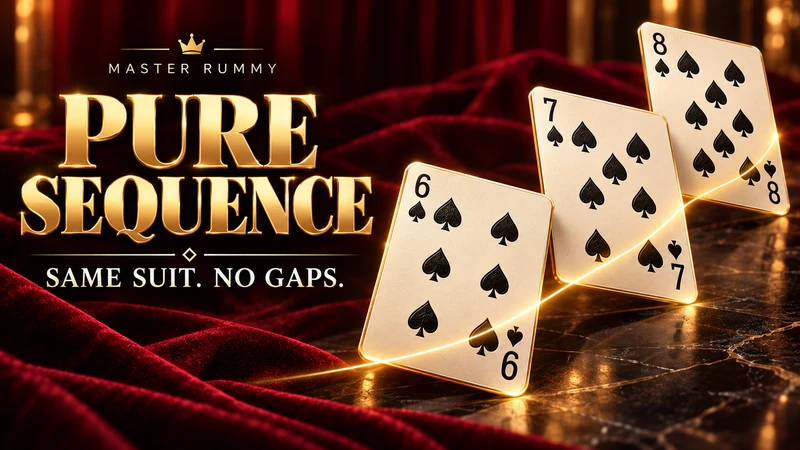
Read a sequence aloud: rank, suit, next rank, same suit. Red does not mean one suit—hearts and diamonds are different. Then check each set for duplicate suits.
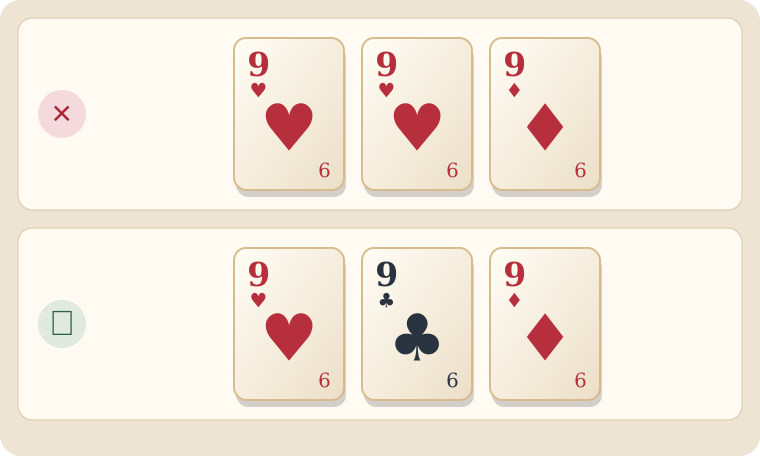
In a multi-deck game, duplicate cards can legitimately be in your hand. That does not mean they fit together in every group. Here, 9♥ 9♥ 9♦ fails the different-suit check. Replacing one heart with 9♣ makes 9♥ 9♣ 9♦ a valid set under the rules used in this guide.
3. Give every joker an exact meaning
Do not say only, “The joker fixes it.” Say which card it replaces. In 6♠ 7♠ PJ, the printed joker can stand for 8♠. That group is an impure sequence, so it cannot be your only claim to a pure sequence.
A selected-rank wild card needs a different check. When used as its own natural rank and suit in the right position, it can remain part of a pure sequence in this teaching model. A printed joker has no such natural position. See the joker guide if those two situations are easy to mix up.
4. Audit a complete 13-card hand
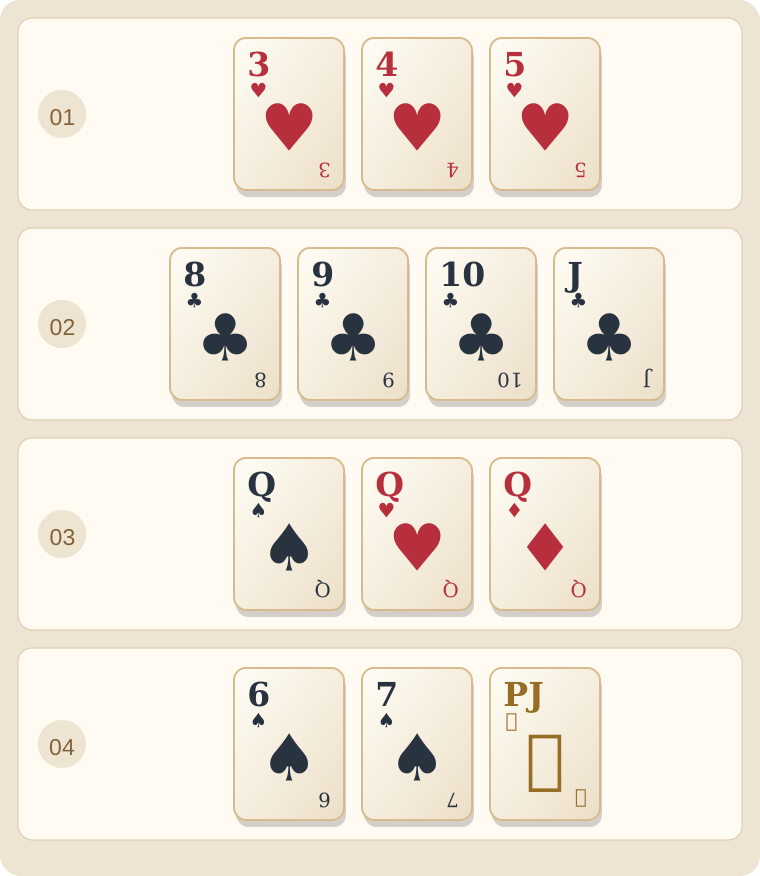
Take the following cards after the final discard. Assume aces are the selected wild rank, so none of the numbered or face cards shown is being used as a substitute.
Swipe or scroll to read the full table ↔
| Group | What to verify |
|---|---|
| 3♥ 4♥ 5♥ | Three consecutive hearts: a pure sequence. |
| 8♣ 9♣ 10♣ J♣ | Four consecutive clubs: another pure sequence. |
| Q♠ Q♥ Q♦ | Same rank, three different suits: a set. |
| 6♠ 7♠ PJ | PJ replaces 8♠: an impure sequence. |
The count is 13, there are enough sequences including a pure one, and no card is left over. Notice that 7♠ is not borrowed by another group. The explanation should still work if you cover the picture and read only the card list.
5. Use the same final check every time
- Count: the submitted groups contain exactly 13 cards.
- Sequences: at least two are valid, with at least one pure in this rules model.
- Remainder: all other cards belong to valid sequences or sets.
- Jokers: each substitute has one named role.
- Duplicates: no physical card is used twice; sets pass the suit check.
- Controls: confirm the final discard and grouping steps before submitting.
An enabled button is not proof that the hand has passed all these tests. Some interfaces let you submit an incorrect declaration and apply a penalty afterwards. Do not deliberately make a bad declaration to find out the penalty; read the table information instead.
Try two small repairs
Exercise A: in the complete hand above, replace 10♣ with K♦. Can you still use the displayed groups? Answer: no. The clubs now have a gap and K♦ is unassigned. A good group elsewhere does not repair that automatically.
Exercise B: restore 10♣, then replace Q♦ with a second Q♥. Answer: the shown queen set now repeats a suit. The original arrangement is invalid. Do not assume another grouping exists without rebuilding and checking the entire hand.
Questions that often cause hesitation
Do all sequences have to be pure?
No. The model here requires at least one pure sequence and at least two sequences overall. The worked hand contains both pure and impure sequences.
Does a low point total make a declaration valid?
No. Scoring and declaring are different checks. Even one low-value card outside the valid groups can prevent a complete declaration.
Keep practising the final check
Use the card-arrangement guide to make missing cards easier to spot, then try the short practice drills. For another description of the underlying game, consult Pagat's Indian Rummy rules; individual variants differ.