Practise one skill at a time and check the answer before repeating it. A deck of cards or handwritten card labels is enough. Spend ten minutes recognising groups, accounting for all 13 cards and explaining a discard. Record the mistake you found, not just how quickly you finished.
Playing more hands is not the same as practising a particular skill. If you keep missing an invalid set, another fast session may repeat the problem without making it clearer. These rummy card game practice tips give you small tasks with visible answers. No purchase or special app practice mode is needed for the paper exercises.
Use the rules guide beside you at first. In the exercises below, ordinary cards keep their natural ranks and suits; only a printed joker marked PJ acts as a substitute. This keeps the exercise focused. In a real game, also account for its selected wild rank and table rules.
Set up a ten-minute practice session
Swipe or scroll to read the full table ↔
| Time | Task | What to record |
|---|---|---|
| 0–1 minute | Sort a small pile by suit, then rank. | Any suit or rank you misread. |
| 1–3 minutes | Classify the three groups below. | Pure, impure or invalid, with a reason. |
| 3–5 minutes | Check the complete 13-card hand. | The count and each group's role. |
| 5–7 minutes | Explain a discard comparison. | What each choice breaks or preserves. |
| 7–9 minutes | Find and repair one changed card. | The exact error, not just “wrong hand.” |
| 9–10 minutes | Review the first mistake. | One check to repeat next time. |
The timer is a way to keep the session small, not a score you must beat. If you need longer to read a suit or understand a joker, take it. Start timing your checking routine only after the reasoning is reliable.
Drill 1: name the group, then explain why
Look at each row before reading the answers. Say whether it is pure, impure or invalid. “They are all red” or “there is a joker” is not a full explanation.
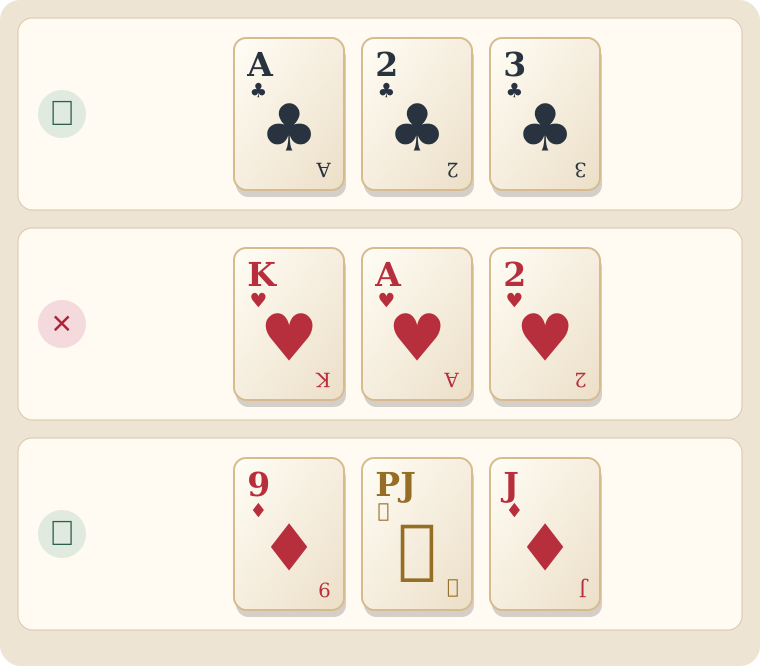
- A♣ 2♣ 3♣: pure. The ace is low, the ranks are consecutive and the suit stays clubs.
- K♥ A♥ 2♥: invalid as a natural sequence. The rank order does not wrap through the ace from king to two.
- 9♦ PJ J♦: impure. PJ replaces 10♦ between nine and jack.
Now cover the answers and build one new example of each type. Keep the change small: use a different suit for the valid low-ace run, for instance. This tests whether you understand the pattern rather than merely remember the picture.
Drill 2: give every card one home
Build the following hand with real cards or labels. Count first, then identify the groups.
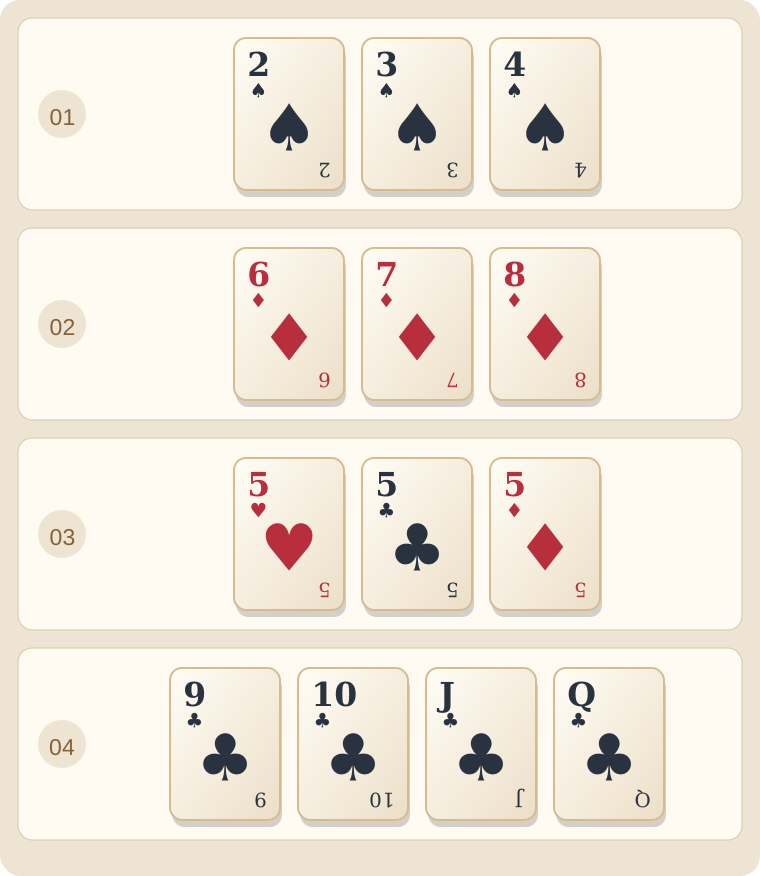
Answer: 2♠ 3♠ 4♠ and 6♦ 7♦ 8♦ are pure sequences. The 5♥ 5♣ 5♦ group is a different-suit set. The clubs form the four-card pure sequence 9♣ 10♣ J♣ Q♣. The total is 3 + 3 + 3 + 4 = 13.
Mix the same cards and rebuild the hand. If you use one card in two imagined groups, place the physical card in just one of them and look at what remains. The gap is easier to notice on the table than in your head.
Drill 3: explain what a discard would change
For a separate small exercise, hold 4♥ 5♥ 6♥ as a completed group and Q♠ as a loose card. Assume Q♠ has no connection to any other card in the practice hand. Compare discarding 6♥ with discarding Q♠.
Answer: 6♥ breaks the displayed sequence; Q♠ does not. This is a local comparison with stated assumptions, not a universal instruction to discard queens. If the full hand gave Q♠ a useful role, you would have to compare those arrangements too. Use the discard guide for fuller decisions.
Drill 4: change one card and find the damage
Return to the illustrated 13-card hand. Replace 10♣ with K♥. Do not add a card: the total must stay 13.
Answer: the displayed club sequence now has a gap between 9♣ and J♣, and K♥ has no assigned group. The other completed groups do not make that arrangement ready to declare. Restore 10♣ to repair it, then describe the problem without looking at this paragraph.
Next replace 5♦ with another 5♥. The count remains 13, but the displayed set repeats a suit. Again, you have changed the validity without changing the number of cards. These two exercises test different checks: sequence continuity and set suits.
Measure accuracy before speed
Keep three numbers in a notebook: groups classified correctly, complete hands checked without missing a card, and discard choices you could explain. These are practice results, not predictions of winning.
If you misread a suit twice, make the next session a suit-and-rank drill. If the count is correct but one group is invalid, spend time on group checks. Rotate skills after you can explain the answers, rather than adding harder tasks because the timer ran out.
Practice questions
Do I need to play against another person?
No. Sorting, classifying and checking a hand can be practised alone. Reading another player's choices is a different skill and cannot be fully rehearsed with a fixed answer sheet.
Should I memorise these exact hands?
Use them to learn the checking method, then change suits or a single card and explain what changes. Memorising one picture is less useful than spotting why a new arrangement works or fails.
Choose your next drill
If the first exercise was difficult, try making a pure sequence. If the complete hand caused trouble, use the final declaration checklist. For a separate rules account, see Pagat's Indian Rummy reference; the examples here are original practice exercises, not a description of every app's features.