

For an experienced player, a useful next step is better review. Check what a rearrangement costs elsewhere in the hand, label an opponent read as a possibility rather than a fact, and write down one alternative before looking at the result. That makes repeated decision errors easier to identify.
You already recognise a sequence and remember which cards were picked up. The harder part is not letting a familiar pattern make the decision for you. A card can be useful and still be expensive to move. A sensible discard can be picked up. A poor choice can survive because the next draw happens to be kind.
These rummy tips for experienced players focus on decisions you can explain and review. They do not offer a winning formula. If the fundamentals need a refresh, start with the rules guide; for a broader overview, use the seven practical strategy lessons.
1. Price the rearrangement, not just the new group
Suppose your 13 cards are arranged as follows. Aces are wild in this exercise, and none is held:
6♥ 7♥ 8♥ 9♥ | 8♣ 8♦ | 4♠ 5♠ 6♠ | J♣ Q♣ K♣ | 2♦
The count is 4 + 2 + 3 + 3 + 1 = 13. The eights look close to a set. It is tempting to mentally borrow 8♥ from the heart sequence and regard both groups as finished. But that is the same physical card.
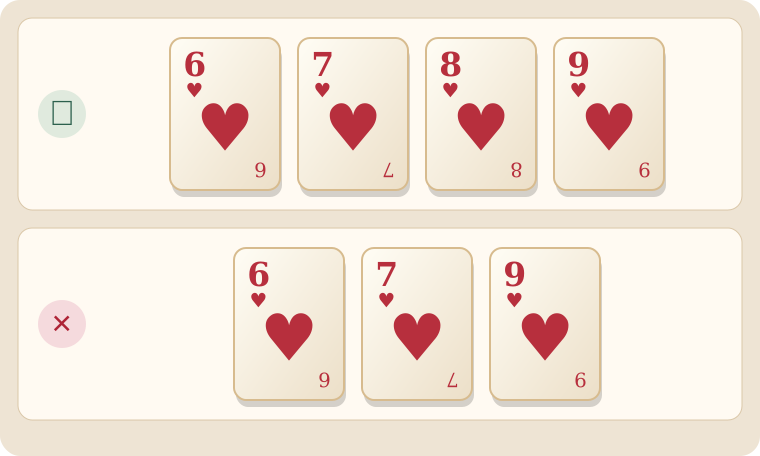
If you move 8♥ into the set, 6♥ 7♥ 9♥ are no longer a completed sequence. That may still be a rearrangement worth considering under some future draw, but it is not the completed hand you first pictured. Compare the whole arrangement before and after moving the card.
Now change one piece of information
You draw 8♠ from the closed stock. There are now 14 cards. It completes 8♣ 8♦ 8♠ without disturbing the heart sequence. Discarding the unconnected 2♦ leaves:
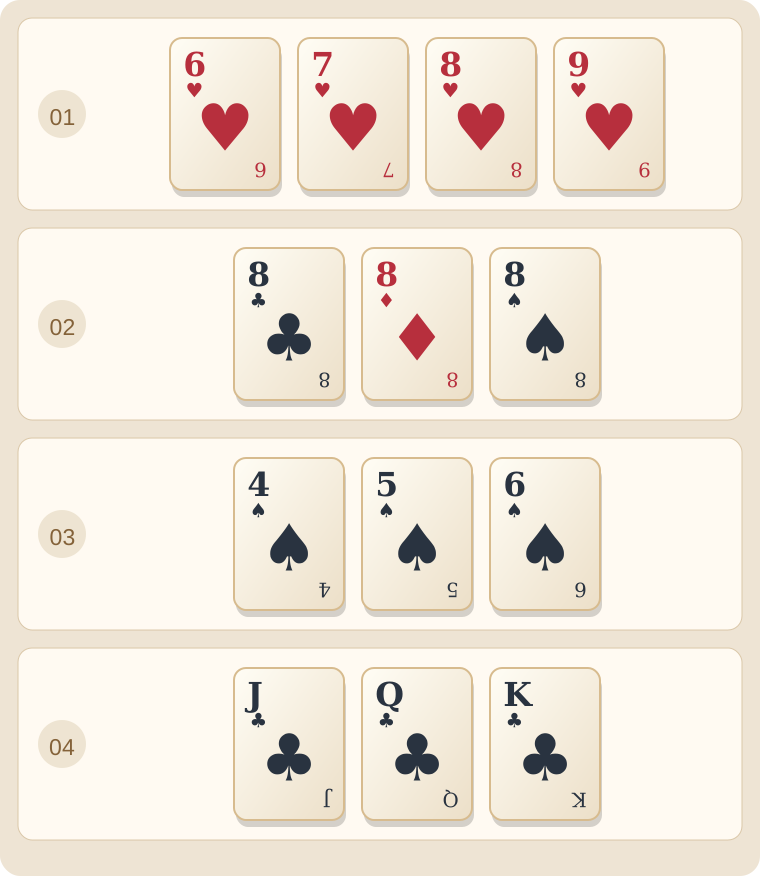
This is a complete grouping in the teaching rules used here. The lesson is not “always keep an eight.” It is that the new card changes the cost of your plan. Reassess the hand when information changes rather than defending the first arrangement you saw.
2. Split a read into fact, possibility and action
An opponent takes 10♦. Write the read in three parts:
- Fact: that player took 10♦ from the open pile.
- Possibilities: it could help a diamond sequence, a set of tens or a longer group.
- Action: when two discard candidates serve you equally poorly, compare their connection to that pickup.
“They must have J♦” skips the middle step. You have not seen their hand. A later discard may make your first explanation less plausible, so update it. Do not keep every diamond indefinitely and leave your own hand worse simply to maintain a theory.
Also remember who can actually take your next discard. Information about a player elsewhere in the turn order is not automatically a reason to avoid that card now. Follow the table's pickup restrictions.
3. Keep a review log small enough to use
Review one meaningful decision, not every motion. On paper, record the hand or the relevant groups before the discard. Keep the result in a separate column so it does not quietly rewrite your original reasoning.
Swipe or scroll to read the full table ↔
| Write down | Useful detail |
|---|---|
| Decision | The card you kept and the card you discarded. |
| Alternative | One realistic other discard, not a perfect choice invented afterwards. |
| Hand effect | Which group stays complete, breaks or gains a route. |
| Visible evidence | A specific pickup or exposed card, separate from a guess. |
| Result and lesson | What happened later, then whether the original reasoning still holds. |
If you discarded 9♦ and the next player took it, do not stop at “bad discard.” Ask whether you had an equally unhelpful alternative and whether their earlier pickups supplied a useful clue. Conversely, nobody taking it does not prove the decision was sound.
4. Do not turn rough counts into precise odds
List the card types that improve a particular arrangement, then separate them from physical copies. Seeing one copy does not tell you where every other copy is. Unseen cards may be in another hand, not in the stock.
If you cannot state the stock composition and the assumptions, avoid attaching an exact percentage to the draw. “This pattern has two natural completion ranks” is a narrower claim than “I have twice the chance of winning.” The latter also depends on other players, future turns and the rest of your hand.
5. Practise the mistake you actually repeat
Choose one target from your last few notes: double-counted cards, guesses treated as facts, or a made sequence broken during rearrangement. Build three paper hands around that problem. Explain the decision before revealing the next practice card.
Keep your first attempt. If you change the answer, write what new information caused the change. That is more informative than rewriting the note so every choice looks obvious. Stop the drill when attention drops; rushed repetitions can rehearse the same mistake.
Two questions about advanced play
Should an experienced player always play faster?
No. Speed is useful only if the required checks still happen. Make familiar sorting steps efficient, but keep a deliberate final declaration check.
Can a correct decision still lead to a poor result?
Yes. You make decisions with incomplete information. Review whether the choice used the available evidence and protected useful groups, not whether a favourable card happened to arrive later.
A practical next session
Use the discard comparison guide to create two alternatives, then finish with the declaration checklist. The worked hands use common Indian rummy conventions; Pagat's rules reference describes a related variant. Check your table's rules where they differ.