Before you declare, count the cards, identify the selected wild-joker rank and check every group—not just the green ticks. These Master Rummy table examples show why a hand with three accepted groups can still be incomplete, and how rearranging the same cards changes their jobs.
This guide uses table images supplied by the Master Rummy team. They include presentation labels and are examples for reading a hand, not a recording of a tested start-to-finish app session. Controls and their positions can vary by version. For downloading the app, use our separate Android installation guide; here, we concentrate on the cards in front of you.
Start with the hand, not the action label
Look along the bottom of each table image for the grouped cards. Then find the joker indicator: the supplied examples show Q♣, making queens the selected wild rank for these examples. A printed joker is a separate card; we write it as PJ below.
A queen can act as a substitute, or occupy its natural position in a same-suit sequence. Its job depends on the group. A displayed score, tick or “FINISH” label should not replace checking that job. Keep the complete 13-card rules guide handy if sequences and sets are new to you.
Example 1: three ticks, but an incomplete 13-card hand
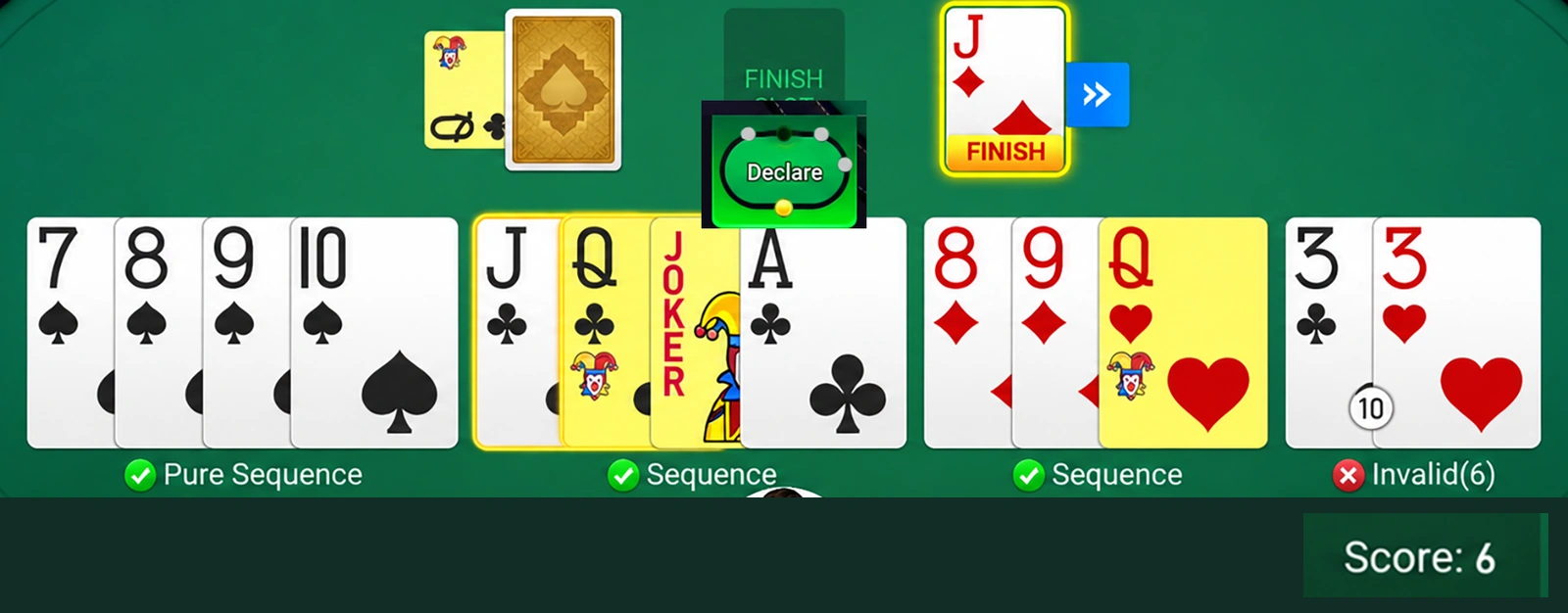
Read the four sections as:
7♠ 8♠ 9♠ 10♠ | J♣ Q♣ PJ A♣ | 8♦ 9♦ Q♥ | 3♣ 3♥
The count is 4 + 4 + 3 + 2 = 13. Now inspect what each group means:
- 7♠ 8♠ 9♠ 10♠: consecutive spades, forming a pure sequence.
- J♣ Q♣ PJ A♣: Q♣ occupies its natural queen position; PJ fills K♣, giving J–Q–K–A. The printed joker makes this an impure sequence.
- 8♦ 9♦ Q♥: the wild Q♥ can stand for 10♦, forming an impure sequence.
- 3♣ 3♥: only two cards. Different suits alone do not make a valid set; the group is too short.
The two exposed threes are consistent with the shown 6-point label. More importantly, all 13 cards are not yet covered by valid groups. The correct reading is “unfinished,” even though the other groups carry green ticks.
Example 2: a 14-card arrangement with one card left over
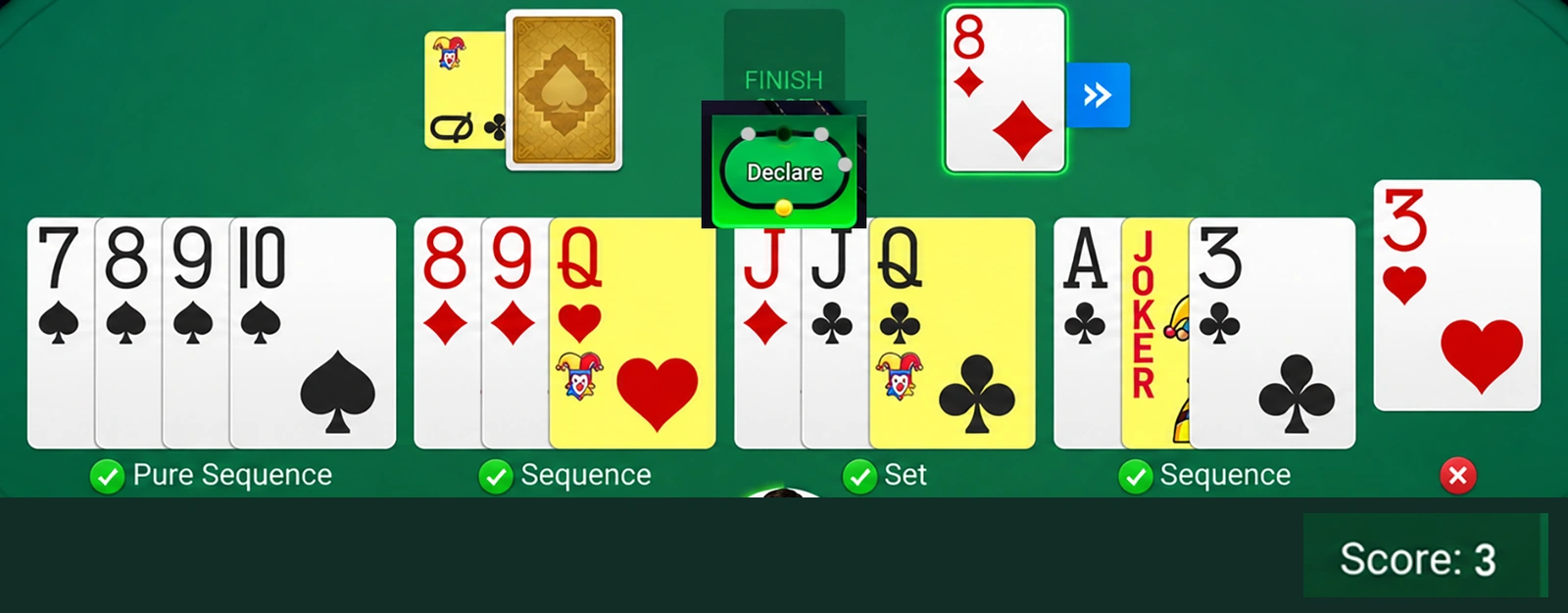
This example contains:
7♠ 8♠ 9♠ 10♠ | 8♦ 9♦ Q♥ | J♦ J♣ Q♣ | A♣ PJ 3♣ | 3♥
Count 4 + 3 + 3 + 3 + 1 = 14. Compared with the earlier example, J♦ is present and the clubs have been rearranged. One possible explanation is that adding J♦ allows these changes:
- Keep the four spades and 8♦ 9♦ Q♥ together.
- Use J♦ J♣ Q♣ as a set: the wild Q♣ supplies a third jack, for example J♥.
- Use A♣ PJ 3♣ as a sequence, with PJ supplying 2♣.
- Leave 3♥ as the spare card.
No physical card is used twice. Q♣ changes from a natural queen in the earlier club run to a substitute in the jack set. PJ changes from filling K♣ to filling 2♣. For more on those changing roles, see how to use jokers.
This is a possible regrouping of the illustrated cards, not proof of which tap or gesture produced the screenshot. A J♦ marked “FINISH” is not, by itself, evidence that simply choosing it completes the game.
Example 3: check the final 13-card arrangement
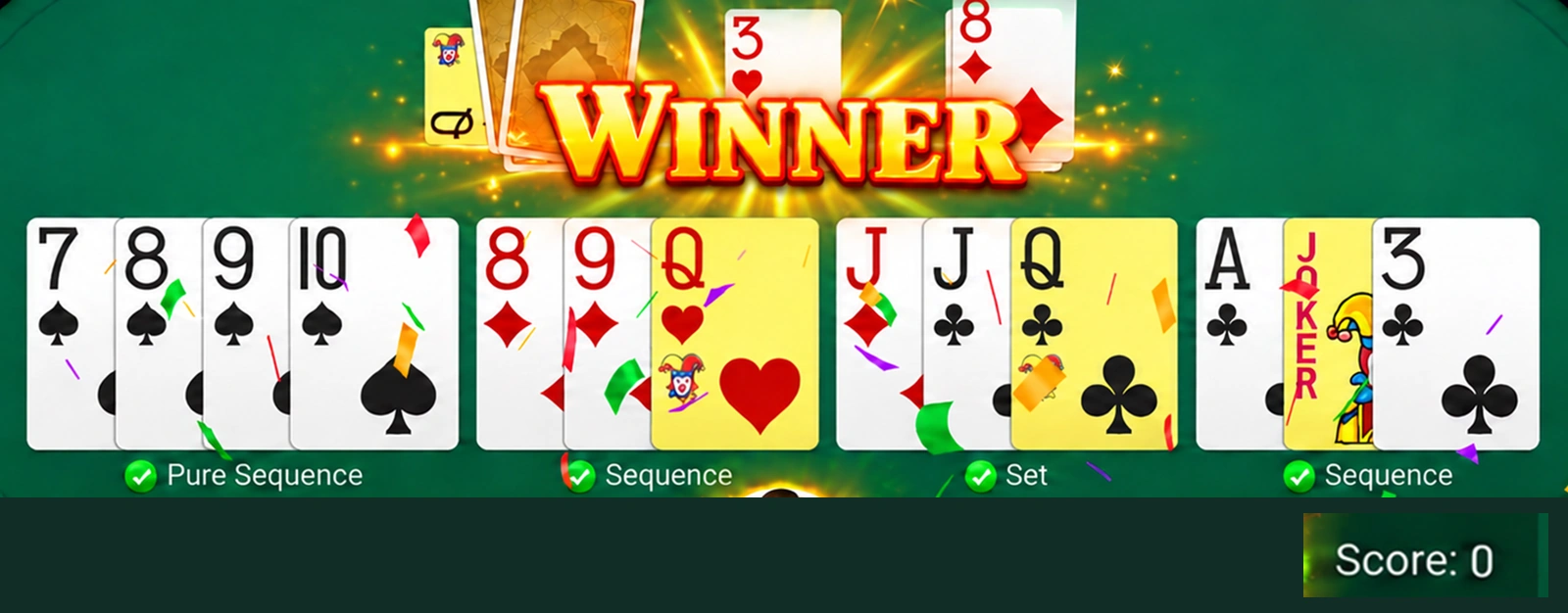
Without the spare 3♥, the count is 4 + 3 + 3 + 3 = 13. The hand has a pure spade sequence, the joker-assisted diamond sequence, a valid jack set and the A–2–3 club sequence using PJ.
That arrangement meets the combination requirement illustrated here: every card has one place, there are at least two sequences, and one is pure. The zero shown agrees with this example, but a number alone is not a substitute for checking the cards or the app's confirmation process. The supplied picture also carries a “Winner” banner: that is the result shown in this example, not a promise for another hand.
A final check you can repeat on any hand
- Count: distinguish a 13-card end arrangement from a 14-card hand awaiting a discard.
- Identify jokers: read the selected rank rather than assuming the previous hand's rank still applies.
- Check the pure sequence: consecutive ranks, same suit, no substitute filling a gap.
- Check the remaining cards: no two-card “set,” shared card, missing rank or forgotten spare.
- Read the current control: follow the app's actual declaration instructions; an added presentation label is not a guaranteed button location.
What these pictures do not establish
The numeric Drop labels and coin-like symbols visible in the supplied material do not establish universal penalties or a cash balance. This guide does not derive a money rule from them. Master Rummy supports recharge and paid purchases; it does not offer cash withdrawals or cash rewards.
If your table differs or a seemingly valid hand is rejected, contact Master Rummy support with the app version, the selected joker and a screenshot with personal details hidden. Describe the actual groups, not just “it showed zero.”
Quick answers
Why is the queen still natural in J♣ Q♣ PJ A♣?
It is in its own suit and rank position. PJ, not Q♣, supplies the missing king. The group remains impure because of that printed-joker substitution.
Can three green ticks be enough?
Only if all required groups cover all 13 cards correctly. In the first example, the two threes remain unfinished, so those three ticks are not enough.