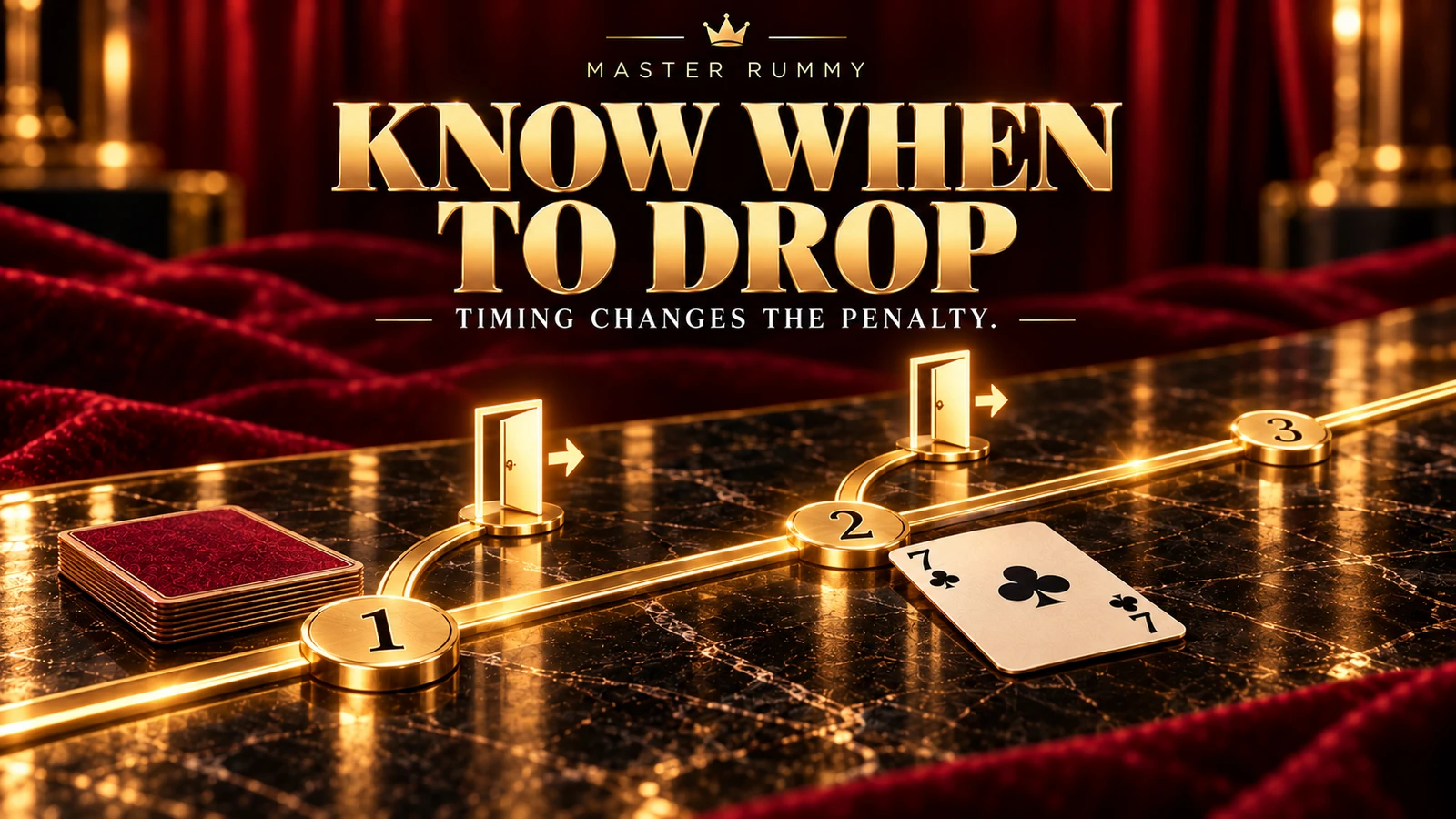
A drop means withdrawing from the current deal when its rules allow it, usually before drawing on your turn. A first drop is an early withdrawal; a middle drop is a later one, often with a different penalty. The timing, availability and points are table-specific. Discarding a card, declaring a hand and disconnecting are not interchangeable ways to drop.
A button labelled “Drop” can look simple until you have already taken a card. Can you still use it? Is the penalty the same? Does closing the app count? These are questions to settle before the first turn, not while a timer is running.
This guide explains common conventions and how to read them. It does not confirm a Drop button, any particular format or a penalty schedule in Master Rummy. The current in-app table rules take priority over an educational example.
Drop, discard and declare: three different actions
Swipe or scroll to read the full table ↔
| Action | What changes? | What to check |
|---|---|---|
| Discard | You remove one card after drawing and normally continue with 13. | Which card can be returned to the open pile? |
| Drop | You withdraw from this deal if permitted. | Is it available now, and what penalty applies? |
| Declare | You submit a claimed complete hand for validation. | Are all 13 cards correctly grouped with the required sequences? |
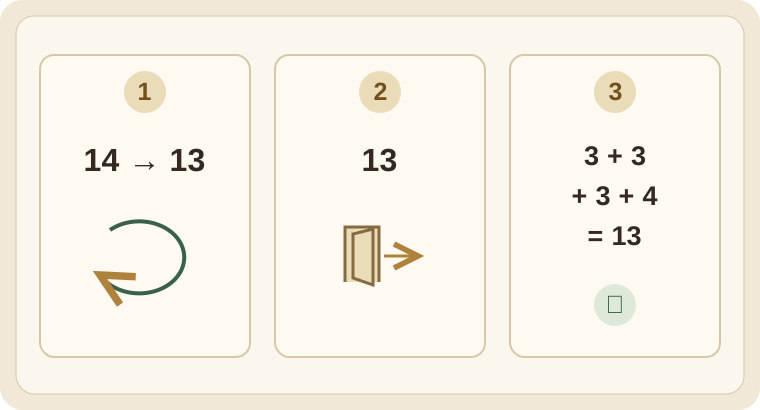
If declaration requirements are unfamiliar, read the 13-card rules guide. If you are simply deciding which of your 14 cards to remove, you need the discard guide, not the drop rules.
What makes a first drop “first”?
A common rule ties the first-drop window to your own first turn before you pick a card. It does not mean any moment in the first few minutes, and it does not necessarily remain available until the table completes a whole circuit.
RummyCircle's published Points rules are one example: they distinguish the first turn from later turns and require dropping before drawing on that turn. This describes that operator's convention; check the exact boundary on the table you use.
Three timing situations
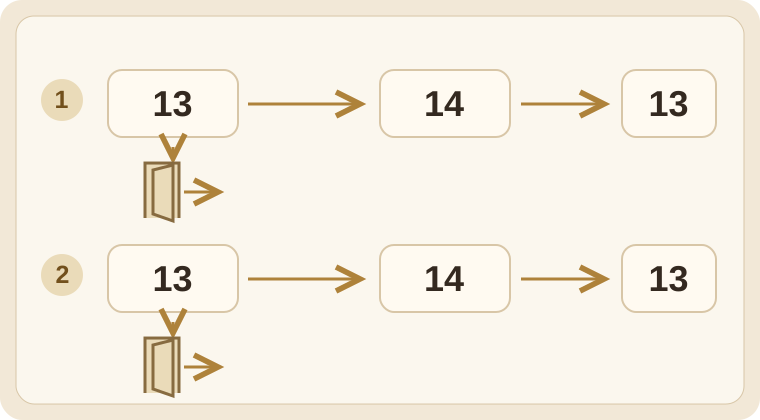
- Your first turn, no card drawn: check whether the first-drop option is allowed and read the displayed penalty.
- You drew and discarded on a previous turn: do not assume first-drop eligibility returns just because your hand is back to 13 cards.
- A later turn, before drawing: check the later-drop rule. If you have already drawn this turn, do not assume you can cancel the draw by dropping.
Why 20, 40 and 80 are not one universal rule
Use this small comparison as a warning against memorising one number for every table. The operator's published Pool rules give these examples:
Swipe or scroll to read the full table ↔
| Published format | First drop | Middle drop |
|---|---|---|
| 101 Pool | 20 | 40 |
| 201 Pool | 25 | 50 |
The “80” you may see elsewhere can refer to a maximum assessed hand score or an invalid-declaration penalty. It is not automatically a third drop category called “last drop.” Read each label with its event: an ordinary hand assessment, an early withdrawal, a later withdrawal and an invalid declaration are different situations.
Some formats or player-count configurations do not offer voluntary drops at all. For example, the same operator's published Deals rules distinguish two-player drop availability from larger tables. Never transfer a Pool button or penalty to a Deals game by assumption.
A small ledger shows why timing matters
Imagine a practice 101-Pool session using the 20/40 schedule above, with an existing total of 68. At an eligible first-drop checkpoint, 20 would bring that total to 88. At an eligible middle-drop checkpoint, 40 would bring it to 108, crossing the elimination threshold in this example.
These are different checkpoints, not two prices you can choose between on a later turn. Once the first-drop window has gone, wishing you had used it does not make it available again. Neither calculation tells you what the eventual score would be if you played on; that outcome remains uncertain.
Also distinguish this deal's penalty from your session total. A displayed 40 may be added to an existing ledger rather than replace it. Our Points, Pool and Deals comparison explains that difference with complete worked totals.
Timeout and disconnection need their own check
Closing a tab is not a reliable way to request a voluntary drop. The service might continue the timer, use an automatic action, wait for reconnection or apply a separate missed-turn rule. Those behaviours are product-specific. A button named “Auto Drop” may also affect future deals rather than only the hand you are looking at.
Before a session, find the rules for missed turns, temporary disconnection, returning to the table and any queued automatic action. If something unexpected happens, save the round identifier, the displayed result and the time, then ask support what was recorded. Do not infer the server's action from the fact that the screen closed.
A short check before you confirm
- Am I leaving a deal, discarding one card, or submitting a declaration?
- Have I already drawn on this turn, and have I played an earlier turn?
- Is voluntary dropping available in this format?
- What penalty is shown, and does it add to a running total?
- Does the control apply once or stay active for later deals?
This is not a formula for winning or a reason to keep playing a session you want to leave. It is a way to understand the action and its stated consequences before confirming it.
Quick answers
Can I take a card and then use the cheaper first drop?
Do not assume so. Under the before-draw convention illustrated here, taking the card passes that checkpoint. Check the active table's rule rather than trying to undo the action by closing the screen.
Will one bad hand always make dropping the best option?
No universal threshold can answer that. Eligibility, penalty, current session total and the actual hand all matter. A guide cannot know the hidden future cards or decide your table's rules for you.