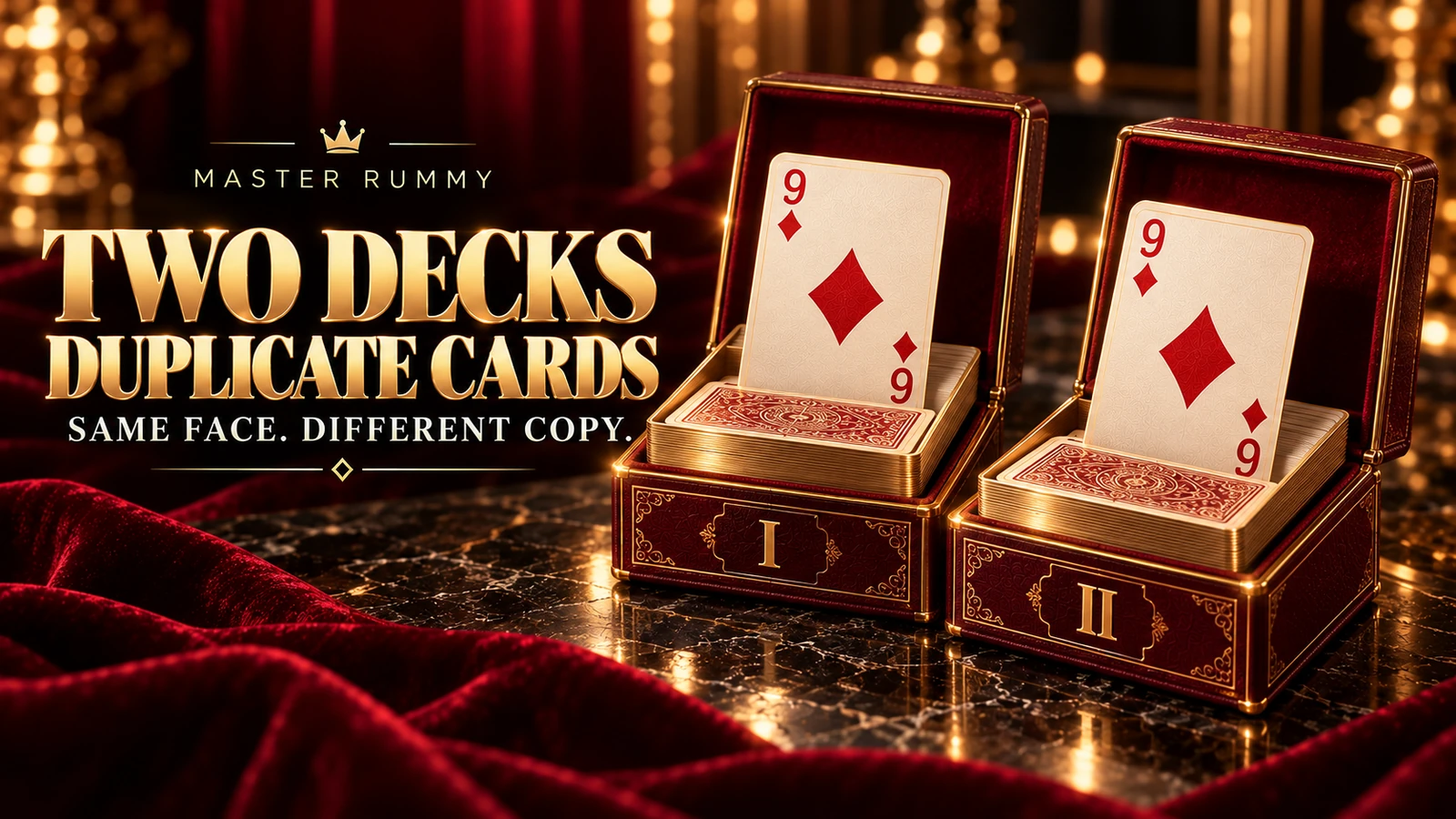
Two identical-looking cards can be two separate physical cards. In a two-deck game, you may hold two copies of 9♦. Each copy can have its own job in a different group. What you cannot do is treat them as two different suits inside the same set, or count one physical copy twice.
The green-table diagrams are teaching illustrations, not screenshots of a live game.
The confusing part is that “the same card” can mean two things: the same rank-and-suit combination, or the very same piece of card in your hand. This guide separates them. We are discussing a two-deck teaching example, not confirming the deck count of a particular Master Rummy table. Check the game's displayed rules for its actual deck and joker setup.
Give identical copies a temporary name
Call one diamond nine 9♦① and the other 9♦②. The small numbers are labels for this lesson, not new ranks or special cards. Both are still ordinary diamond nines. If you use paper cards for practice, write the copy number on a removable note rather than changing the card's rank.
Now count the pieces in front of you. 9♦① and 9♦② mean two cards. Writing 9♦① in two different combinations does not create a second card. This sounds obvious on a table, but it is an easy mistake when you are planning several groups in your head.
A duplicate suit does not make a standard set
Compare the two rows below. For this exercise queens are wild, so the ordinary nines are not substitutes. Each row is a separate proposed group, not two groups you can combine and declare together.
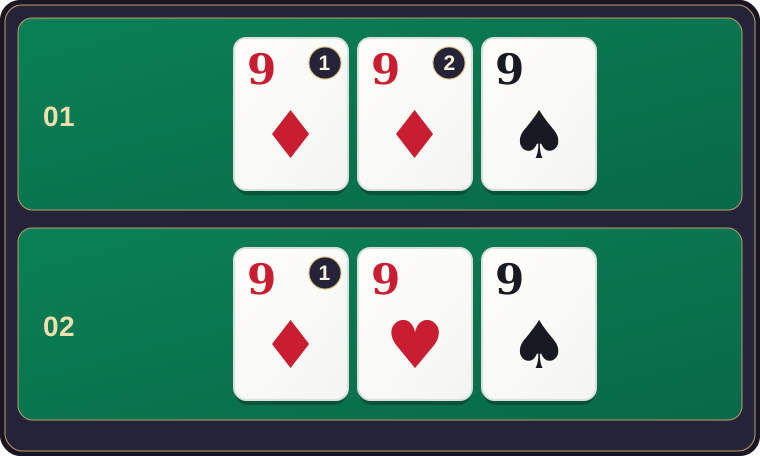
The first row contains three physical cards, but only two suits. That is why it fails the standard set check used here. The second row passes. Notice that 9♦② is not in the second row; it has not disappeared or been silently counted. It must find a valid place elsewhere if it belongs to the full hand.
A printed joker does not erase a duplicate natural suit already present in a set. Before adding a joker to a questionable group, identify the exact rank and suit it would represent and check the other cards. Our joker guide covers that separate question.
Two copies can do different jobs
Here is a complete 13-card arrangement. Queens remain the designated wild rank and no queen is held. Every shown card is used naturally.
7♦ 8♦ 9♦① | 9♦② 9♥ 9♠ | A♣ 2♣ 3♣ 4♣ | 5♥ 6♥ 7♥
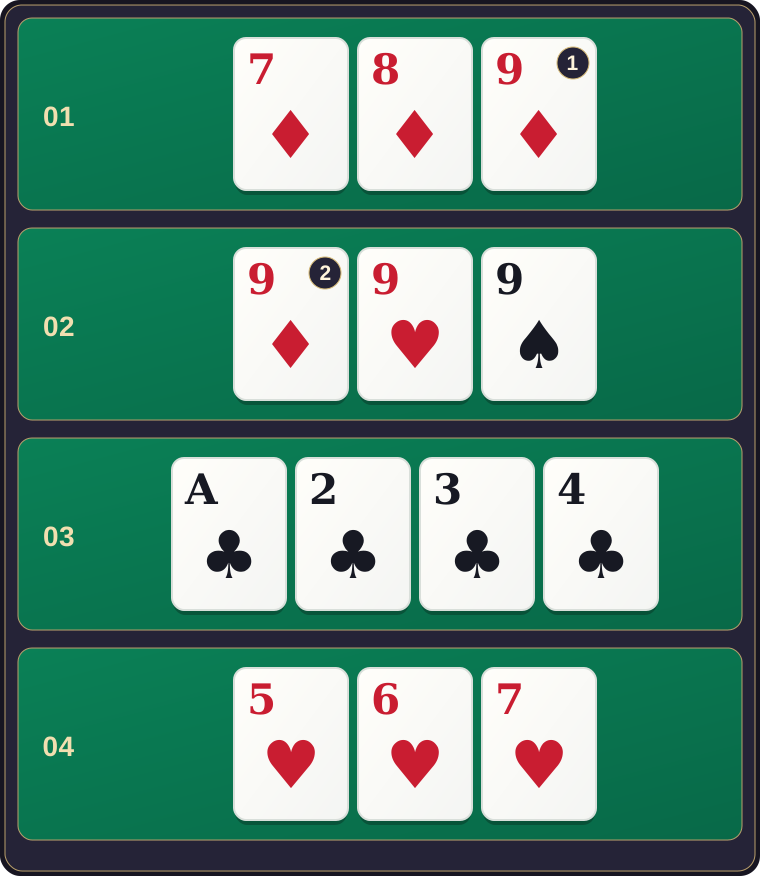
Copy ① completes the diamond sequence. Copy ② joins the heart and spade nines in a set. The clubs and hearts provide two more pure sequences. There is no overlap: each of the 13 physical cards has one place.
Remove 9♦② from the table. You now have 12 cards, not the same completed hand with a tidier layout. You cannot borrow 9♦① for the set while leaving it in the diamond sequence. If you move it, inspect the unfinished 7♦ 8♦ that remain. That is the difference between moving a card and imagining an extra copy.
Seeing a copy is not seeing every copy
Suppose you see one 9♦ in the discard pile. In a two-deck game that does not, by itself, prove that no diamond nine can still be elsewhere. But it also does not prove that the other copy is available in the closed stock: it might already be in another hand.
Record what is actually visible. “One copy has been exposed” is a useful observation. “The other copy is definitely my next draw” is not. When comparing connected cards, distinguish a possible card type from the number and location of physical copies you can account for.
There is no reason to label every card during normal play. Use copy labels only when identical cards are causing confusion, then return to the ordinary suit-and-rank view.
One quick duplicate-card audit
- Count the physical cards, including repeated faces.
- For a set, read the suits as well as the matching ranks.
- For a sequence, check consecutive positions; two identical ranks do not fill two successive positions.
- If two proposed groups share a card name, ask whether there are genuinely two physical copies.
- Assign each copy once and recount the whole hand.
For example, 7♦ 8♦ 8♦ does not become a natural sequence because the two eights came from different decks. The rank after seven is eight; another eight does not supply nine. The extra copy may be useful somewhere else, but that particular group is not complete.
Questions about two decks
Does a second deck create a fifth suit?
No. A diamond remains a diamond. Copy identifiers track physical cards; they do not change the suit.
Can identical copies be in two separate sequences?
Yes, if each sequence is valid and each uses its own physical cards. For instance, two separate 7♦ 8♦ 9♦ sequences require two copies of all three cards, not merely a second nine.
What about rules allowing three identical cards?
Some variants use additional combinations. Do not import those into this two-deck lesson or a table that does not list them. Follow the variant actually being played.
Check the idea with a full hand
Try the six complete-hand exercises, then use the declaration checklist. The main rules guide explains the wider hand requirements.
For rule comparison, Pagat's Indian Rummy account distinguishes non-overlapping combinations, and RummyCircle's official rules describe its two-deck game. Their platform features and variant-specific rules are not claims about Master Rummy.