A completed hand must cover all 13 physical cards once, with at least two sequences, including at least one pure sequence. A neat-looking layout can still fail one of those checks. Try the six hands below before reading the answers.
The green-table diagrams are teaching illustrations, not screenshots of a live game.
These are paper exercises using the standard 13-card structure explained in our complete rules guide. They do not require an app practice mode. Each question states its designated wild rank. That rank is absent from the hand, so do not silently turn another card into a joker. PJ means a printed joker.
Before you start
Imagine that the extra card has already been discarded: each question shows the remaining 13 cards. Your job is to decide whether those cards can form a valid completed hand, not whether the hand could improve after another draw. The dividing bars show a proposed arrangement, not an automatic answer.
For each hand, write three short notes: the card count, the number of sequences, and the exact card or group that makes you hesitate. A correct guess is useful; an explanation that identifies the problem is better. The answer section follows all six questions.
Hand 1: follow every group
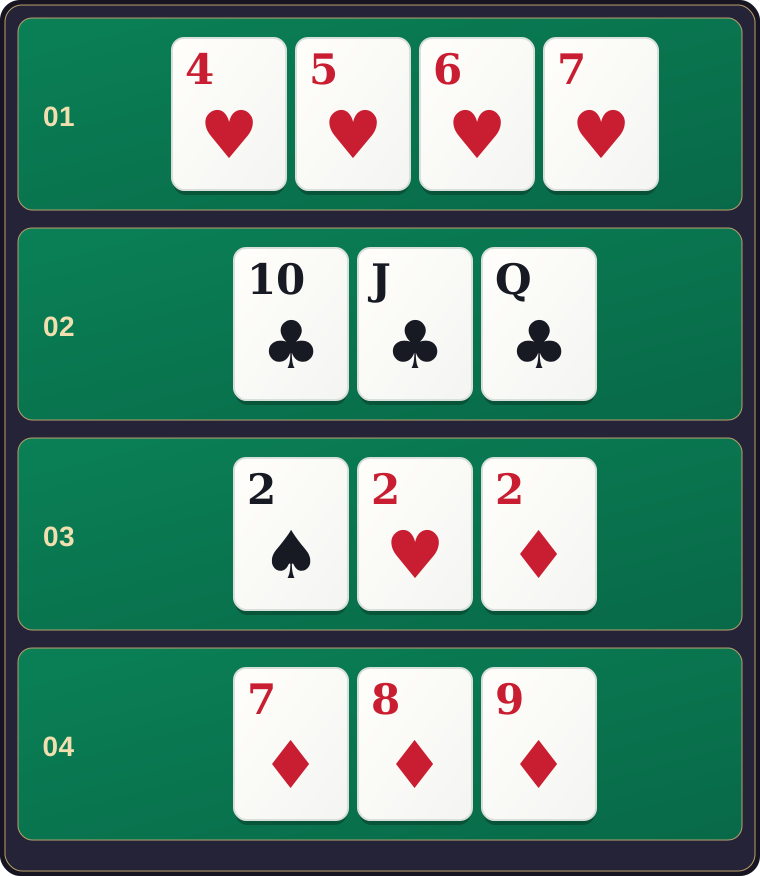
Wild rank: A. Cards: 4♥ 5♥ 6♥ 7♥ | 10♣ J♣ Q♣ | 2♠ 2♥ 2♦ | 7♦ 8♦ 9♦.
Hand 2: inspect the middle ranks
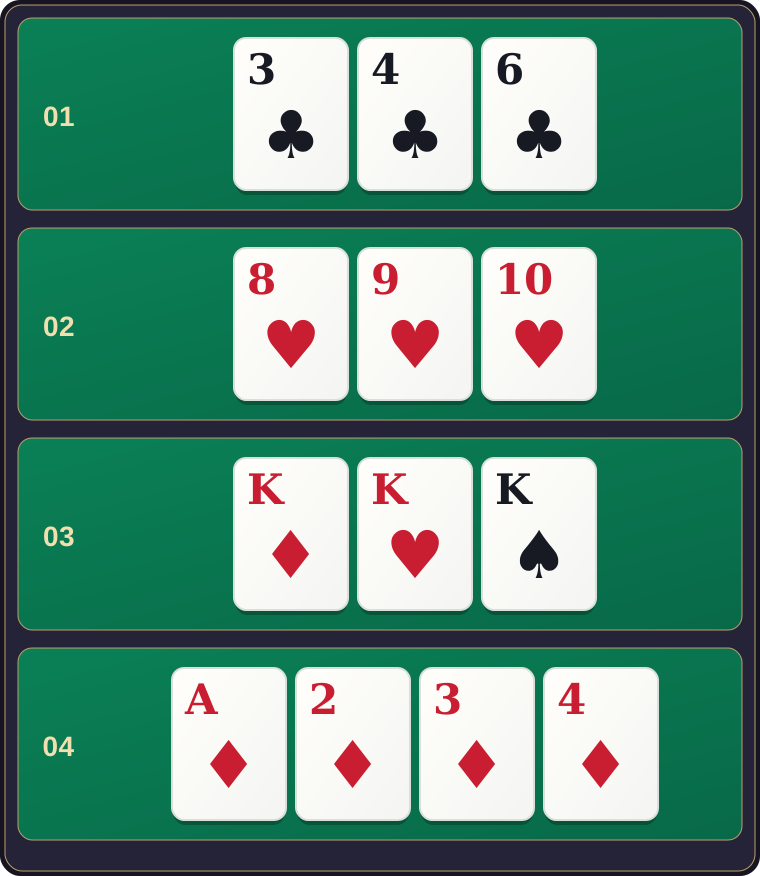
Wild rank: 7. Cards: 3♣ 4♣ 6♣ | 8♥ 9♥ 10♥ | K♦ K♥ K♠ | A♦ 2♦ 3♦ 4♦.
Hand 3: check the whole-hand requirement
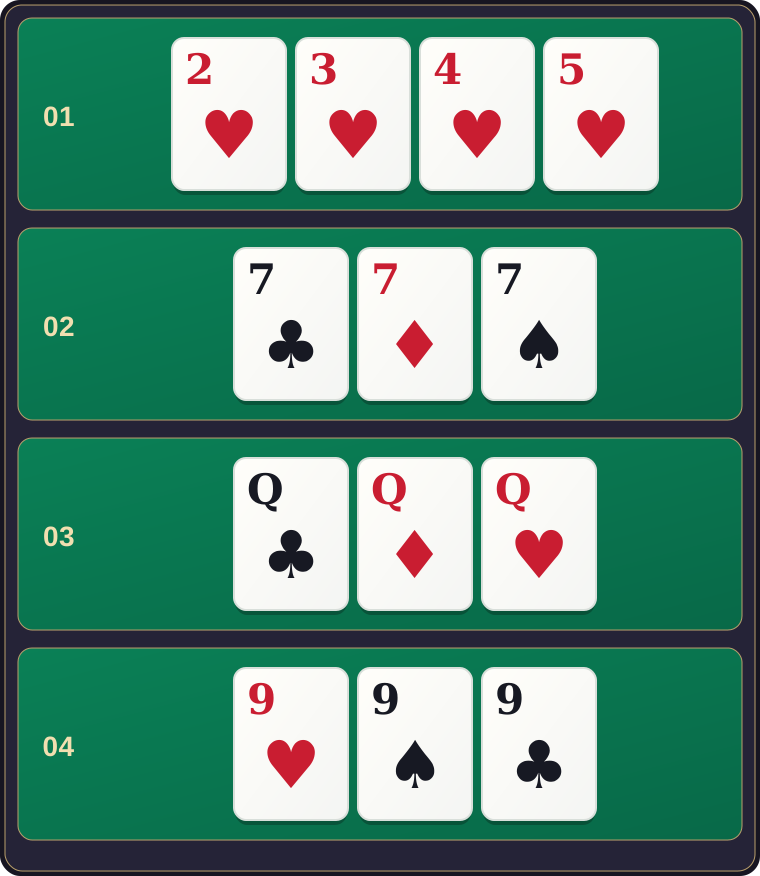
Wild rank: A. Cards: 2♥ 3♥ 4♥ 5♥ | 7♣ 7♦ 7♠ | Q♣ Q♦ Q♥ | 9♥ 9♠ 9♣.
Hand 4: ignore the familiar layout
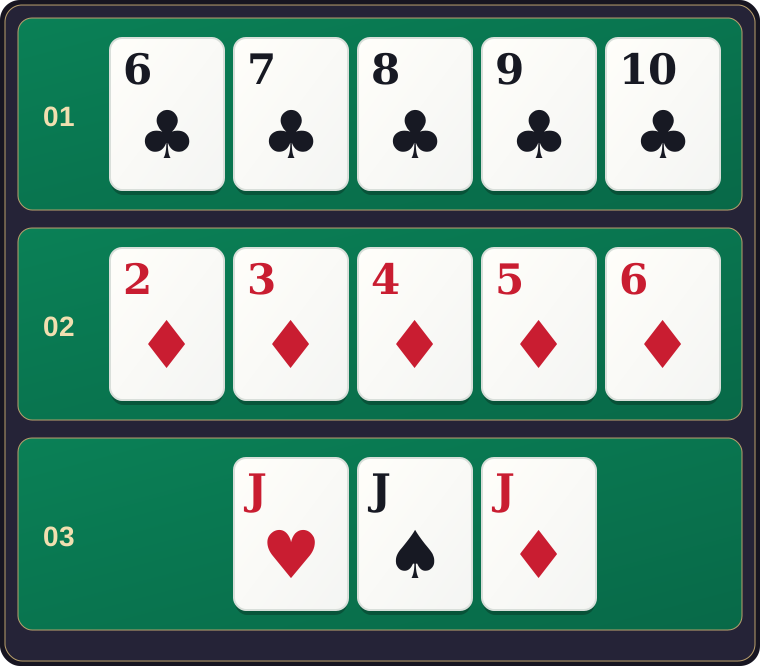
Wild rank: A. Cards: 6♣ 7♣ 8♣ 9♣ 10♣ | 2♦ 3♦ 4♦ 5♦ 6♦ | J♥ J♠ J♦.
Hand 5: separate faces from physical copies
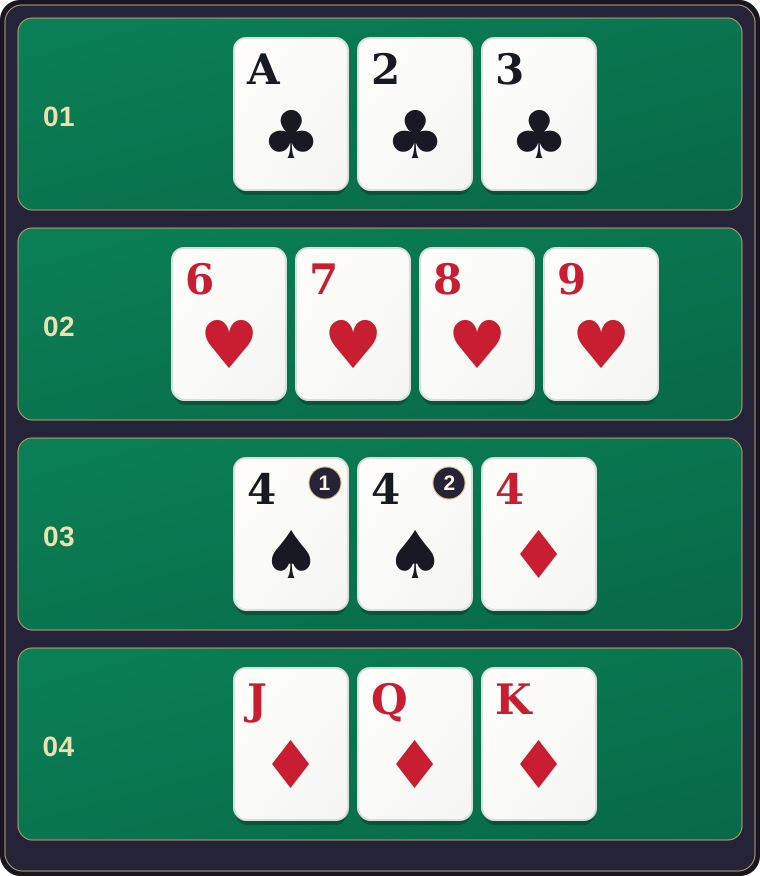
Wild rank: 10. Cards: A♣ 2♣ 3♣ | 6♥ 7♥ 8♥ 9♥ | 4♠① 4♠② 4♦ | J♦ Q♦ K♦. The numbered spade fours are two different physical cards from two decks.
Hand 6: give the joker one exact job
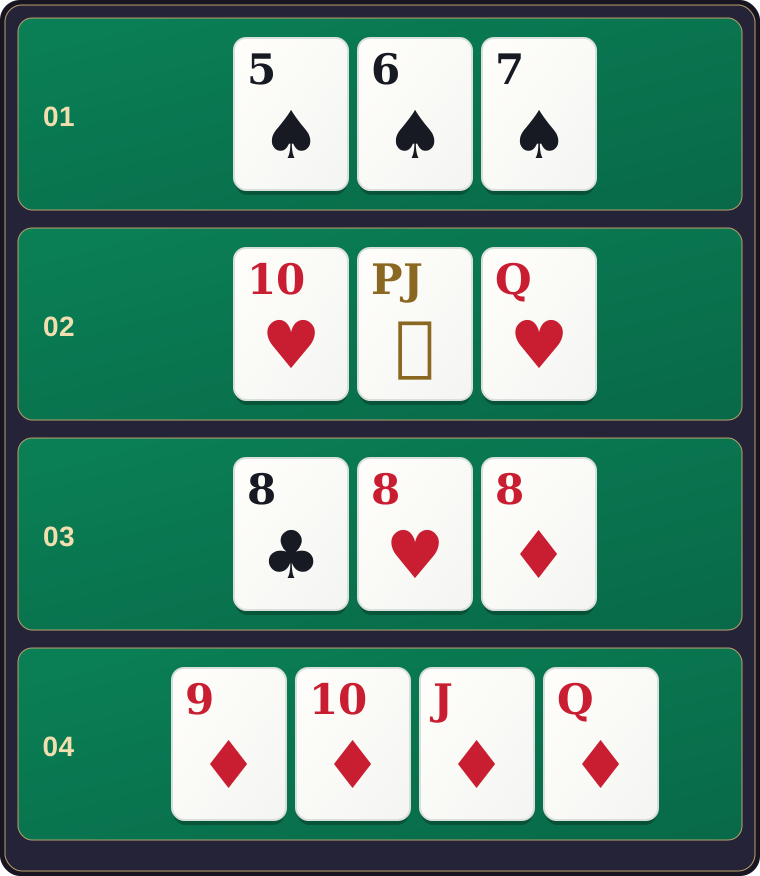
Wild rank: A. Cards: 5♠ 6♠ 7♠ | 10♥ PJ Q♥ | 8♣ 8♥ 8♦ | 9♦ 10♦ J♦ Q♦.
Answers and repairs
1. Valid: every card has one place
The count is 4 + 3 + 3 + 3 = 13. The hearts, clubs and diamonds are three pure sequences. The twos form a different-suit set. There are no loose cards and no card has been borrowed by two groups.
2. Invalid: 3♣ 4♣ 6♣ has a gap
The other groups work, but the club cards cannot be covered by a valid rearrangement of this hand. You need 5♣ between four and six; merely sorting the row does not supply it. For a paper repair, replace 6♣ with 5♣. The row becomes 3♣ 4♣ 5♣, and the repaired 13-card hand works. Keeping all four clubs would require a separate count and discard check.
3. Invalid: three sets are not a second sequence
All four proposed groups are individually sound, but only the hearts form a sequence. A pure sequence is necessary here, not sufficient by itself. A paper repair is to replace Q♣ and Q♥ with J♦ and K♦, keeping the existing Q♦. That creates J♦ Q♦ K♦ as a second pure sequence. This two-card swap illustrates the structure; it is not a claim that two cards can be exchanged in one normal turn.
4. Valid: five plus five plus three is still thirteen
Both five-card rows are pure sequences, and the jacks form a set. The standard structure does not demand exactly four groups. Rejecting a hand just because it looks different from a 3 + 3 + 3 + 4 example is a layout mistake, not a rule check.
5. Invalid: the set repeats spades
There are genuinely 13 physical cards, but 4♠① and 4♠② do not become different suits. With tens designated wild, neither four is a substitute. Replace 4♠② with 4♥ for a paper repair: 4♠① 4♥ 4♦ is a different-suit set. The rest of the arrangement can stay. Our two-deck guide explains the copy labels.
6. Valid: the printed joker represents J♥
The spade and diamond rows are pure sequences. 10♥ PJ Q♥ is an impure sequence with PJ standing for J♥, and the eights form a set. The count is 3 + 3 + 3 + 4 = 13. A joker may complete a suitable group; it does not remove the need to check the other groups.
Use your mistakes to choose the next drill
If you missed Hand 2, read ranks aloud instead of recognizing a rough shape. If you missed Hand 3 or 4, review the whole-hand requirements rather than memorizing one layout. If you missed Hand 5, track suits and physical copies. If you missed Hand 6, write down the joker's exact role.
Then shuffle the order of these six paper examples and explain each answer again. Do not measure improvement only by speed. Use the declaration checklist and the short practice routine to make the checking habit repeatable.
Quick questions
Does a pure sequence make any 13-card hand valid?
No. You still need the other required sequence and valid coverage of every remaining card.
Should I reject a bad-looking row immediately?
Check whether the same physical cards can be regrouped legally. The answers above consider the complete hand, not just the supplied row breaks.
Rule references: Pagat's Indian Rummy rules and RummyCircle's official rules. The six exercises and teaching repairs are original examples; platform-specific features and scoring are outside this drill.