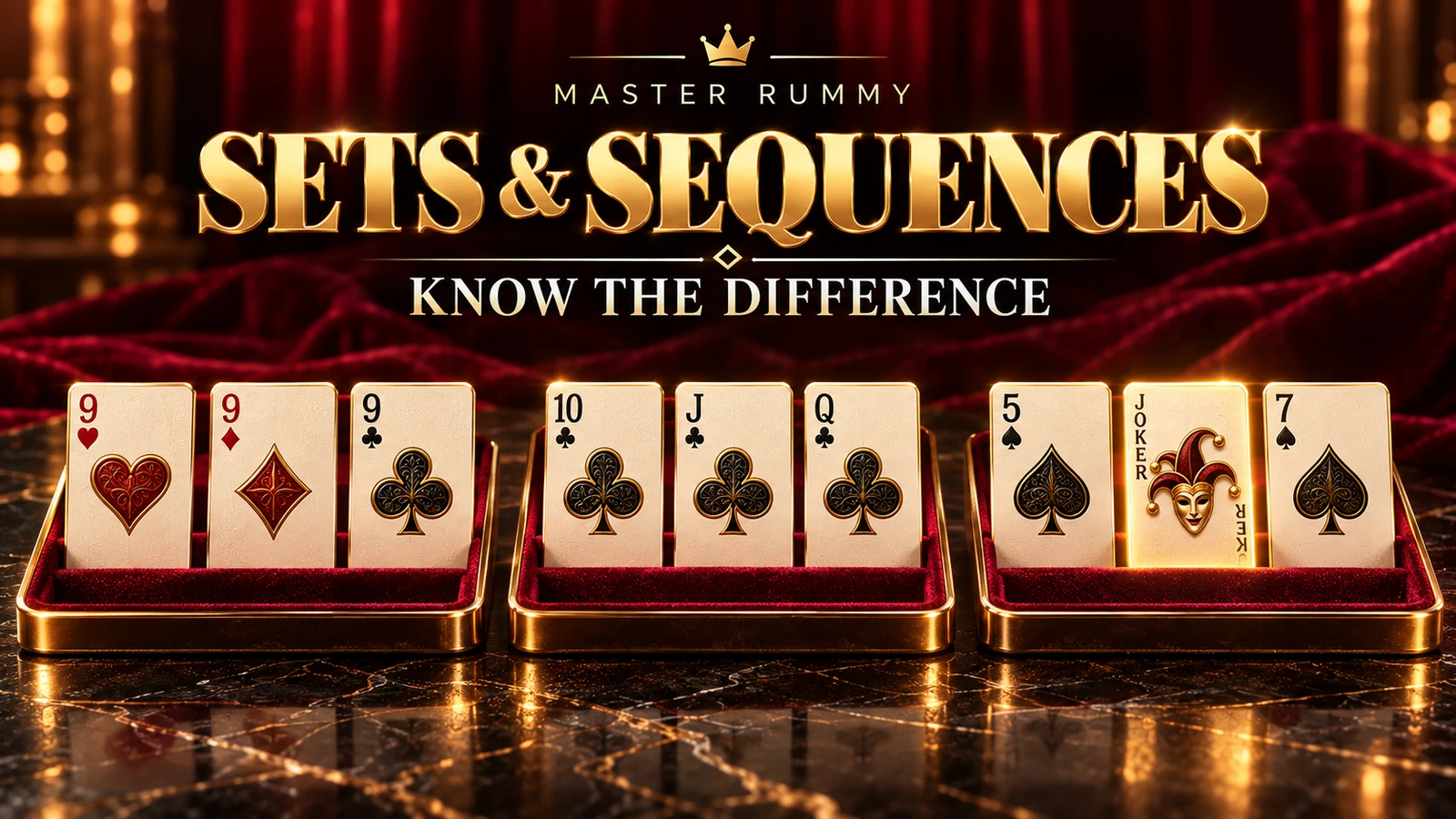
A set matches ranks; a sequence connects ranks within one suit. That is the quickest way to separate them. Three nines of different suits can form a set. Ten, jack and queen of clubs form a sequence. Both are useful, but a set cannot replace a required sequence.
This is a recognition guide, not a promise that every table uses identical group limits. The examples use ordinary three-card groups in the common 13-card model. Unless a question says otherwise, 2 is the designated wild rank; PJ means a printed joker.
Three group types, side by side
The original teaching diagrams below use illustrated card layouts, not app screenshots.
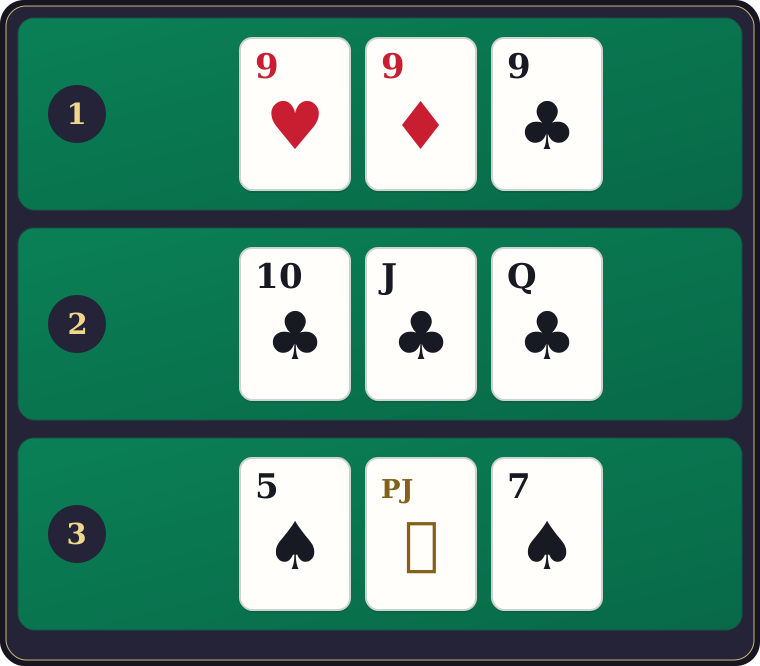
Swipe or scroll to read the full table ↔
| Type | Example | Check |
|---|---|---|
| Set | 9♥ 9♦ 9♣ | Same rank, different suits |
| Pure sequence | 10♣ J♣ Q♣ | One suit, consecutive ranks, no substitution |
| Impure sequence | 5♠ PJ 7♠ | One continuous suit-and-rank pattern after PJ takes 6♠ |
The printed joker in the third row is not “another six” floating between any two cards. It has a defined job: supply 6♠. If you cannot name the missing card, stop and check whether the proposed sequence actually works.
Likewise, red is a colour, not a suit. Hearts and diamonds cannot be mixed to make a natural sequence just because both are red. Clubs and spades are different suits too.
Two mistakes that survive a quick glance
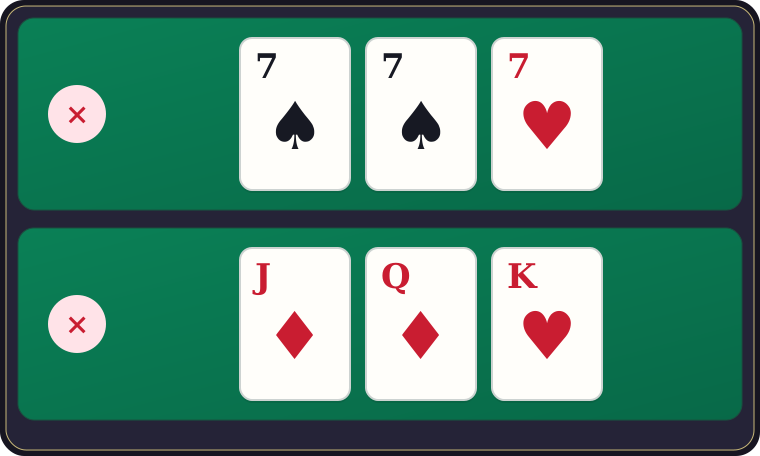
7♠ 7♠ 7♥: a second deck may provide another physical 7♠, but it does not provide another suit. Under the ordinary set rule used here, those three cards are not a valid set. Do not assume that three identical cards are allowed simply because a different rummy variant accepts them.
J♦ Q♦ K♥: the ranks are consecutive, but K♥ belongs to the wrong suit. Moving it nearer to the diamonds changes the layout, not its identity. You need K♦ for this particular natural sequence.
Six quick checks: name the group before reading the answer
- Q♦ Q♣ Q♥ — set. The queen rank stays the same and each suit is different. It is not a sequence: there is no run of neighbouring ranks.
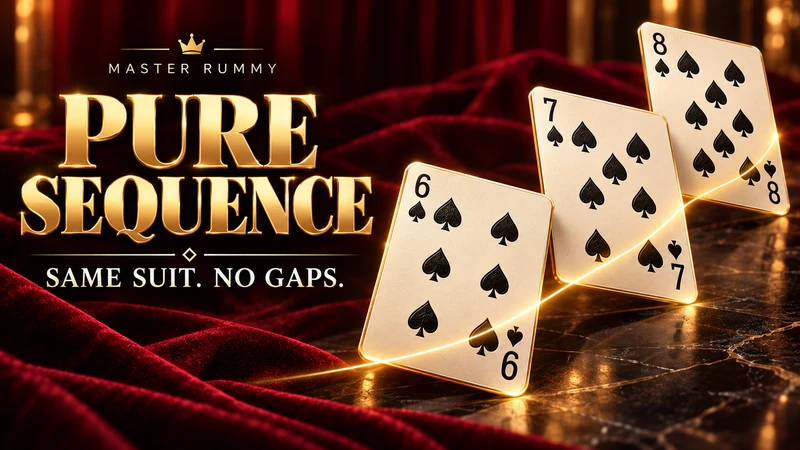
- 4♥ 5♥ 6♥ — pure sequence. All three hearts are consecutive. None is being used as a substitute.
- 8♣ PJ 10♣ — impure sequence. PJ fills 9♣. The pattern is complete, but it relies on substitution.
- 7♠ 7♠ 7♥ — invalid set. The spade suit repeats. A second copy of a card is not a new suit.
- J♦ Q♦ K♥ — invalid natural sequence. The king changes suit. None of these ranks is wild in this exercise.
- A♠ 2♠ 3♠, with 2 wild — pure sequence under the natural-use convention. The 2♠ occupies its own printed rank and suit. It is not standing in for a different card.
The last answer is why “a pure sequence never contains a wild-rank card” is an unreliable shortcut. The important question is what the card is doing. Compare the natural-use rule in your game; the joker guide explains the distinction with more examples.
A valid group does not make a valid hand
Imagine putting four attractive sets on the table. Even if each set is correct and the card count reaches 13, the usual requirement for two sequences, including a pure one, has not been met. Do the group-level check first, then the hand-level check.
Also watch for double use. If 9♦ is part of 8♦ 9♦ 10♦, the same physical 9♦ cannot simultaneously complete 9♣ 9♥ 9♦. You must choose where it belongs, or hold a separate suitable card. This is easy to miss when planning several groups in your head.
Quick questions
Are three consecutive numbers always a sequence?
No. Check the suits and any substitution. For a natural sequence, all cards must belong to the same suit; three close numbers alone are insufficient.
Is an impure sequence a bad group?
No. It can be a valid second sequence in the teaching model. It simply cannot replace the required pure sequence.
Where should I go from here?
Use the complete rules for a full-hand example, the pure-sequence guide to practise gaps, or the points examples to see when groups are excluded from a score.
Rule reference: Pagat's Indian Rummy rules document the group distinctions and natural use of a designated wild card. The comparison layouts and quiz are original exercises. The displayed rules of your game take priority where a variant differs.