
In the common 13-card rummy model, an ace can sit before 2 or after K, but it cannot connect K to 2. A♥ 2♥ 3♥ and Q♣ K♣ A♣ are natural sequences. K♦ A♦ 2♦ is not. Think of the ace as an end card, not a bridge that turns the rank order into a loop.
There are three separate questions to ask about an ace: Where can it go? What is it worth if counted? Is it the designated wild rank this round? Mixing those questions is what causes most confusion.
Position: one end of a sequence at a time
The original teaching diagrams below use illustrated card layouts, not app screenshots.
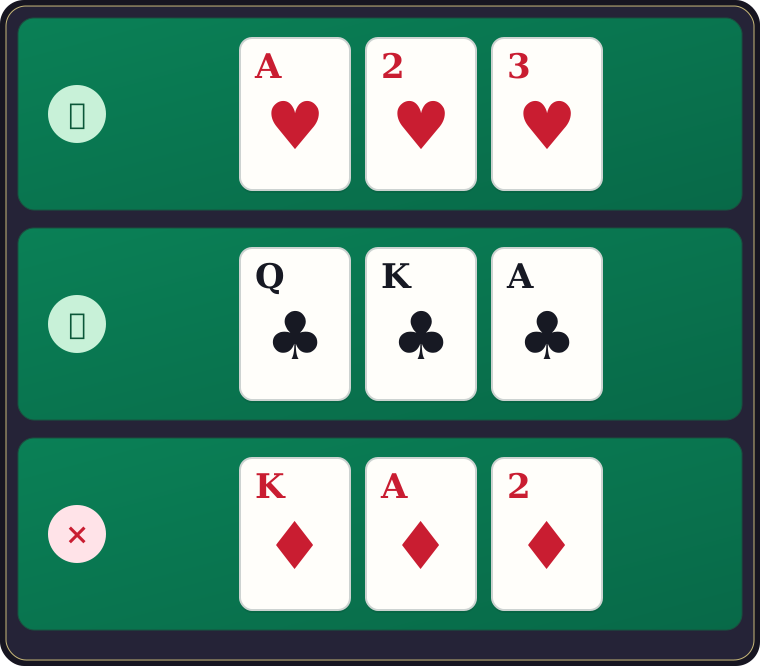
- A♥ 2♥ 3♥: the ace is low. Continue with 4♥ if you have it.
- Q♣ K♣ A♣: the ace is high. You may extend to the left with J♣, not to the right with 2♣.
- K♦ A♦ 2♦: this wraps from the high end to the low end, so it fails the ordinary natural-sequence test.
A useful physical check is to spread the ranks in a line: A–2–3–4–5–6–7–8–9–10–J–Q–K–A. The ace appears at both ends to show two possible positions; that printed line does not give you two physical aces. One card still belongs to one group.
Value: low position does not mean one point
Under the common scoring convention used in our points guide, an ordinary non-wild ace contributes 10 points if it must be counted. It does not become one point because you hoped to combine it with 2 and 3.
For example, if A♦, 4♠ and 7♣ are the cards that count at settlement, their sum is 10 + 4 + 7 = 21. If the ace belongs to an eligible excluded group, you do not count it. Group eligibility and the ace's point value remain separate checks.
Wild role: is the ace itself, or a substitute?
Now change the round: aces are the designated wild rank. This changes what they may represent, not just where they sort in your hand.
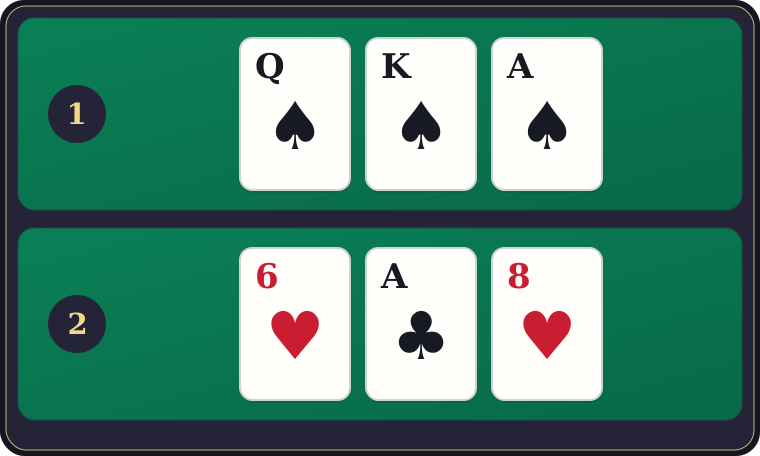
In Q♠ K♠ A♠, the ace is exactly the spade ace needed at that end. It can remain a pure sequence under the natural-use convention. In 6♥ A♣ 8♥, the ace represents 7♥; it is substitution, so the sequence is impure. Do not decide purity from a “wild” highlight alone.
A designated wild ace has the joker value of zero in this scoring model, rather than the ordinary ace value of 10. Confirm both natural-use and scoring rules in the format you are playing.
Three quick answers
Can K–A–2 work if all three suits match?
Not as a natural sequence under these rules. Matching suits do not repair the wraparound.
Can an ace form a set?
Yes. A♥ A♦ A♣ is a same-rank, different-suit set. It does not replace the required sequences.
Should I always keep an ace?
No automatic rule follows from its rank. Look at its actual neighbours and the current wild rank. For that decision, read which cards to discard; for the full hand requirements, use the complete rules and the joker guide.
Rule reference: Pagat's Indian Rummy rules describe ace-end positions and natural use of wild cards. These examples teach a common convention, not every possible rummy variant or a promise about a particular Master Rummy table.