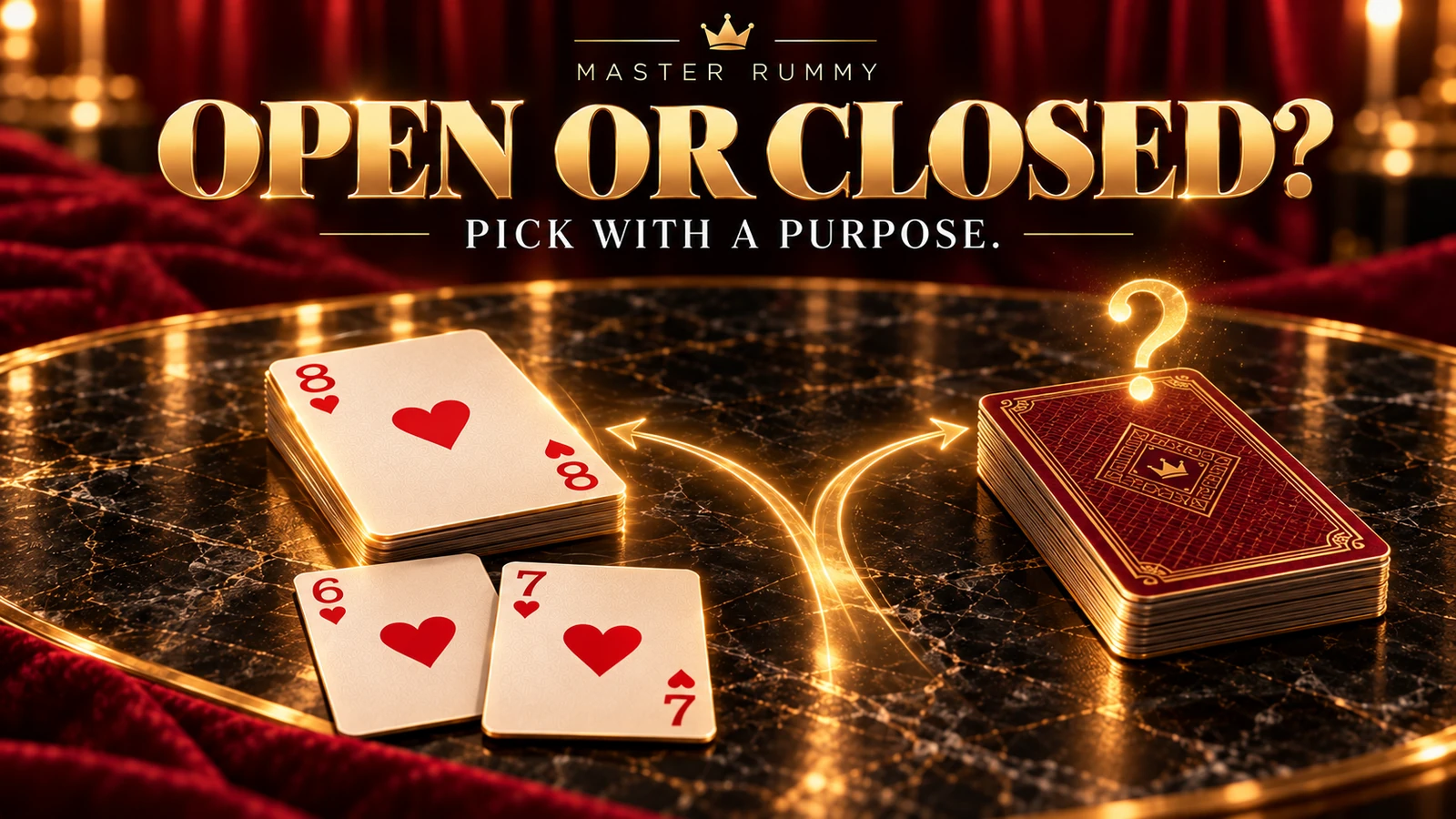
Take the visible card when it gives your hand a clear, useful improvement. Choose the closed deck when the open card has no convincing job. Compare what you know with what you do not know: the face-up card is certain; the next face-down card is not. Neither pile is automatically the better choice.
You have sorted your cards, and an 8♥ appears on the discard pile. Should you take it or try the closed deck? “Never reveal your plan” is too rigid an answer. So is “always pick a card that connects.” The useful question is what those connections actually achieve.
What open deck and closed deck mean
The open deck is the face-up discard pile; normally only its top card is available. The closed deck is the face-down stock, so you cannot inspect its next card before choosing. A normal draw takes a 13-card hand to 14, followed by a discard back to 13. The Pagat Indian Rummy reference describes this draw-and-discard structure. Its specific conventions are not a promise of Master Rummy features.
Check the table's restrictions on taking an exposed joker and on immediately returning a card picked from the open pile. Do not assume a rule from a different rummy game applies here. For the full hand-building foundation, start with our 13-card rules guide.
Situation 1: the visible card completes something useful
In this exercise, none of the displayed cards is a wild joker. Your 13 cards are:
6♥ 7♥ | 2♣ 3♣ 4♣ | Q♠ Q♥ Q♦ | 10♠ J♠ | A♣ 5♦ K♦
That is 2 + 3 + 3 + 2 + 3 = 13. The top discard is 8♥. Taking it makes 6♥ 7♥ 8♥ a natural sequence without moving a card out of another group. You now have 14 cards. If you discard the isolated K♦, you return to 13 while keeping that new sequence, the club sequence and the queens.
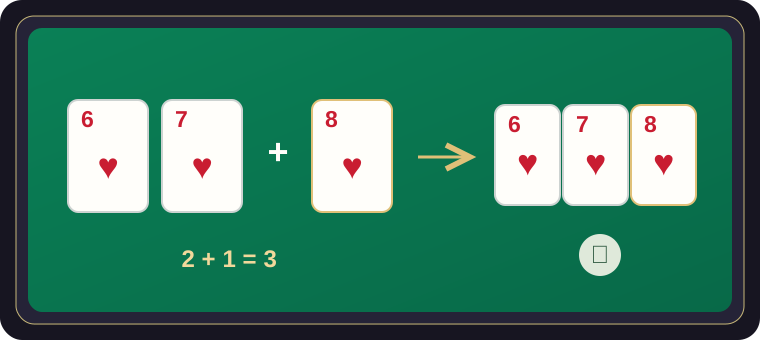
You are still not ready to declare: 10♠ J♠ and the remaining A♣ 5♦ are unfinished. But the improvement is real. Rejecting 8♥ merely because someone might notice your hearts would trade a certain useful card for an unknown one. That does not make taking it mandatory in every format; it does make “I don't want to give a clue” an incomplete explanation.
Situation 2: the card fixes an overlap problem
Try a separate hand, again with no displayed card acting as a joker:
8♣ 9♣ 10♣ | 4♥ 5♥ 6♥ | 9♥ 9♠ | 2♦ 3♦ | A♠ K♦ Q♣
The count is 3 + 3 + 2 + 2 + 3 = 13. You might be tempted to borrow 9♣ for the pair of nines. That produces a set but leaves 8♣ 10♣ with a gap. One physical card cannot do both jobs.
If the visible top card is 9♦, taking it solves the conflict: keep 8♣ 9♣ 10♣ intact and use 9♥ 9♠ 9♦ as a separate set. Drawing makes 14; discarding A♠ gives 3 + 3 + 3 + 2 + 2 = 13. The diamond pair and K♦ Q♣ are still unfinished. This is a better arrangement, not a completed hand.
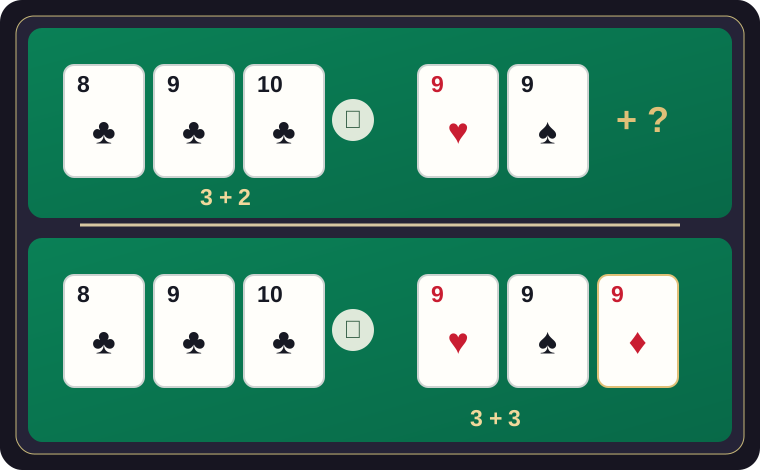
Before calling any pickup “useful,” mentally lay out the groups after the next discard. Our card-arrangement walkthrough makes this check easier.
Situation 3: the open card offers only a vague possibility
Return to the first hand, but imagine the top discard is 2♠ instead of 8♥. It does not complete the heart pair, extend the club run, complete the queens or directly finish 10♠ J♠. You could invent a future spade sequence around it, but that would require more cards and a new space in your hand.
The closed deck is a reasonable choice here because the visible alternative has little immediate value—not because the next hidden card is guaranteed to help. It might be equally unhelpful. Avoid comparing an ordinary face-up card with the perfect card you hope is underneath the stock.
What a pickup tells the table—and what it does not
A visible pickup reveals that a player chose that card. It does not reveal their full hand, whether their first sequence is complete, or how close they are to declaring. A 9♦ might join a diamond run, a set of nines, or a temporary arrangement that later changes.
That distinction works both ways. Consider the information you reveal, but do not sacrifice every clear improvement just to appear mysterious. Observe actual actions instead of treating them as proof of a hidden plan.
A practical three-question check
- What exact job does the open card do? Name the group or conflict it resolves.
- What will my 13 cards look like after discarding? Check the whole hand, not just the attractive fragment.
- What am I assuming about the unknown draw? Hope is not evidence that the stock is better.
To practise, pause before drawing and write a one-sentence reason. Review it before revealing the stock card; otherwise hindsight makes a lucky result look like a better decision. Continue with choosing the following discard and our short practice exercises.
Quick answers
Does the open deck let me take any exposed card?
In the usual draw-and-discard version described here, you choose the current top card, not any card buried underneath. Check the specific table rules before playing a different variant.
Does choosing the closed deck hide everything?
It hides the identity of the card you draw from other players, but your later discards and pickups still provide clues. It does not make your decisions invisible or your next draw more favourable.