To calculate rummy points, first check which groups qualify for exclusion, then add the values of the remaining cards. Adding every card immediately can give the wrong answer. A completed set may still count if the hand has not met the sequence requirements.
This guide uses one common 13-card settlement convention: A, K, Q and J count 10; numbered cards count their face value; printed and designated wild jokers count zero. A pure sequence is excluded first. Once a second sequence is also present, other valid groups can be excluded. The examples are ordinary end-of-hand calculations, not incorrect-declaration penalties, drop scores or a confirmation of every Master Rummy table rule.
Start with values, but do not stop there
Swipe or scroll to read the full table ↔
| Card | Value if counted |
|---|---|
| 2 to 9 | The printed number |
| 10, J, Q, K, A | 10 each |
| Printed joker or designated wild rank | 0 |
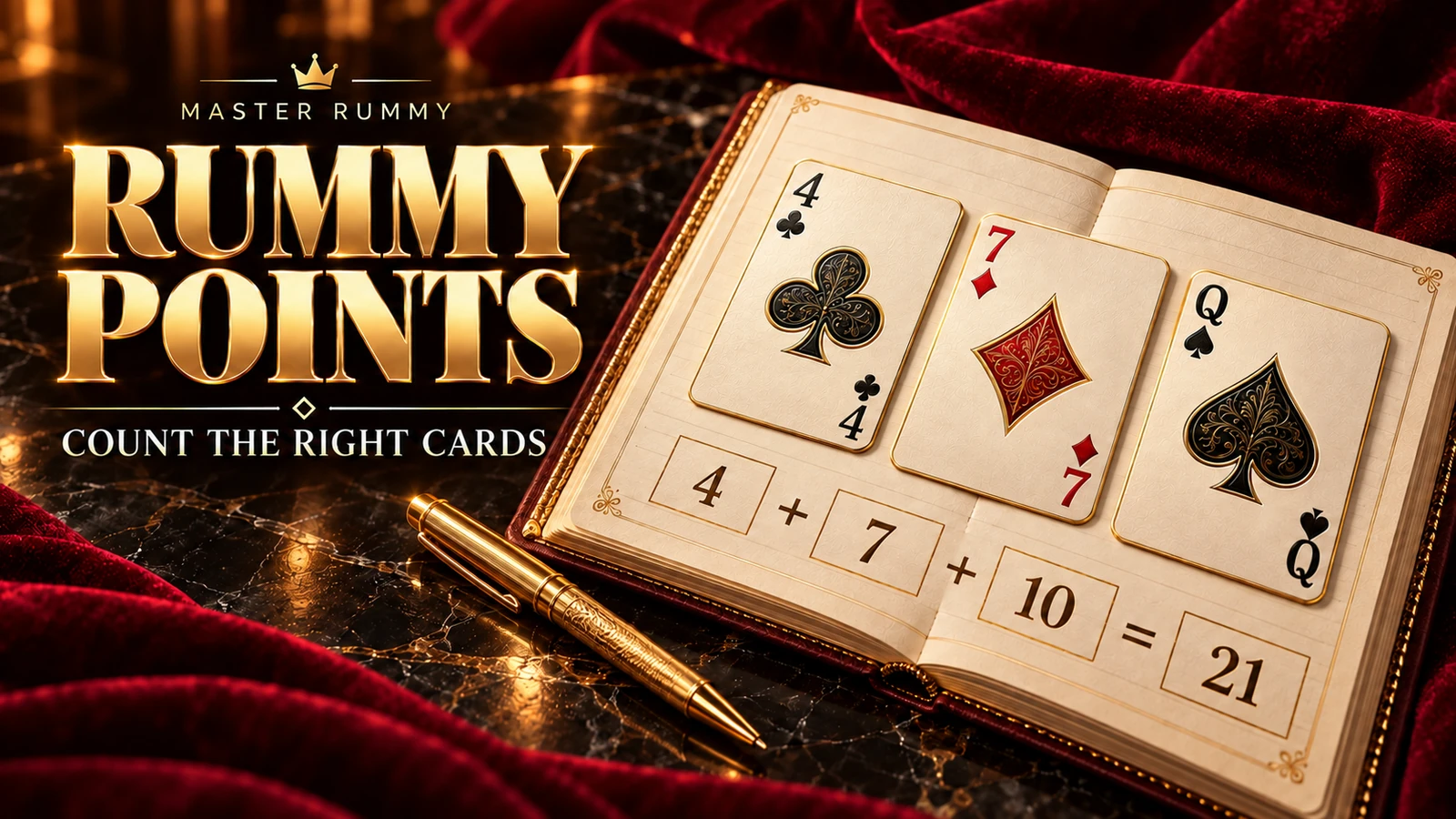
For example, three counted cards 4♣, 7♦ and Q♠ total 4 + 7 + 10 = 21. The queen is not 12 points. An ace used at the low end of a sequence is not automatically worth one point either: sequence position and scoring value are different questions.
Before using the table, identify the round's designated wild rank. In all three hands below, K is wild; there are no kings in the hands. “PJ” means a printed joker. Every listed hand has exactly 13 physical cards, after the player's normal discard. The circles beside diagram rows show that row's counted subtotal; a green 0 marks an excluded row.
Example 1: no pure sequence — 74 points
Hand: 2♥ 3♥ 5♥ / 4♣ 4♦ 4♠ / 7♣ 9♣ J♣ / 2♦ 6♠ 8♦ Q♠.
The original teaching diagrams below use illustrated card layouts, not app screenshots.
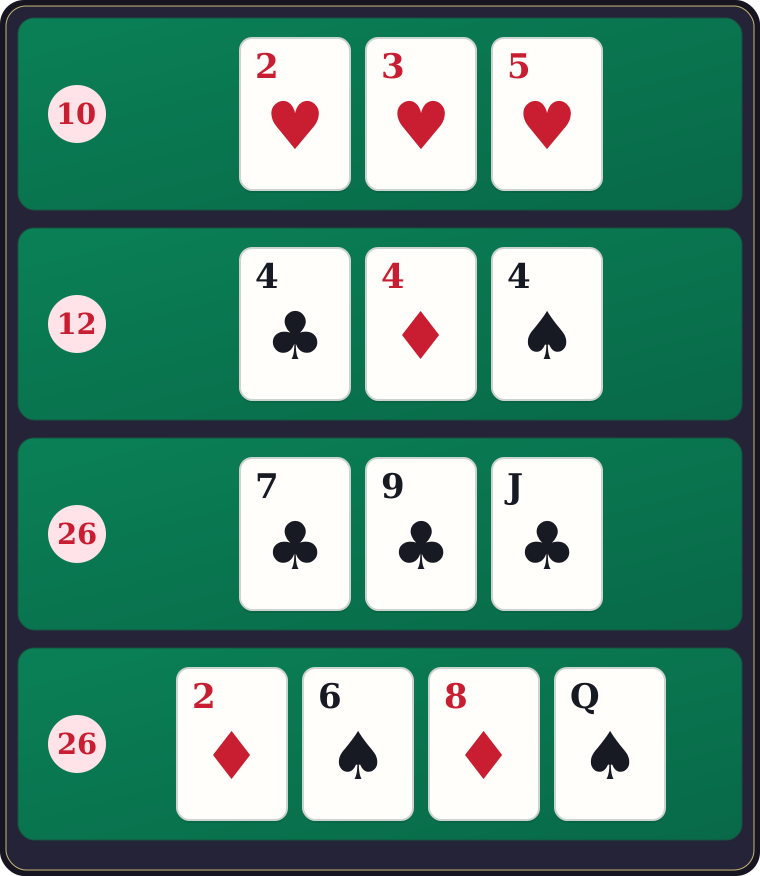
The hearts miss 4♥. The clubs have gaps. The three fours do form a set, but that set does not yet qualify for exclusion under this convention.
- Heart row: 2 + 3 + 5 = 10.
- Three fours: 4 + 4 + 4 = 12.
- Club row: 7 + 9 + 10 = 26.
- Last row: 2 + 6 + 8 + 10 = 26.
Total: 10 + 12 + 26 + 26 = 74 points. A neat-looking layout does not change the calculation. This is also a useful arithmetic check: J♣ contributes 10, not 11.
Example 2: one pure sequence, no second sequence — 72 points
Hand: 3♦ 4♦ 5♦ 6♦ / 8♥ 8♣ 8♠ / J♥ J♣ J♠ / 2♣ 6♥ A♠.
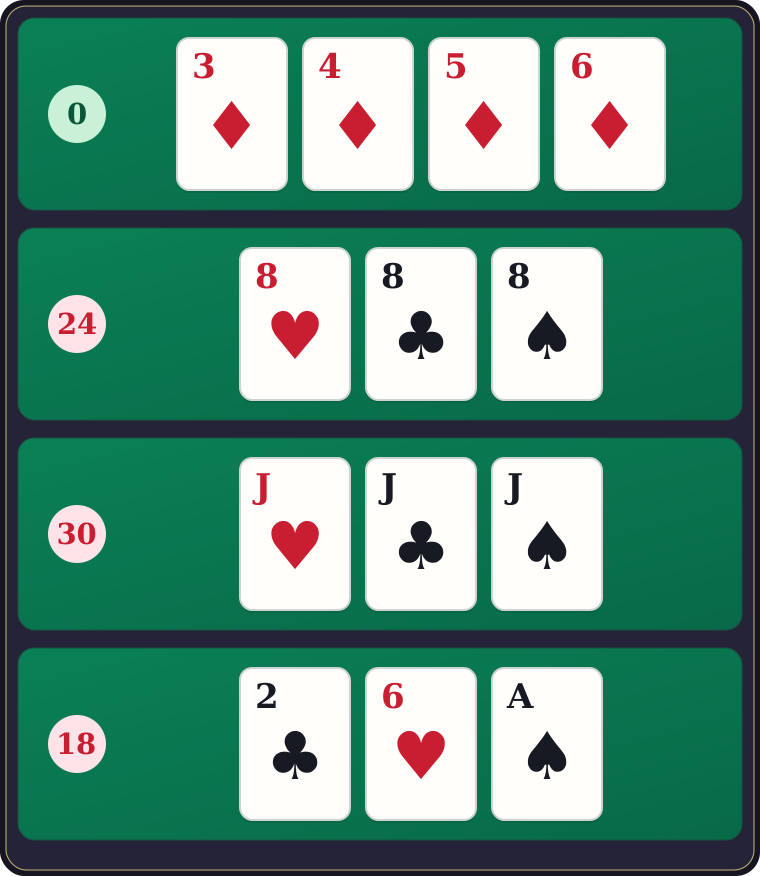
The diamond run is pure, so its 18 points are excluded. Neither the eights nor the jacks create the missing second sequence. Both sets still count here.
The counted cards are 8 + 8 + 8 + 10 + 10 + 10 + 2 + 6 + 10 = 72. The hand has several completed groups, but its sequence condition remains incomplete. Do not subtract the sets just because the app has allowed you to place them together visually.
Example 3: two sequences, including a pure one — 31 points
Hand: 9♠ 10♠ J♠ / 2♥ 3♥ PJ / 6♣ 6♦ 6♠ / 4♣ 7♦ Q♥ A♦.
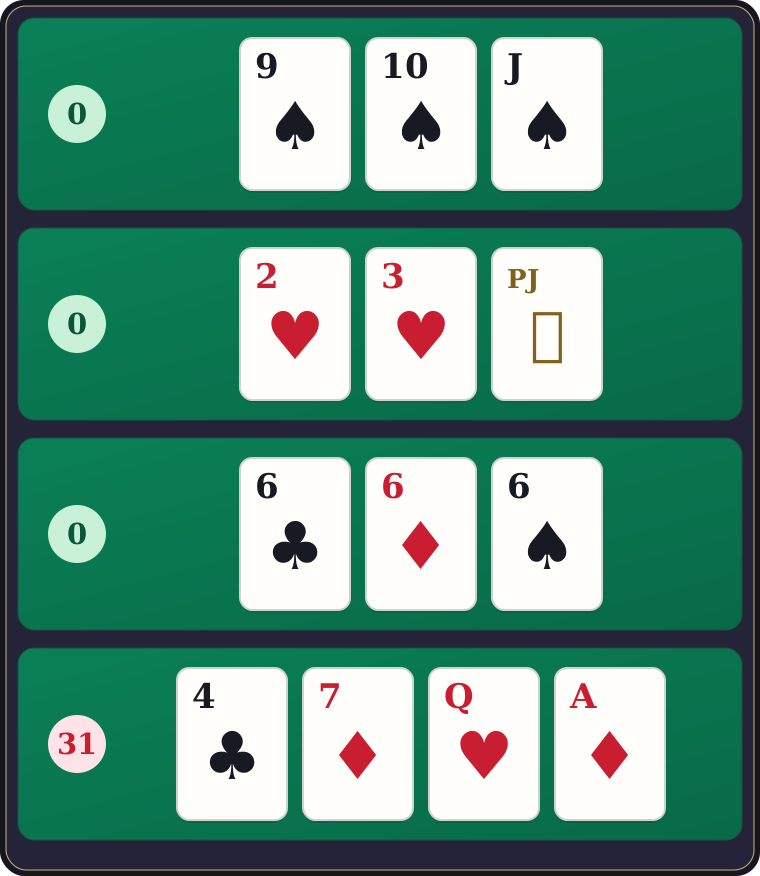
There is one pure sequence in spades and a second, impure sequence in hearts. The sixes form a valid set. Those nine cards are excluded, leaving 4 + 7 + 10 + 10 = 31.
The joker fills one specific missing place; it is not a blanket permission to ignore all remaining cards. The four loose cards still count, and this hand is not ready for a valid declaration.
Keep the raw total separate from the final recorded result
Write down the counted cards and their sum before applying a table's special rules. A maximum hand score, a drop penalty or an incorrect-declaration penalty can replace or limit that sum. They are separate rules, not properties of the cards. Check the displayed format rather than importing a number from a different app.
For an ordinary settlement, a reliable note is: “13 cards checked; wild rank identified; qualifying groups marked; remaining values added.” If your result differs from the game, compare the exact group arrangement and the table's settlement rule before assuming the addition is wrong.
Quick questions
Does a valid set always score zero?
Not in this teaching model. Example 2 has two valid sets, yet both count because there is no second sequence.
Can a low-value hand be a valid declaration?
A small score alone proves nothing. All 13 cards must satisfy the required grouping conditions; check the declaration checklist.
What should I learn next?
Use the complete 13-card rules for the overall game, sets versus sequences for group recognition, and reducing exposed points for decisions during play.
Rule reference: The scoring convention can be compared with RummyCircle's published points-format rules. That operator's special penalties and commercial format are not Master Rummy promises. The card layouts and arithmetic here are original teaching exercises; your game's displayed rules take priority.