Yes, two people can play 13-card Indian rummy. Each starts with 13 cards, and turns alternate between the two players. Fewer players do not reduce the requirement for a complete, valid hand. Deck count, joker selection and the way a hand ends must still come from the chosen rules.
“Rummy for two” can mean several different games. If you expected 13 cards but a tutorial gives you ten, you may be reading about another form of rummy. This guide stays with Indian 13-card rummy. It is a tabletop explanation, not a claim that Master Rummy currently offers private rooms, friend invitations or a two-player mode.
Agree on the setup before dealing
Write down the game name, number of packs, printed jokers, selected wild rank and how the first player is chosen. Also settle the score format and empty-stock rule. Those are small decisions before the deal and large arguments afterwards.
Pagat's Indian Rummy reference describes two packs, each with a printed joker, for two to six players. That is one documented arrangement, not proof that every two-player table uses the same pack count. Follow the rule sheet you actually chose.
A card-count check for one practice setup
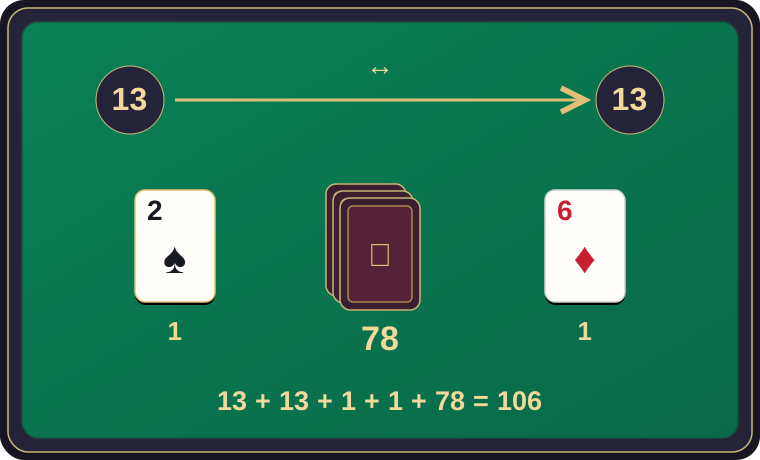
For this exercise, use 106 physical cards. Deal 13 to each player, set one card aside as the wild-rank indicator, and expose one different card to start the discard pile. The closed stock then contains 106 − 26 − 1 − 1 = 78 cards. This arithmetic assumes the indicator is physically separate; do not subtract it again if your chosen setup treats it differently.
Follow the turn, not a race to touch the pile
Once the starting player is known, play alternates A, B, A, B. On an ordinary continuing turn, draw one eligible card, organise the hand, then discard one. Your hand moves from 13 to 14 to 13. There is no extra draw merely because only one opponent is waiting.
The visible top discard and the unknown stock card are different choices. Taking a card buried in the discard pile is not part of the top-card draw convention used here. Restrictions on taking a joker or discarding a card just collected from the open pile should be checked separately; our discarded-card pickup guide explains why the timing matters.
A worked hand: improvement is not the same as completion
In this exercise, twos are wild and none of the following cards is a joker. Player A holds:
4♣ 5♣ 6♣ | 9♥ 10♥ J♥ | Q♠ Q♥ | 7♦ 8♦ 9♦ | A♠ 4♠
Count 3 + 3 + 2 + 3 + 2 = 13. If Q♦ is the eligible top discard, A can take it and discard A♠. The queen set is now complete, but 4♠ remains loose. The resulting 3 + 3 + 3 + 3 + 1 = 13 arrangement is not ready to declare.
Player B now takes a turn. We do not need to invent B's hidden cards. Suppose, on A's next turn, A draws 10♦ from the stock. There are 14 cards again. Put 10♦ with 7♦ 8♦ 9♦ and discard 4♠:
4♣ 5♣ 6♣ | 9♥ 10♥ J♥ | Q♠ Q♥ Q♦ | 7♦ 8♦ 9♦ 10♦
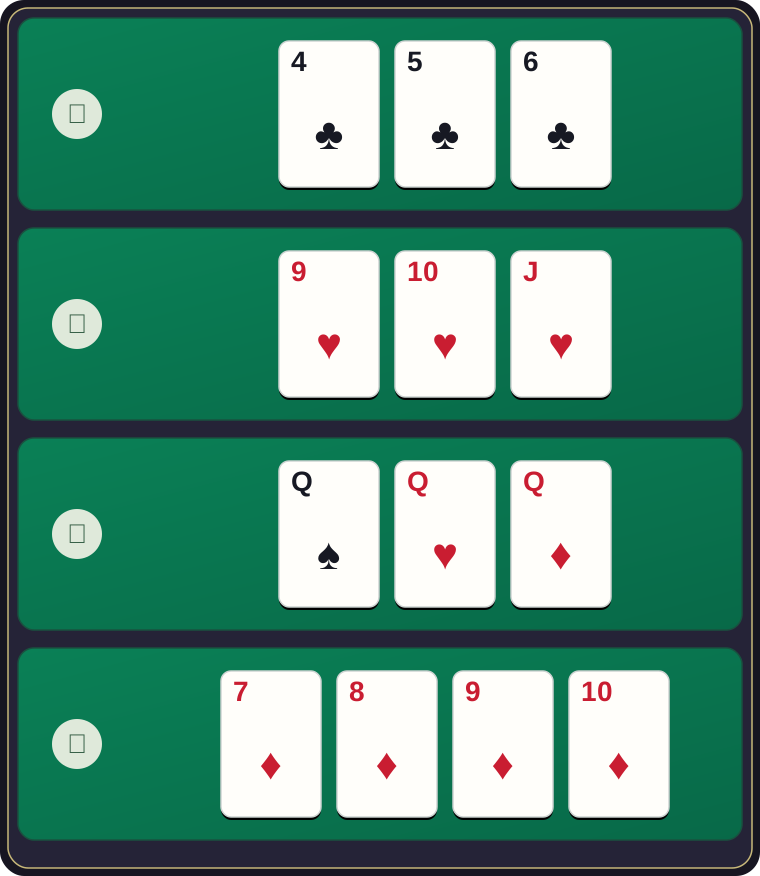
This arrangement satisfies the usual combination check: at least two sequences, at least one pure, and all remaining cards in valid groups. Follow the table's declaration procedure as well. The example demonstrates a possible draw sequence, not a predicted result or a guaranteed win. For the full grouping rules, use our complete rules guide.
What changes when there is only one opponent?
The same person receives the next opportunity after every discard you make. That makes the immediate consequence easier to follow, but it does not reveal their hand. Seeing them take Q♣ could mean a queen set or a club sequence; it does not tell you which.
Keep two notes separate: what actually happened, and what you think it might mean. “Picked 8♥” is an observation. “Needs 7♥” is only one hypothesis. A useful visible card is not automatically a trap, and an unseen draw is not automatically safer.
For a relaxed practice session, review one decision after each hand: which card changed a group, which card stayed loose, and whether you counted all 13 before declaring. Do not pause a live timed game to consult notes. Our practice exercises are designed for reviewing decisions away from the timer.
Quick answers
Do two players get fewer than 13 cards?
Not in the 13-card version explained here. A different starting count usually means a different game or an explicitly agreed variation.
Does two-player rummy mean Master Rummy has a private room?
No. A general rules article cannot confirm an app feature. Check the current app information or ask Master Rummy support about available modes.