“Can I pick up a discarded card?” needs a time and a source. Taking the current top discard on your legal turn, undoing your own finished discard, and discarding a card you have just taken from the open pile are three different actions. Do not treat one answer as permission for all three.
The frustrating moment is familiar: you release 7♦, notice 6♦ 8♦ in your hand, and want the seven back. Seeing the mistake does not create another turn. Before reaching for the pile, identify exactly what happened.
First, separate the three situations
Swipe or scroll to read the full table ↔
| Situation | What to check |
|---|---|
| You have already discarded and ended your turn | A new draw is not an undo. Any correction requires an explicitly agreed procedure. |
| It is a later legal turn and the card is currently on top | Check whether that card is eligible under the table's pickup rules. |
| You just drew a card from the open pile and want to discard that exact card | Check the same-turn return rule; published versions differ. |
This guide concerns the usual top-card draw convention. It does not describe games where you collect a whole discard pile or take a buried card. For choosing between an eligible visible card and the stock, see open deck versus closed deck.
A finished discard is not a second chance to draw
In an ordinary draw-and-discard turn, you start with 13, draw to 14, and discard back to 13. Picking your discarded card straight back up would give you 14 again after your turn has ended. That is a different action from drawing at the start of your next turn.
At a practice table, agree on a learning take-back rule before starting, if you want one. Do not introduce it only after seeing your opponent react. In an app, use only its actual correction or support process; this article does not claim that Master Rummy has an undo button.
What if I pick the open card and immediately want to return it?
Pagat's Indian Rummy rules require a different discard after taking the open top card. Other summaries use different wording: RummyCircle's glossary describes discarding a drawn card more broadly, while A23's Pool Rummy article describes a restriction on returning the picked card. These pages do not establish Master Rummy's rule.
The practical question is precise: “If I take this exact physical card from the open pile, must I discard a different card this turn?” A separate question covers a card drawn unseen from the stock. Do not silently extend an open-pile restriction to every stock draw, or assume a general glossary resolves a particular table's policy.
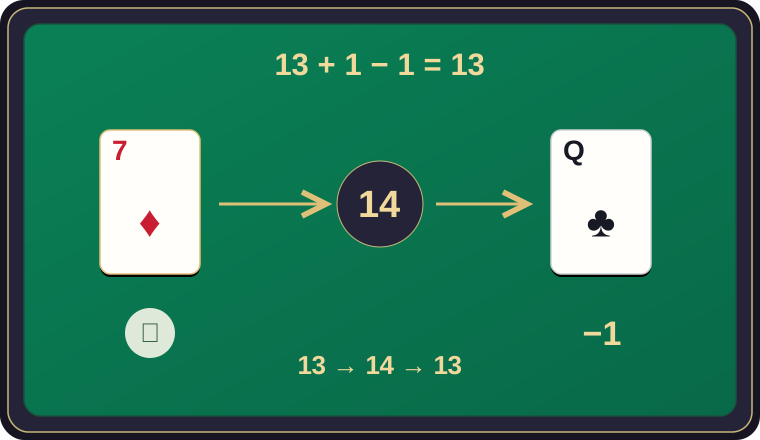
A useful pickup with all thirteen cards accounted for
Assume twos are wild, no displayed card is wild, and the example uses the different-discard rule above. Your hand is:
3♥ 4♥ 5♥ | 9♠ 10♠ J♠ | 6♦ 8♦ | K♣ K♦ K♥ | Q♣ A♠
That is 3 + 3 + 2 + 3 + 2 = 13. The eligible top discard is 7♦. Taking it makes 14 and completes 6♦ 7♦ 8♦. Discarding Q♣ restores 13. You have improved the hand, but A♠ is still loose: 3 + 3 + 3 + 3 + 1 = 13. Do not declare just because the new sequence looks good.
Notice what this example does not say. It does not say that Q♣ is always the best discard, that your opponent cannot use it, or that a visible pickup guarantees completion. It demonstrates a permitted sequence of actions under a stated rule.
On a later turn, is the old card still available?
The first check is physical availability. A card you remember seeing is not necessarily the current top card. If 3♣ covers the 7♦ you want, the visible older seven is not available under the top-only convention. You cannot lift the three to get at it.
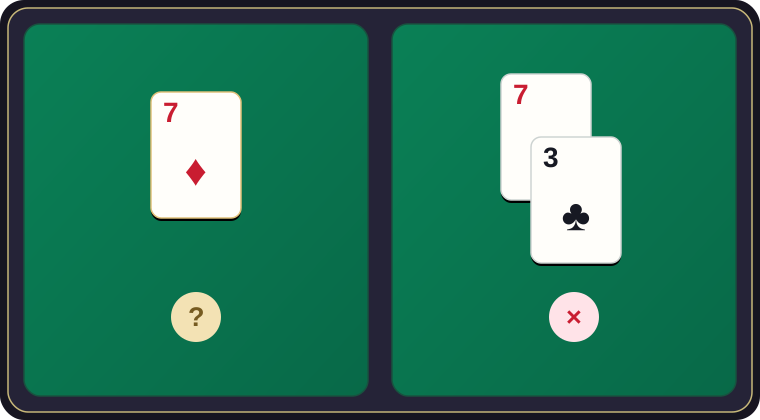
If a previously discarded card becomes the eligible top card on a later legal turn, check the chosen rules rather than inventing a permanent ownership ban. But do not plan on getting your discard back next turn. In the usual two-player loop, your opponent can take it or cover it with their next discard. With two packs, a matching rank and suit may also be a different physical copy.
A short check before touching the pile
- Is it your legal draw, or has your discard already ended the turn?
- Is the wanted card on top, rather than merely visible underneath?
- Is it eligible, including any joker restriction?
- If you take it, which different card will you discard if required?
- After that discard, can you still account for all 13 cards?
Use the discard decision guide for the next choice, and the complete rules guide for the declaration check. The rules of a particular app or table take precedence over an example here.
Quick answers
Can I reclaim an accidental discard immediately?
Not as an ordinary extra draw after finishing your turn. A practice correction needs prior agreement; an app correction depends on its actual supported process.
Is a card permanently forbidden because I discarded it earlier?
Do not assume that from the word “discard.” On a later legal turn, availability and the chosen pickup rule matter. A buried card is still unavailable under the top-only convention.