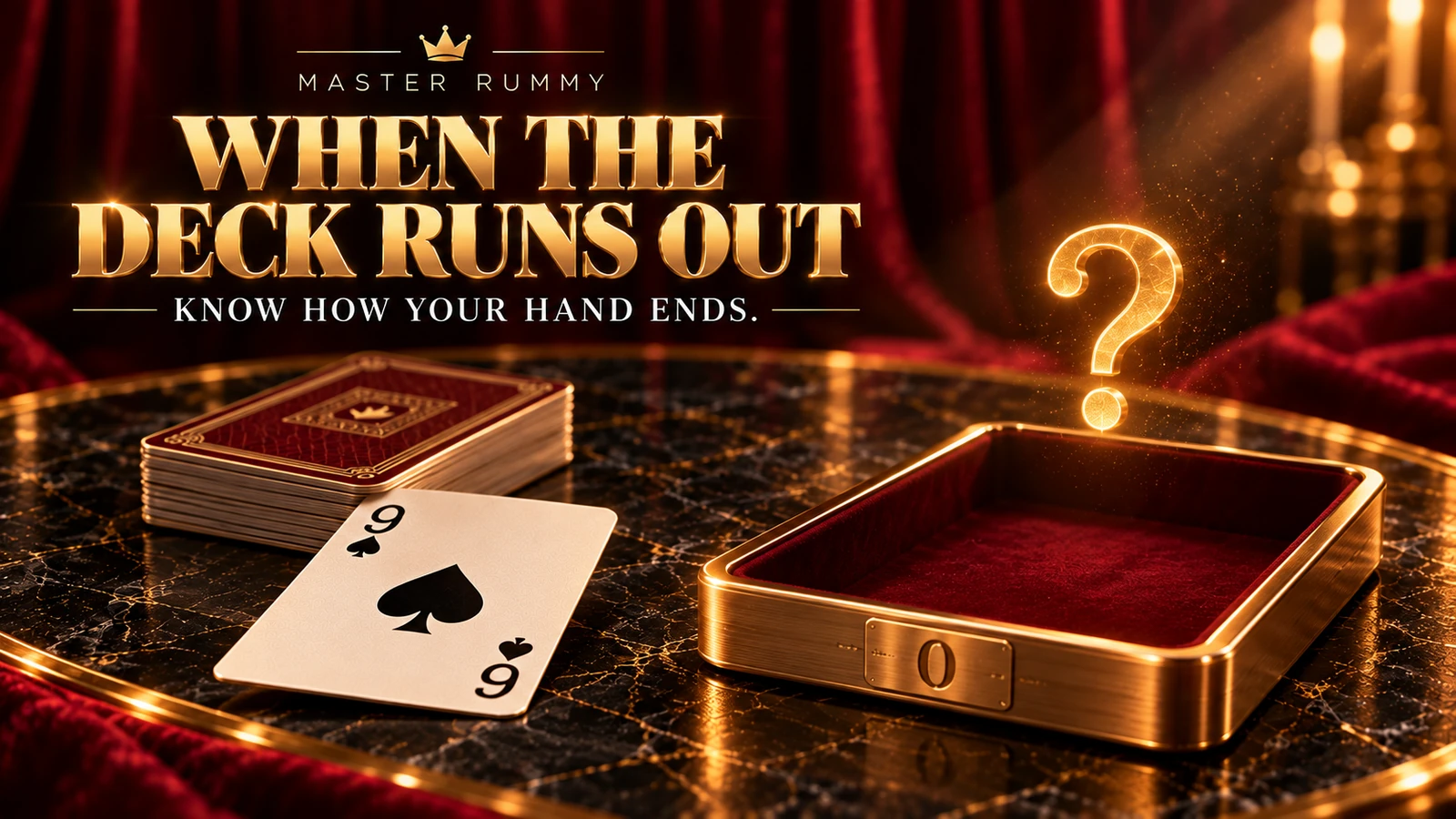
An empty draw pile does not have one universal rummy outcome. Some rules end the hand; other versions reuse the discards. Check the named game and the precise end-of-turn rule before shuffling anything. Do not award yourself a win just because you have fewer points.
You draw the last face-down card. There is no stock left, but neither player has announced a valid hand. Does the next person take the open card? Do you shuffle the discards? Or is the hand over? The word “rummy” alone does not settle it.
A specific 13-card rule: the last draw can still finish the hand
Pagat's Indian Rummy rules say that if nobody declares by the end of the turn that takes the last stock card, the hand is void with no winner. The timing matters: taking the final card is not itself the end of that player's turn.
This is a documented version, not a verified statement about Master Rummy's current empty-stock behaviour. A room with different published rules may resolve it differently. Before playing, look for what happens after the last draw, whether discards are reused, and whether any score is recorded.
A last-card example, with a real declaration check
For this exercise, nines are wild and none of the displayed cards is wild. Before drawing, you hold:
3♥ 4♥ 5♥ | 6♠ 7♠ 8♠ | 10♣ 10♦ 10♥ | J♦ Q♦ K♦ | 2♣
There are 3 + 3 + 3 + 3 + 1 = 13 cards. The final stock card is A♦. Drawing it makes 14. Extend the diamond sequence to J♦ Q♦ K♦ A♦ and discard 2♣. The retained groups now total 3 + 3 + 3 + 4 = 13.
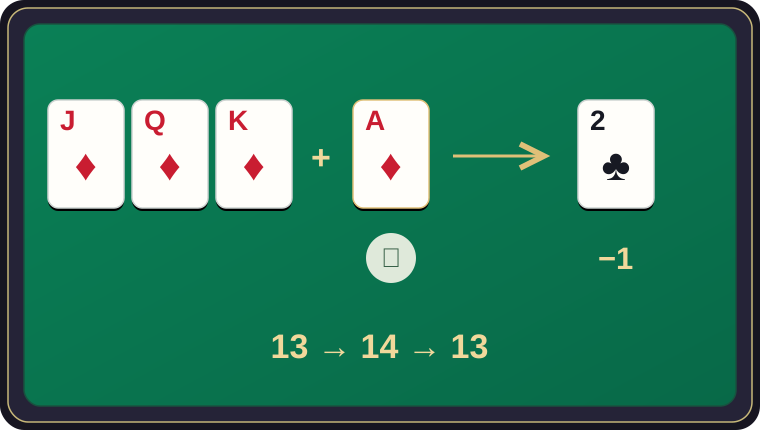
The entire arrangement has three natural sequences and a valid ten set, with no card reused. Under the stated last-turn rule, the empty stock does not prevent this valid completion. You must still make the declaration correctly; see the declaration checklist.
Now change only the final draw to 7♣. That card does not fill the loose 2♣ or complete another group. If you discard 7♣, the original incomplete 13-card hand remains. Under the Pagat convention above, no valid declaration by the end of that turn means the hand is void. It does not mean the player with the lower displayed number automatically wins.
Reusing cards is not always the same as reshuffling
A rule can say “end the hand,” “turn over the discards,” or “shuffle some discards into a new stock.” Those instructions are different. Bicycle's ordinary Rummy rules, a different game from this 13-card guide, allow a new stock formed by turning the discard pile over without shuffling. That is a useful reminder not to import a familiar recycling rule into every Indian rummy table.
If your chosen 13-card rule explicitly allows reshuffling, follow its details: which cards remain exposed, when the new stock is created, and whether the same hand continues. Do not quietly replace “turn over” with “shuffle,” or collect everyone's hands when only the discards should be reused.
A conditional recycling example—not a Master Rummy feature
Suppose a practice group has explicitly agreed: keep the top discard, shuffle only the older discards, and continue with everyone's hand unchanged. Take a small teaching snapshot of four discards, from bottom to top: 3♥, 7♣, Q♦, 5♠.
Under that agreed example, 5♠ stays face up. The other three cards form a new shuffled stock. The accounting is 4 = 1 retained top card + 3 recycled cards. It is not a new deal and does not bring cards out of either player's hand.
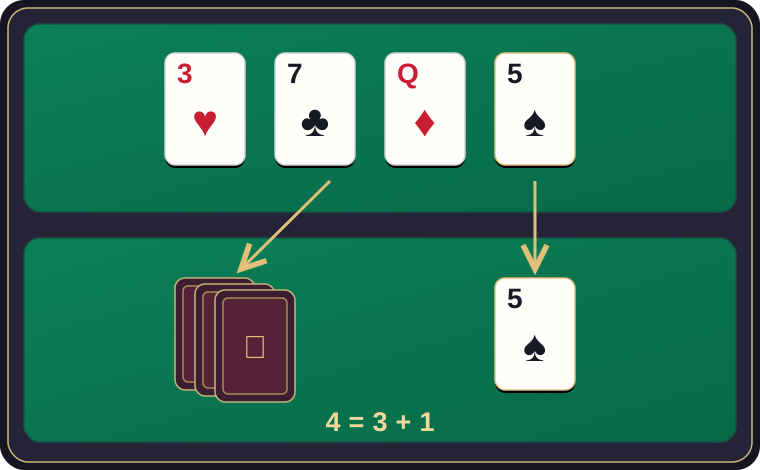
If only the top discard remains, this particular keep-one procedure has zero older cards to recycle. That arithmetic tells you a new stock cannot be made that way; the agreed rule must still say how to resolve the situation. Do not invent an extra card or a winner.
Do not confuse stock size with hand size
Zero cards in the stock does not mean zero cards in your hand. Reaching the end of a pile does not fix a two-card set, supply a missing rank or create a pure sequence. The hand requirements remain separate from the procedure used to continue or end play.
Likewise, seeing a tall discard pile does not prove that a reshuffle is coming. In a two-pack game, a card you already saw may have a second physical copy elsewhere. Counting visible ranks is not the same as knowing the stock's order. Review duplicate-card examples if this distinction is confusing.
What to check in an app
- Read the rule for the exact mode before starting, not a rule borrowed from another rummy game.
- Distinguish the final draw from the end of its turn.
- Follow the actual result or continuation shown; do not assume a frozen screen is a rule decision.
- If the outcome is unclear, note the mode, app version and what happened before contacting support.
For Master Rummy, this guide does not claim an automatic reshuffle, lowest-points tie-break or special payout. Ask support for the current mode-specific rule. General grouping questions are covered in our complete 13-card rules guide.
Quick answers
Must every rummy game reshuffle an empty draw pile?
No. Even documented rulebooks use different end and recycling procedures. Identify the game and the selected rule before moving the discards.
Can the last stock card complete my hand?
In the stated Pagat example, yes: the player finishes that turn and can declare a valid hand. The card still has to complete a legal 13-card arrangement; its position in the stock gives it no special power.