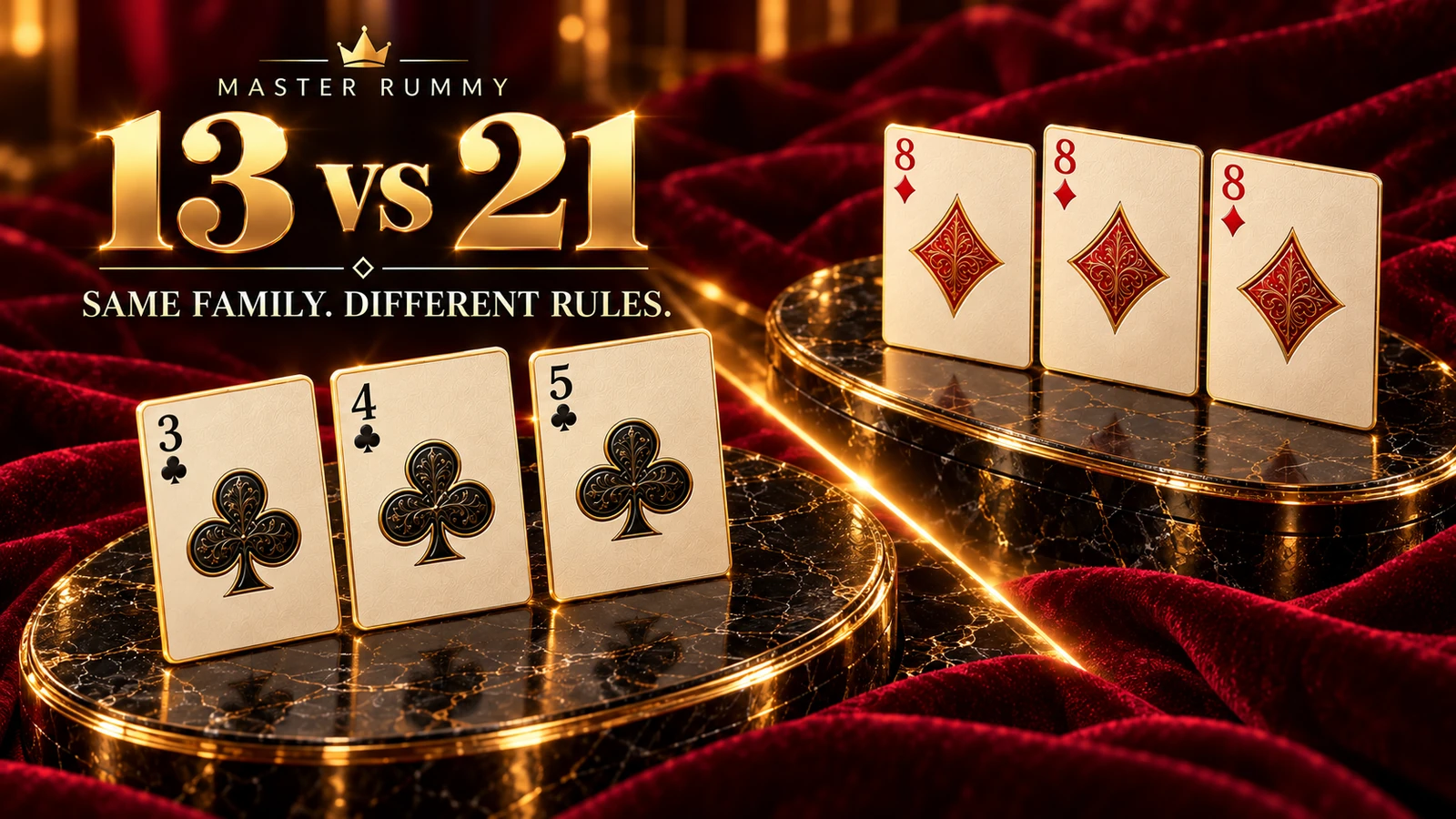
21-card rummy is not simply 13-card rummy with eight extra cards. The larger hand may come with different qualifying groups, joker relationships and scoring rules. “21-card” identifies a hand size, not one universal rulebook.
This is an educational comparison of related games. It does not announce a 21-card mode in Master Rummy. For the standard 13-card learning path on this site, start with the complete rules guide.
Compare the rules you are actually reading
Swipe or scroll to read the full table ↔
| Question | 13-card learning model | A 21-card ruleset |
|---|---|---|
| How many cards are dealt? | 13 per player | 21 per player |
| What starts a valid declaration? | At least two sequences, including a pure one | Read the specified qualification and any alternative declaration routes |
| Are identical cards useful? | Do not treat identical suits as an ordinary set | Check whether named identical-card combinations exist |
| What determines a joker? | Check the designated wild rank and printed jokers | Check whether neighbours of a selected card also have special roles |
| How is the result scored? | Use the stated group-exclusion and penalty rules | Look for separate special-card scoring as well as hand settlement |
The hand-size distinction and a three-deck 21-card setup appear in A23's published comparison. Deck count alone is not enough to infer the rest of the rules, and it should not be used to invent a fixed duration for a round.
The same-looking group can have a different job
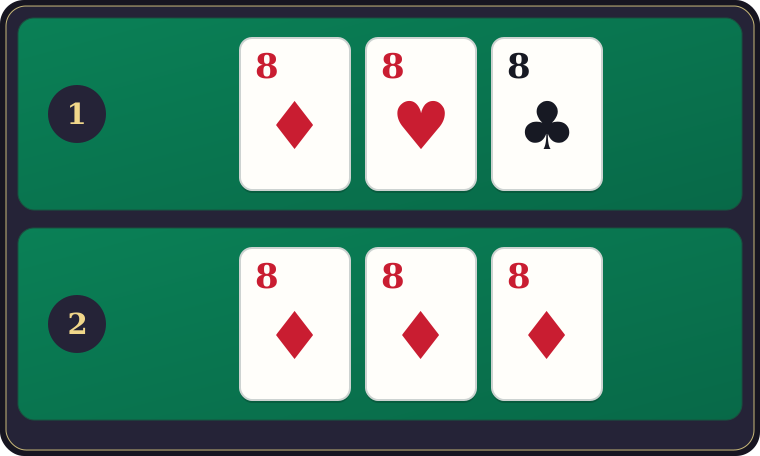
RummyCircle's historical 21-card rules name the identical-card triple a Tunnela. That page also includes a three-pure-sequence declaration route alongside alternatives. It explicitly says the service is discontinued; it is evidence of that ruleset, not a currently available game recommendation.
The practical lesson is to stop at the word “valid” and ask: valid as what? An ordinary set and a special combination are not interchangeable labels. A pattern accepted under a named 21-card condition does not become acceptable in a 13-card hand simply because the cards look tidy.
Our duplicate-card guide covers the ordinary 13-card distinction without importing these special combinations.
Joker rules need their own comparison
Pagat's Marriage rules describe another 21-card game. That version uses no printed jokers and has a special process for learning the selected card, called the tiplu. Its same-suit neighbours also receive special roles.
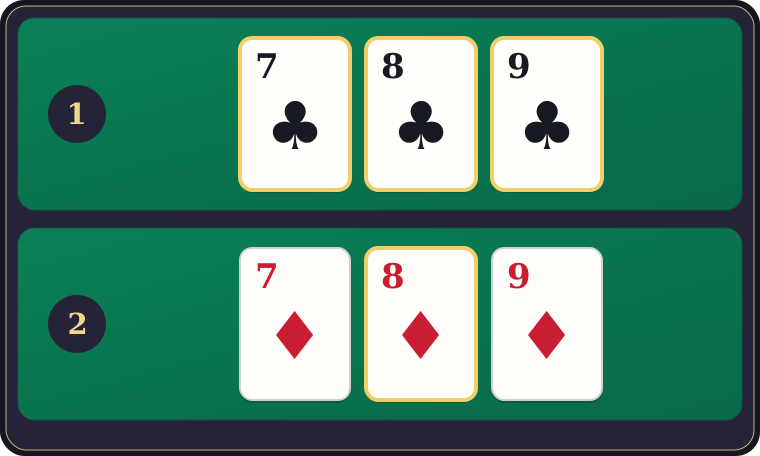
This is why “one rank above or below the joker” is not a safe rule to carry from memory. You also need the suit condition and the named variant. When learning a new table, list exactly which cards changed roles instead of colouring every seven or every nine in your mind.
The timing matters too. Knowing a card's identity before play and discovering it after meeting a condition are different information situations. Do not combine one page's selection procedure with another page's scoring table and call the result a standard game.
What changes for a learner?
More cards mean more groups to track, but the useful preparation is not “play faster”. It is learning which questions to ask. Before a practice session, write down the hand size, declaration conditions, joker selection, accepted duplicate patterns and scoring method.
Then try one small group and explain why it works. If your explanation needs a special term such as Tunnela, name the source of that term. This keeps a house rule from quietly becoming a supposed rule of all rummy.
For a new 13-card player, there is no need to learn every 21-card exception first. Get comfortable with sets and sequences and ace positions, then compare variants separately.
Two quick questions
Do all 21-card games require three pure sequences?
No universal statement is safe. The named historical format above includes that route, while its alternatives and the separate Marriage procedure show why the complete ruleset matters.
Is 21-card rummy available in Master Rummy?
This article does not establish availability. Check the current app and its displayed rules; do not treat an educational comparison as a feature list.