Learning 13-card rummy in Hindi is easier when you connect each English label to an action, rather than memorising a formal translation. Draw means “पत्ता उठाना”, discard means “एक पत्ता छोड़ना”, and declare means presenting the arranged hand for checking. A screen may keep the English label even when you understand the action in Hindi.
This is the English companion to our Hindi reading guide, not a second full rulebook. For the start-to-finish explanation, use the complete 13-card rules or its Hindi language version. Here we focus on phrases that commonly lead a beginner to the wrong conclusion.
Match the label to the action
Swipe or scroll to read the full table ↔
| Label | Hindi meaning | Useful distinction |
|---|---|---|
| Draw / Pick | एक पत्ता उठाना | A card enters the hand. |
| Discard | एक पत्ता छोड़ना | Not leaving the whole hand. |
| Drop | इस हाथ से हटना | Availability and penalties depend on the format. |
| Sort / Arrange | पत्ते क्रम में रखना | Moving cards does not validate them. |
| Set | एक रैंक, अलग सूट का समूह | Not just any three cards placed together. |
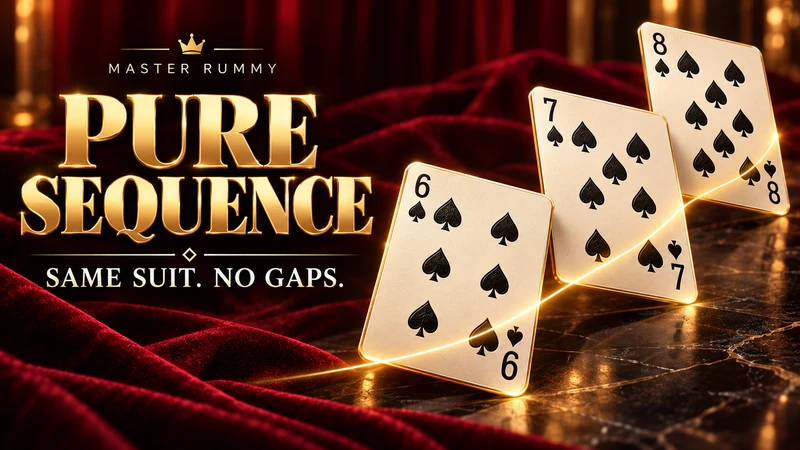
| Sequence / Run | एक सूट की लगातार रैंक | One colour is not enough. |
| Declare / Show | हाथ की घोषणा कर जाँच कराना | The required whole hand is checked, not merely three selected cards. |
These are common labels, not a reproduction of a specific Master Rummy screen. Read the help and confirmation message in the game you use. In Hindi, “छोड़ना” on its own is incomplete: are you releasing one card or leaving the hand? Add the object before acting.
“One colour” is not “one suit”
Hearts ♥ and diamonds ♦ are both red but belong to different suits. Clubs ♣ and spades ♠ are both black and also different. We pair each familiar English suit name with its symbol because household and regional card names can vary. The printed symbol settles the identity.
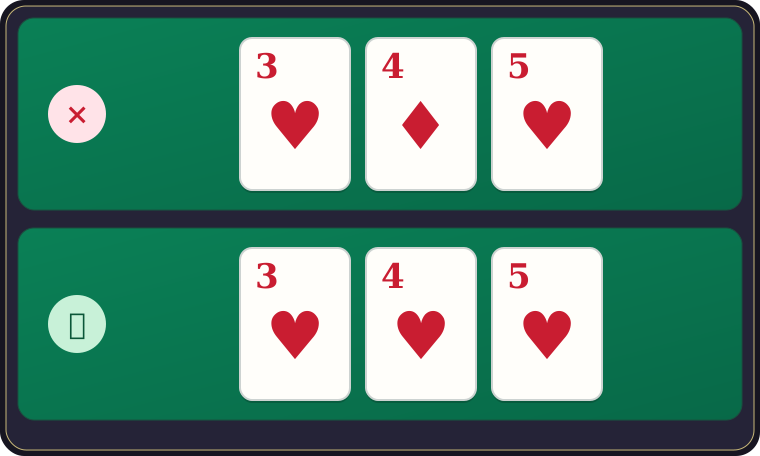
When you hear “three consecutive numbers”, read the entire card, not only 3, 4 and 5. Saying “three of hearts, four of hearts, five of hearts” catches the mismatch that a colour-only check misses.
“At least one” does not mean “exactly one”
The common 13-card model requires at least two sequences, including at least one pure sequence. The second sequence does not have to be impure. Two pure sequences can satisfy that part of the requirement; the remaining cards must also form valid groups.
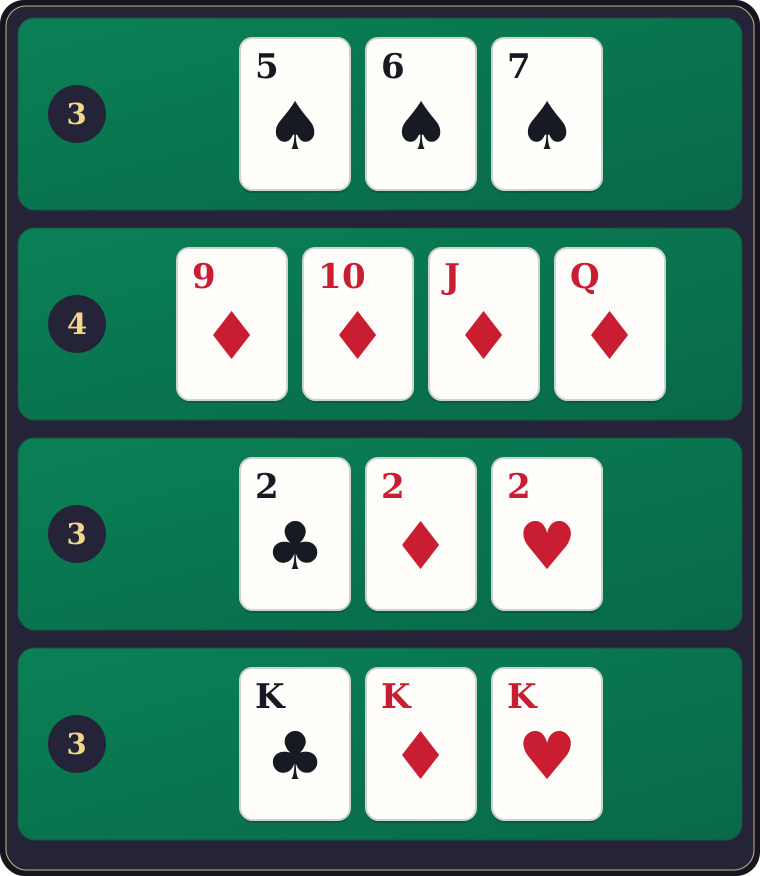
Do not add a joker simply to make this hand fit the phrase “one pure and one impure”. Both sequences already work naturally. The accurate reading is that a pure sequence is required and another sequence must also be completed.
“Pure” describes the card's job
“शुद्ध अनुक्रम” and “प्योर सीक्वेंस” refer to the same idea. In an impure sequence, a joker fills a missing card's place. A designated wild-rank card used as its own printed rank and suit may still belong to a pure sequence under the natural-use convention.
Do not decide from a joker highlight alone. Check your game's convention, then ask whether the card is itself or a substitute. Our joker guide separates those two cases.
Say the final check in your own words
- My final hand has 13 cards.
- It has at least two sequences, including a pure one.
- The remaining cards also fit valid groups.
- I have not counted one physical card in two groups.
This is a quick check for the common model, not a replacement for a table's special conditions. For an unfamiliar word, use the rummy glossary. For an uncertain hand, use the invalid-declaration checklist.
Reference: General grouping and whole-hand conditions were checked against Pagat's Indian Rummy rules. The plain-language explanations and diagrams here are original; they are not a literal translation of one operator's interface.