Draw adds a card to your hand. Discard removes one card. Drop means leaving the hand under its rules. Declare means presenting a hand for validation. Those four words describe different actions; treating them as synonyms can turn a simple instruction into the wrong action.
Use this page as a lookup, not a complete rulebook. It explains the vocabulary used in our 13-card guides. A game may choose different button labels, and this glossary does not claim that any particular screen or option is available in Master Rummy.
Action words: what are you doing?
Swipe or scroll to read the full table ↔
| Term | Plain meaning | Do not confuse it with |
|---|---|---|
| Deal | Distribute the starting cards to players. | Draw: taking a card during a turn. |
| Draw / pick | Take a permitted card into your hand. | Sorting a card already held. |
| Discard | Place one card from your hand onto the discard pile. | Drop: leaving the hand. |
| Drop / pack | Withdraw from the current hand when the format allows it. | Discarding an unwanted king. |
| Declare / show | Present the required arrangement to be checked. | Merely creating a group on screen. |
| Sort / arrange | Move held cards into a useful viewing order. | Drawing, discarding or proving that a group is valid. |
| Meld | A qualifying group, or the act of forming one, depending on the sentence. | Automatically laying cards face up during every turn. |
“Meld” is especially slippery across the rummy family. In a guide, “build a meld” may simply mean organising a valid group in your concealed hand. It does not necessarily mean the table uses a laying-down action.
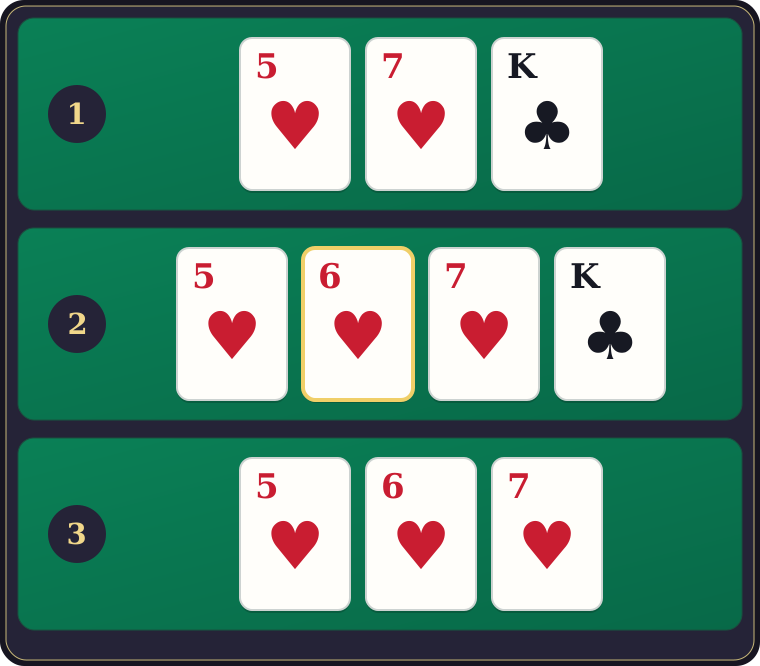
In that example, the king was discarded; the player did not drop. The three hearts now form a group, but they do not by themselves prove that the other ten cards are ready for a declaration.
Place words: where is the card?
- Hand: the cards you currently hold. The word can also mean one completed game, as in “the next hand”. Read the sentence before deciding which meaning is intended.
- Closed deck / stock: the face-down draw pile. You do not know the next card merely because the pile is visible.
- Open deck / discard pile: the pile of face-up discards. “Open” does not mean you may choose any old card buried in it.
- Discard: also a noun: the actual card someone just released.
For decisions between piles, use the separate open-deck and closed-deck guide. This page only supplies the vocabulary.
Group words: what pattern do the cards make?
- Rank: the printed value or letter, such as 6, Q or A.
- Suit: hearts ♥, diamonds ♦, clubs ♣ or spades ♠. Red and black are colours, not suits.
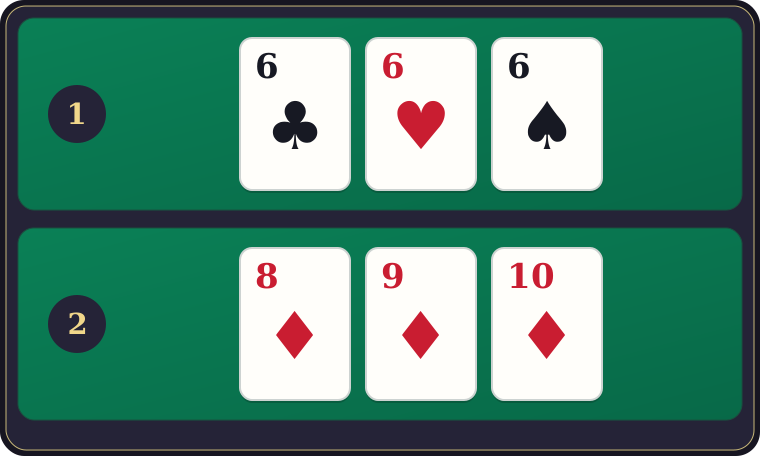
- Set: a same-rank group using different suits under the ordinary rule illustrated here.
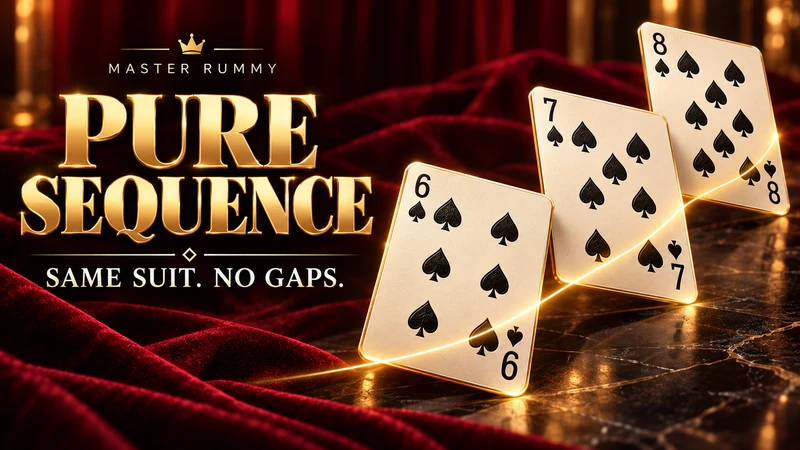
- Sequence / run: a consecutive same-suit pattern.
- Pure / natural sequence: a run without a card substituting for another rank or suit.
- Impure sequence: a run completed through joker substitution.
- Joker: a printed joker or a card designated wild by the current rules. Its role matters: a wild-rank card used naturally need not make a sequence impure.
The set-versus-sequence comparison tests these differences with actual card groups.
Result words: what is being checked or counted?
Valid declaration means the required whole-hand conditions have been met. Invalid declaration means the submitted hand fails a condition; a tidy layout is not enough. Unmatched cards, sometimes called deadwood, are cards outside qualifying groups. Be careful with that last term: some scoring systems also count completed groups when the required sequence conditions are missing.
Points are the units used by a scoring system. A point is not automatically a rupee, an account balance or a cash reward. Our worked scoring examples discuss card totals, not financial returns.
When a word still feels unclear, finish the sentence: “I draw a card”, “I discard this king”, “I drop this hand”, or “I declare this arrangement”. The object often reveals the difference.
Rule reference: The action and grouping distinctions can be checked against Pagat's Indian Rummy description. For a connected tutorial rather than a glossary, read our complete 13-card rules.