Take this rummy practice quiz to test ten different hand-reading decisions, not your speed. Choose one answer for each new layout, then check your score and the explanation. Some questions ask whether the whole hand works; others ask you to find one specific mistake. Read that question before judging the picture.
This is different from our six-hand valid-or-invalid exercise: these ten new questions mix declaration checks, a one-card repair, joker roles and a 14-card draw state. Scoring happens in your browser. Quiz answers and scores are not submitted or saved by this quiz; reloading starts over. It is a learning check, not a skill certificate or a promise of better results in a game.
The rules for this practice session
- Queens are the selected wild rank throughout. PJ means a printed joker; #1 and #2 identify different physical copies.
- A declaration uses exactly 13 physical cards, each in one group, with at least two sequences and at least one pure sequence.
- A sequence has at least three consecutive cards of the same suit. A wild-rank card in its own natural position may remain pure here; a substitution makes the sequence impure.
- Ordinary sets use three or four equal ranks with different suits. A-2-3 and Q-K-A are allowed; K-A-2 is not.
- Question 9 deliberately shows a temporary 14-card holding. Follow each question's stated conditions, and use the rules displayed by your actual game when you play.
The green-table layouts are original teaching diagrams, not app screenshots. If interactive controls are unavailable, the four options and each answer remain readable as ordinary article content. All correct options are identified by A, B, C or D.
01 · Is this hand ready?
Use the groups exactly as shown. Can all 13 cards be declared under the practice rules?
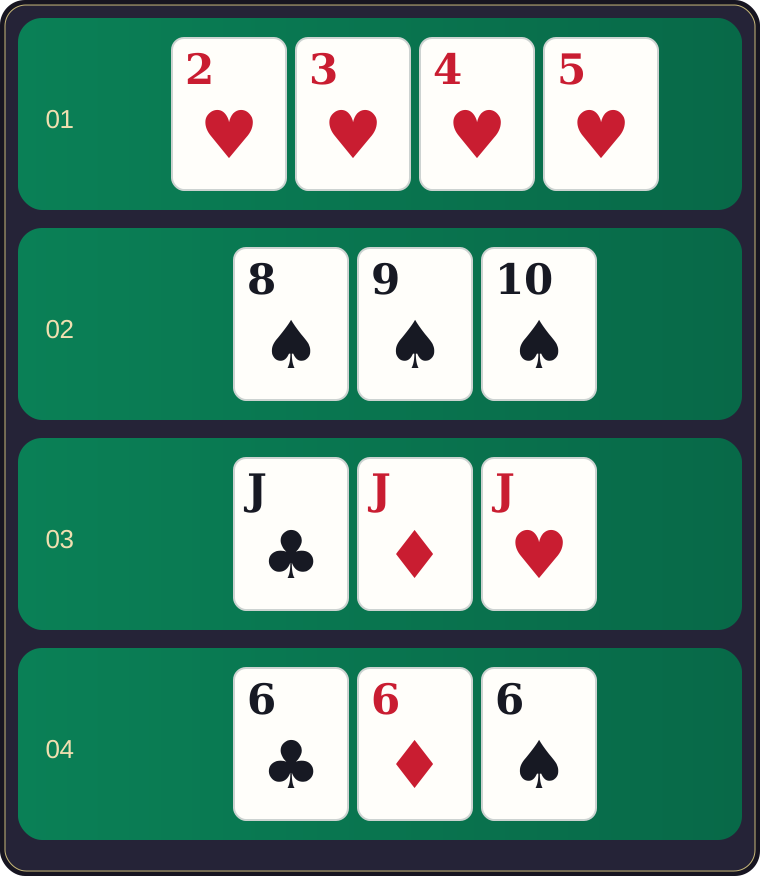
2♥ 3♥ 4♥ 5♥ / 8♠ 9♠ 10♠ / J♣ J♦ J♥ / 6♣ 6♦ 6♠
- Yes: two pure sequences and two valid sets.
- No: every sequence must have exactly three cards.
- No: two sets are forbidden.
- No: every hand needs a printed joker.
A
The heart run has four cards and the spade run has three. Both are pure; the jacks and sixes form different-suit sets. The count is 4 + 3 + 3 + 3 = 13. Longer sequences and a joker-free hand are both allowed here.
02 · Two sequences, one missing requirement
Both runs can be completed with the printed jokers. What still prevents a valid declaration?
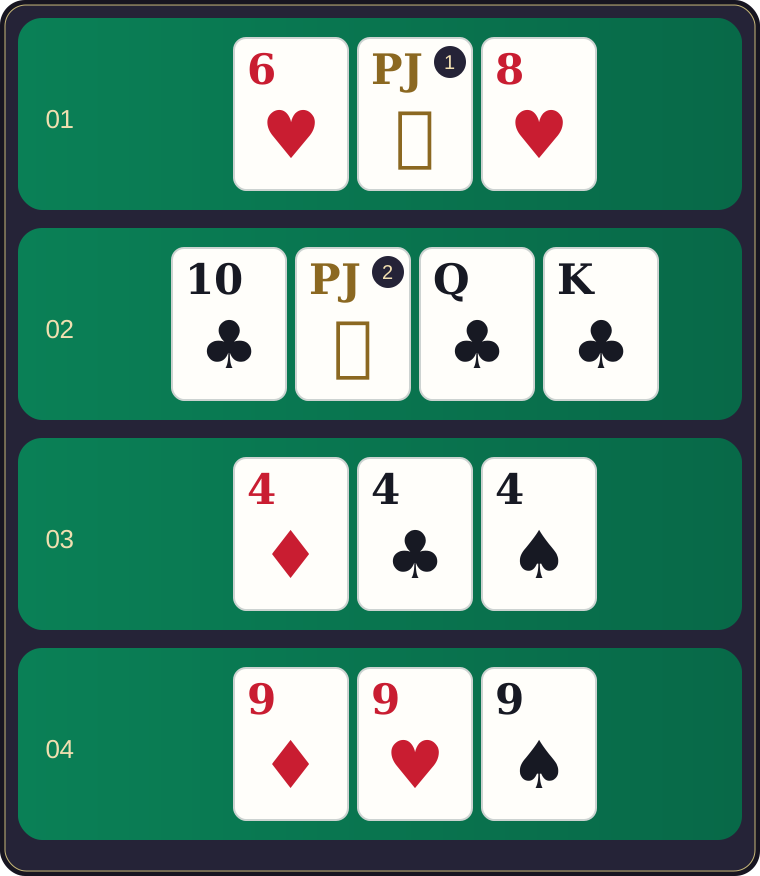
6♥ PJ#1 8♥ / 10♣ PJ#2 Q♣ K♣ / 4♦ 4♣ 4♠ / 9♦ 9♥ 9♠
- The four-card run is too long.
- The two sets must have matching suits.
- Neither sequence is pure.
- A king cannot belong to a sequence.
C
PJ#1 stands for 7♥; PJ#2 stands for J♣. Q♣ may occupy its natural place, but that does not remove the printed joker's substitution. Both runs are impure. Two sequences alone are not enough: at least one must be pure. The copy numbers identify two different printed jokers.
03 · Same rank, wrong set
Which displayed group fails the ordinary different-suit set rule?
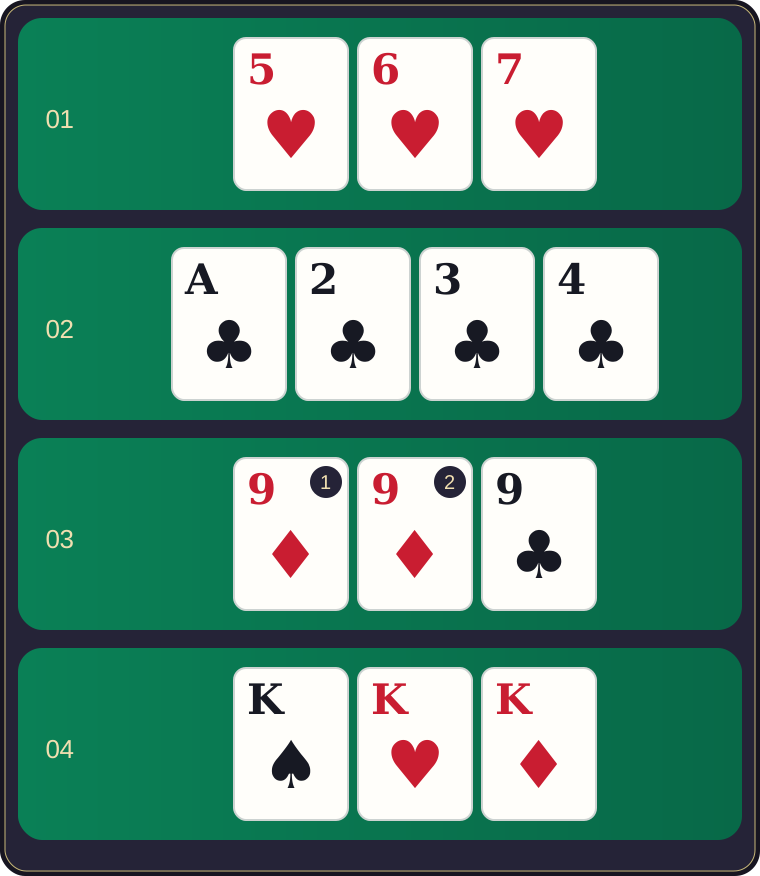
5♥ 6♥ 7♥ / A♣ 2♣ 3♣ 4♣ / 9♦#1 9♦#2 9♣ / K♠ K♥ K♦
- 5♥ 6♥ 7♥.
- 9♦#1 9♦#2 9♣.
- A♣ 2♣ 3♣ 4♣.
- K♠ K♥ K♦.
B
The diamond nines are separate physical copies, but they repeat the same suit within one set. Replacing one with 9♥ or 9♠ repairs that set. Identical faces may exist in a two-deck game; that is not permission to put both into this ordinary set.
04 · Repair the ace wraparound
Keeping the other three groups unchanged, which one-card exchange repairs the first group? Reordering that group is allowed.
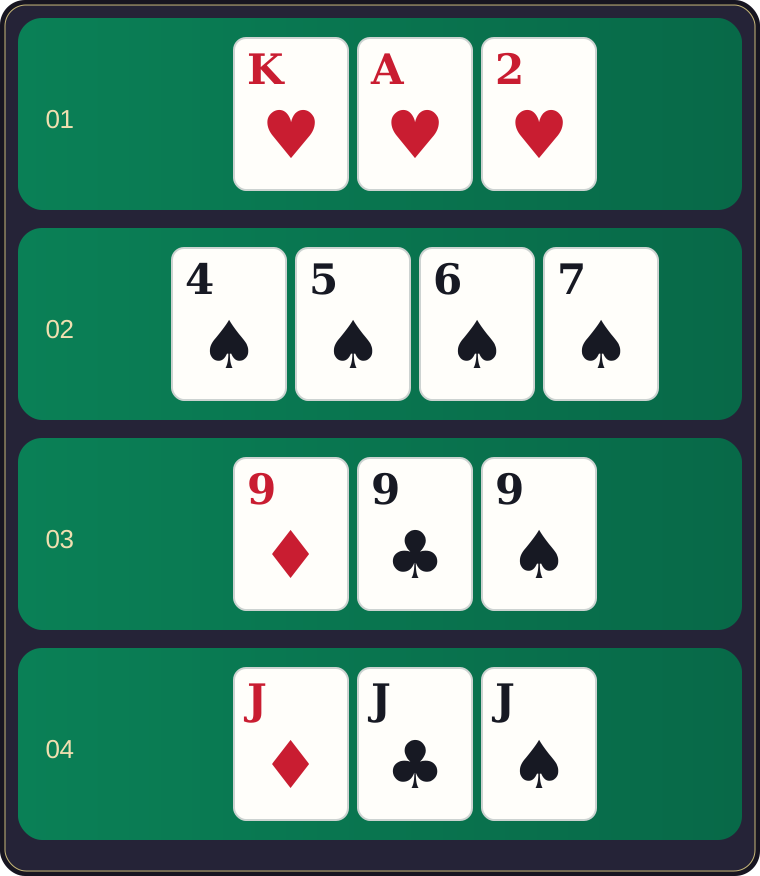
K♥ A♥ 2♥ / 4♠ 5♠ 6♠ 7♠ / 9♦ 9♣ 9♠ / J♦ J♣ J♠
- Replace K♥ with 3♥, then arrange A♥ 2♥ 3♥.
- Replace 2♥ with 2♣.
- Replace A♥ with A♦.
- Keep K♥ A♥ 2♥ because all suits match.
A
An ace may sit at the low or high end, but it does not join king to two. Exchanging K♥ for 3♥ gives a natural A-2-3 run. Matching suits alone do not fix the original wraparound; changing a suit makes it worse.
05 · A wild queen in its own place
Queens are wild in this quiz. Under the natural-use convention stated above, what is J♠ Q♠ K♠?
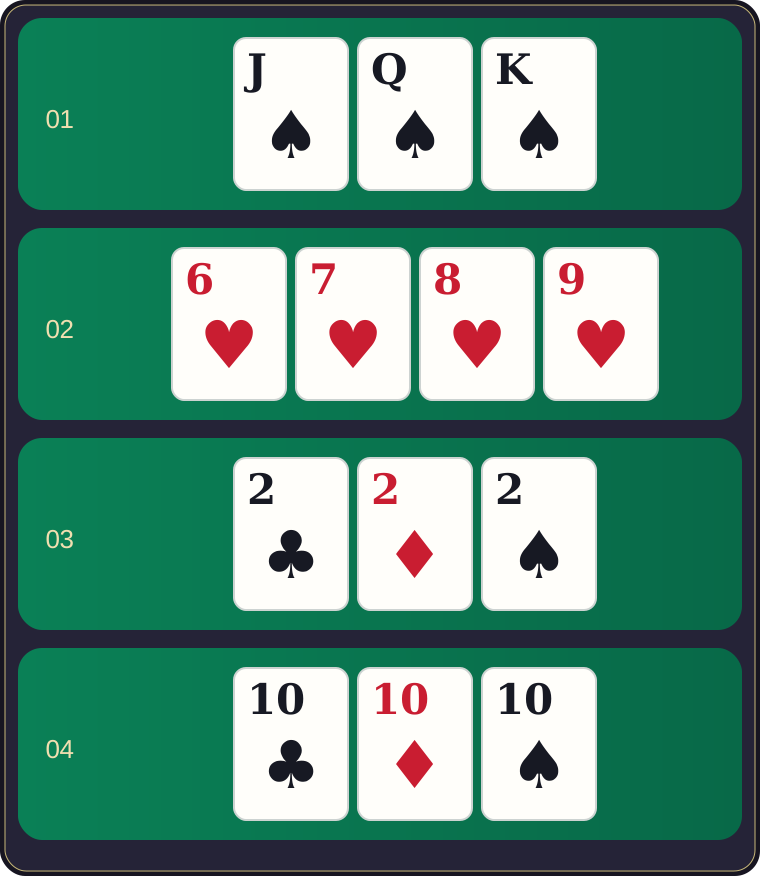
J♠ Q♠ K♠ / 6♥ 7♥ 8♥ 9♥ / 2♣ 2♦ 2♠ / 10♣ 10♦ 10♠
- An invalid group because a queen is present.
- A set of three face cards.
- A pure sequence: Q♠ is its own rank and suit.
- An impure sequence because every wild-rank card must substitute.
C
Q♠ is exactly the spade queen between J♠ and K♠. It is not standing for a missing card. Under this quiz's stated convention the run remains pure. This is why a wild-card highlight alone is not a reliable purity test; confirm the table's convention.
06 · All groups look valid
Every displayed group is valid on its own. Why is the 13-card declaration still incomplete?
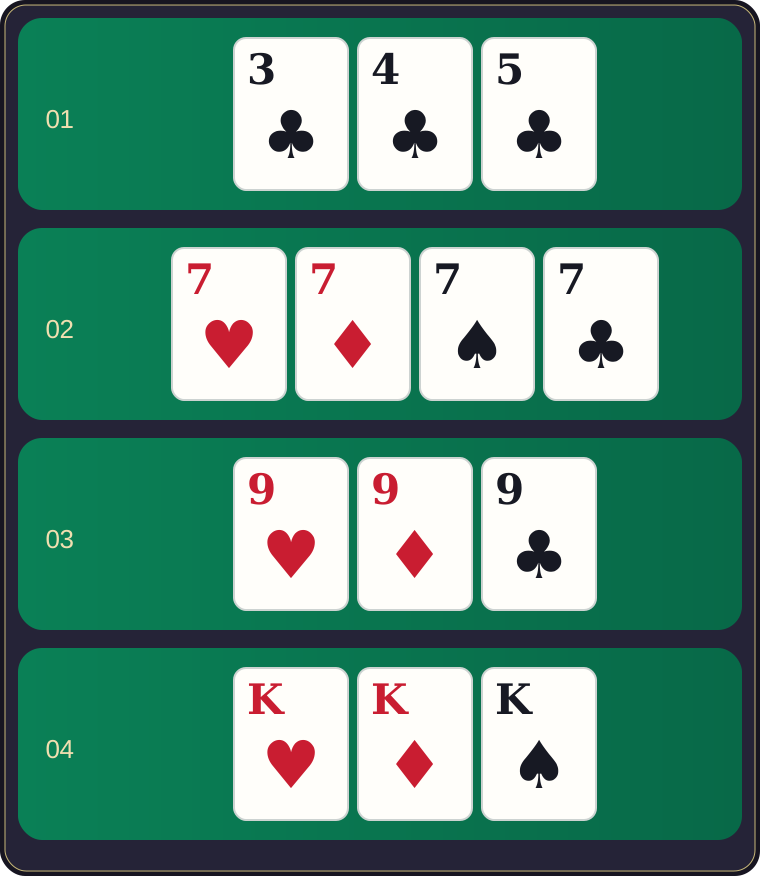
3♣ 4♣ 5♣ / 7♥ 7♦ 7♠ 7♣ / 9♥ 9♦ 9♣ / K♥ K♦ K♠
- Four suits cannot be used in a set.
- There is only one sequence.
- There must be exactly one set.
- The hand contains too many kings.
B
The clubs form the only sequence. The sevens, nines and kings are all sets. A four-card set can be valid, but it does not count as another sequence. The hand still needs a second sequence; a collection of valid groups is not automatically a valid whole hand.
07 · No set anywhere
This arrangement has four sequences and no set. Does it satisfy the stated declaration rules?
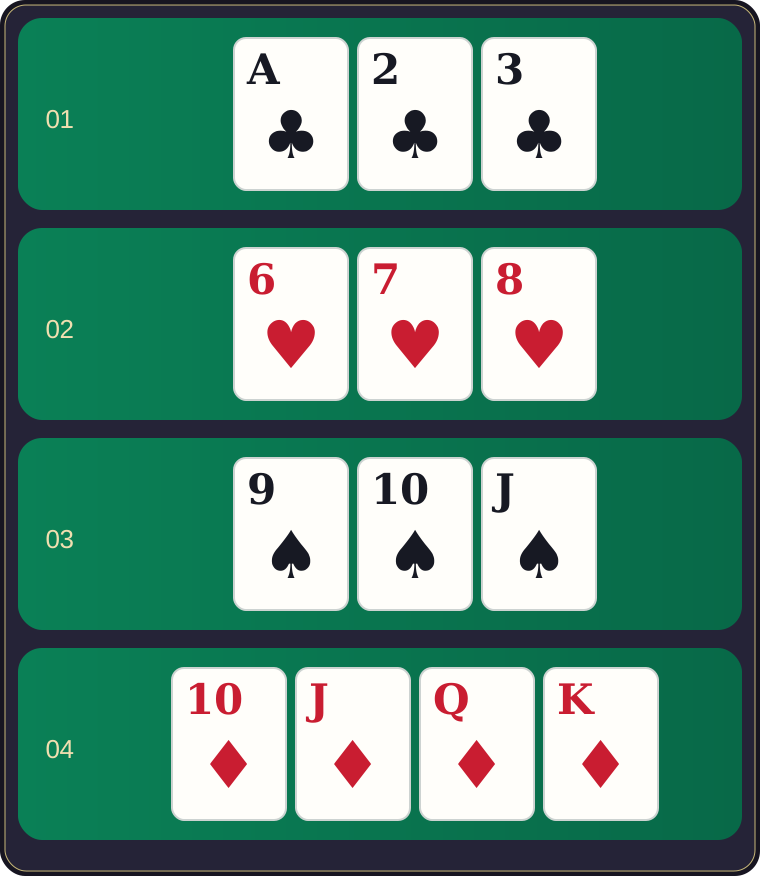
A♣ 2♣ 3♣ / 6♥ 7♥ 8♥ / 9♠ 10♠ J♠ / 10♦ J♦ Q♦ K♦
- Yes: a set is optional, and all 13 cards are covered.
- No: exactly two sets are compulsory.
- No: a diamond sequence cannot have four cards.
- No: there must be one impure sequence.
A
The requirement is at least two sequences with at least one pure sequence, not a fixed recipe of two runs and two sets. Here all four runs are natural, including Q♦ in its own position. The count is 3 + 3 + 3 + 4 = 13. An impure sequence is not compulsory either.
08 · What is the queen doing?
In the first group, which card is Q♦ representing?
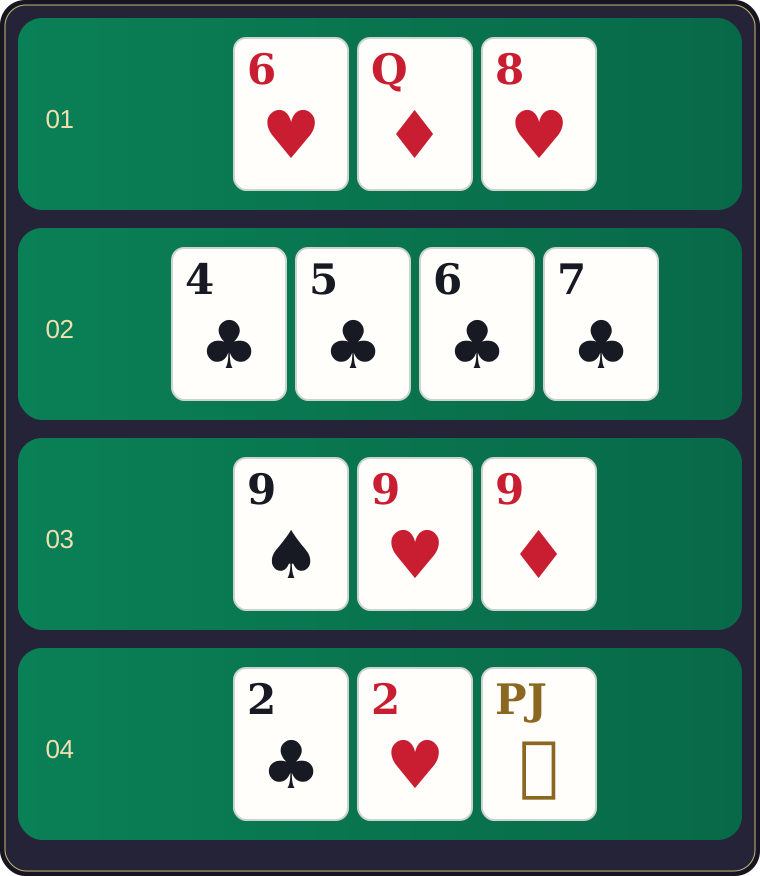
6♥ Q♦ 8♥ / 4♣ 5♣ 6♣ 7♣ / 9♠ 9♥ 9♦ / 2♣ 2♥ PJ
- 6♥, because it copies the left card.
- 8♥, because it copies the right card.
- Q♥, because its printed rank is queen.
- 7♥, completing 6♥ 7♥ 8♥.
D
The queen is the selected wild rank and substitutes for the missing 7♥. That makes the first sequence impure, not invalid. The club run provides the required pure sequence. The printed joker completes the twos as a different-suit two; it is not reused in the first group.
09 · The extra card after a draw
This is a temporary 14-card holding. Which discard leaves the four completed groups unchanged?
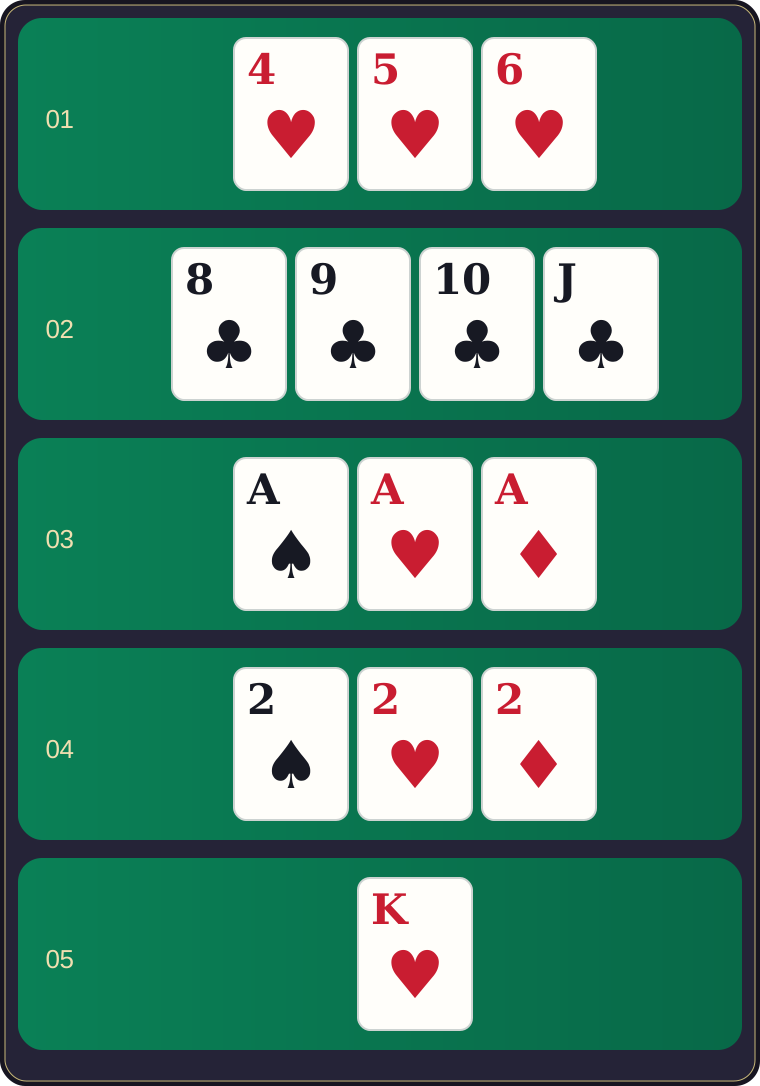
4♥ 5♥ 6♥ / 8♣ 9♣ 10♣ J♣ / A♠ A♥ A♦ / 2♠ 2♥ 2♦ / K♥
- 5♥.
- K♥.
- 9♣.
- A♠.
B
The first four groups already cover 13 cards: 3 + 4 + 3 + 3. K♥ is the extra card. Discarding 5♥ or 9♣ breaks a run; discarding A♠ leaves only two aces. Four green-looking groups do not remove the need to count the whole holding before declaring.
10 · Two copies, two different jobs
9♠#1 and 9♠#2 are different physical cards from two decks. Is their use here allowed under the practice rules?
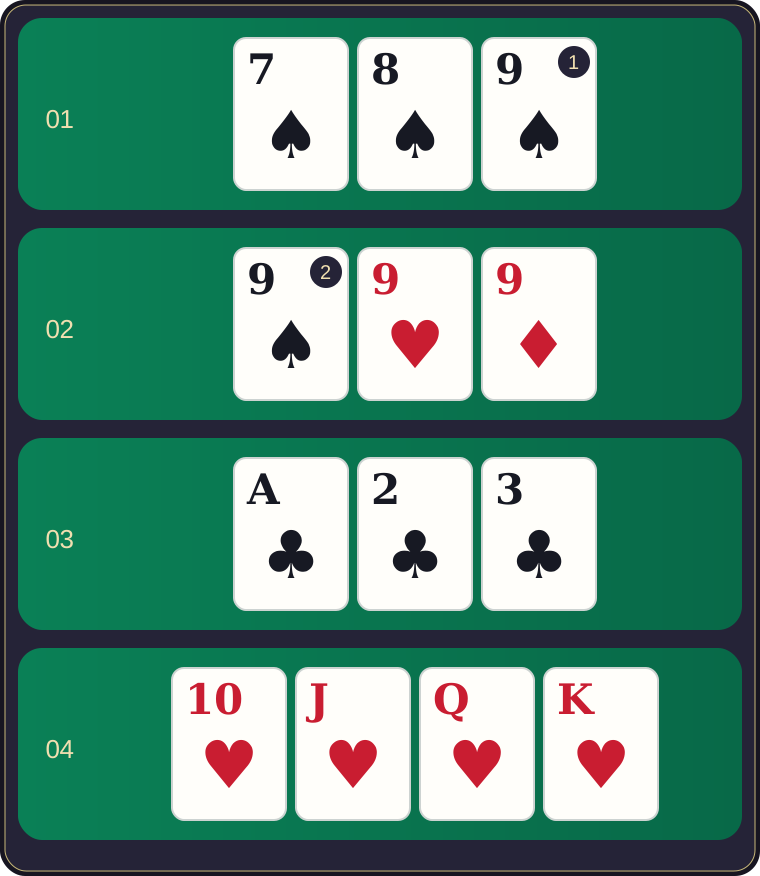
7♠ 8♠ 9♠#1 / 9♠#2 9♥ 9♦ / A♣ 2♣ 3♣ / 10♥ J♥ Q♥ K♥
- No: a rank may appear only once in the whole hand.
- No: a spade nine can only belong to a set.
- No: the same physical card is being counted twice.
- Yes: one copy is in a sequence and the other in a different-suit set.
D
The labels distinguish two cards, not two uses of one card. The first nine completes 7♠ 8♠ 9♠; the second joins 9♥ and 9♦. The remaining club and heart runs are valid. All 13 physical cards have one job each. Compare this with Question 3, where duplicate suits were placed inside the same set.
Turn a wrong answer into one useful habit
Do not just remember the answer letter. For a missed question, point to the exact card or missing condition, then say the repair aloud. “Only one sequence” is more useful than “I got Question 6 wrong.” Reset and retake the quiz after you can explain the difference without looking.
- Questions 1, 6 and 7: revisit the full declaration requirements.
- Questions 2, 5 and 8: read the joker guide.
- Questions 3 and 10: compare duplicate faces and physical copies.
- Question 4: check ace positions. Question 9: use the pre-declaration checklist.
The practice conventions are described in our rules guide and can be compared with Pagat's Indian Rummy reference. This quiz uses ordinary different-suit sets, not Pagat's optional identical-card tanala variation. Different apps or home games may apply different conditions.